Axios Markets

October 23, 2026


1 big thing: Munis are so hot right now


Here's a surprising combination of words: Municipal bonds are sexy right now — offering historically attractive returns at a time when states and localities need more and more cash.
Why it matters: That may be good news for investors, but it costs taxpayers who foot the bill when states and localities borrow money by issuing these bonds.
Where it stands: A sell-off in municipal bonds in September, when interest rates began to rise, was the worst since the financial crisis. Now, yields, which move inversely to prices, are at historic highs.
- State and local governments have issued $611.8 billion in munis over the 52-week period ending Oct. 16, according to Bloomberg data compiled by muni analyst Matt Fabian, president of Municipal Market Analytics.
- It's a record high.
How it works: Municipal bonds are used by states and localities to fund infrastructure — building your roads, bridges, schools and whatnot.
- They've long been appealing to investors because of the tax breaks. Nearly half of outstanding muni bonds are held directly by households or nonprofits, per Federal Reserve data as of the second quarter.
- The income from munis is exempt from federal taxes — and some states offer a state tax exemption, too.
- So Wall Street calculates a "tax-equivalent yield," for those in high tax brackets — a measure of how much a taxable bond would have to yield to deliver the same return as a tax-exempt muni.
By the numbers: As of Sept. 30, the tax-equivalent yield on municipal bonds was at 8.07% for investors in the highest federal tax bracket, according to a new BlackRock report. For high-yield munis, the number was 10.48%.
- The underlying yield on the broader muni bond index was the highest since the 2008 financial crisis, per the report.
Yes, but: Those eye-popping numbers have fallen back a bit as Treasury yields have fallen off recent highs this week.
Catch up quick: In the wake of the financial crisis, states pared back borrowing as they sought to rein in costs and deal with pension funding shortfalls. Then came the pandemic, and the federal government showered local governments with money.
State of play: Now the federal money is gone, and cuts are happening, so states are dealing with a lot of crumbling long-neglected infrastructure and less support. There's a big backlog of infrastructure projects to get done.
- Plus, inflation is making everything more expensive to build — leading to even more issuance.
- "The trucks that dig up the road now cost 50% more to run because of fuel expense, and the asphalt costs twice as much, etc.," Fabian, the muni analyst, says. Many of the bonds issued this year are so-called "completion bonds," for existing projects.
- On top of that, there's climate change: "It wears down existing infrastructure faster, and it raises the cost of replacing it because you need better or at least different stuff."
The intrigue: You might think that the surging interest rates would slow bond issuance down. But it dipped only for a bit, and now governments are back at it, Fabian says.
- He projects issuance to accelerate over the next decade to as much as $1 trillion a year.
What they're saying: Wall Street is amped about munis, touting the rise in yields as an "opportunity" — that's the word du jour. It's a chance to lock in "historically attractive income" for investors, regardless of where rates go next, Pat Haskell, head of the municipal bond group at BlackRock, noted.
- JPMorgan also highlighted the "rare opportunity" at play in munis in a note earlier this week.
"Wait a minute. Munis?!" exclaimed Goldman Sachs' Chris Hussey on a recent podcast, after being told of the high yields.
- "Can you believe it?" responded Alex Finston, co-head of U.S. and Asia credit trading at the bank.
- "I haven't heard a municipal bond get pitched in a long time," Hussey said.
2. Meta joins the negative club
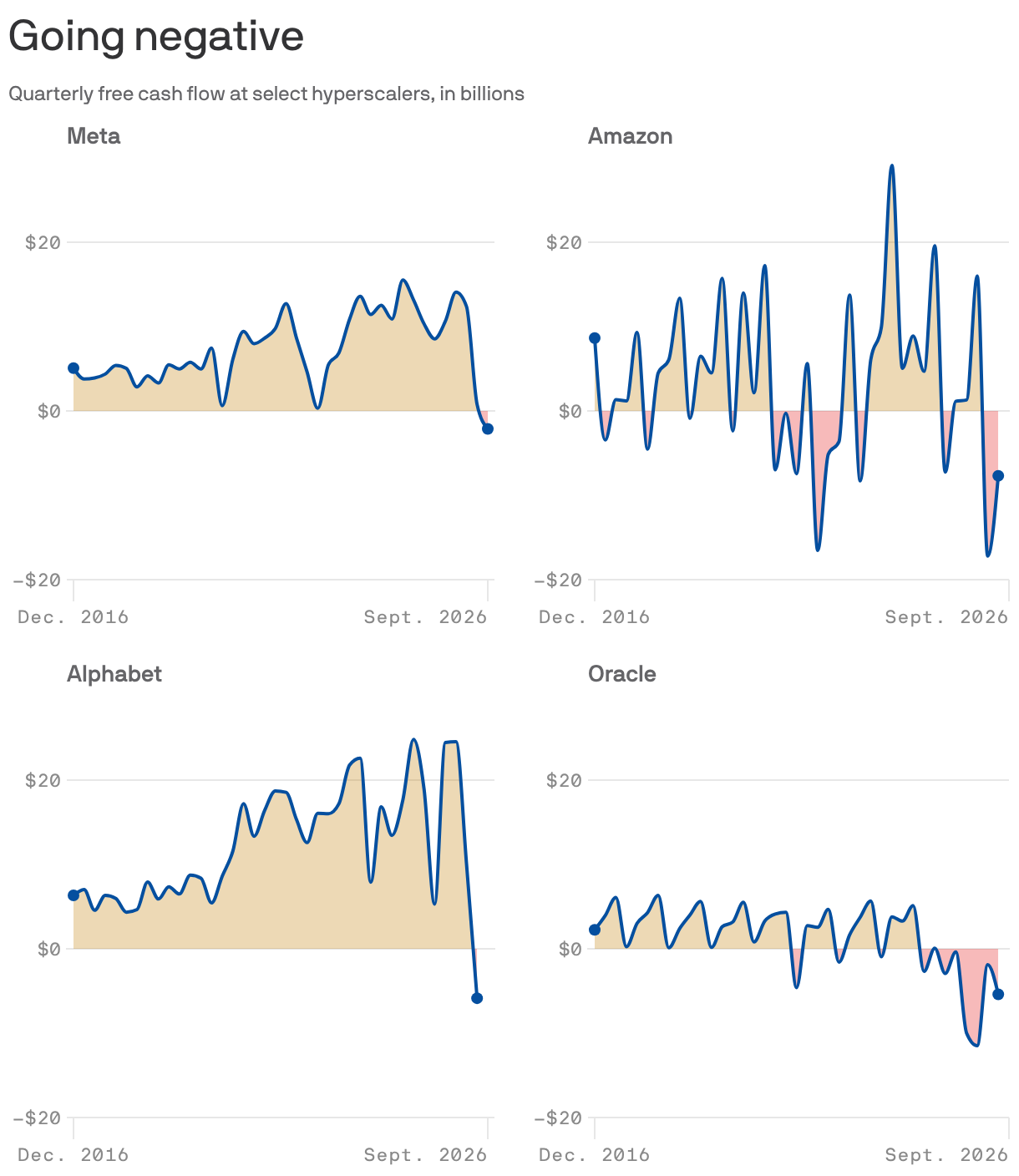
Mark Zuckerberg's Meta got smacked around yesterday after reporting earnings that looked pretty strong at first glance.
Why it matters: Its drubbing in the stock market — Meta ended down 7% —suggests that investors are growing concerned that Big Tech's insistence on pouring more and more capital into data centers could end up costing them in the long run.
Catch up quick: Meta's revenue and adjusted earnings beat Wall Street estimates, but the company also raised the bottom end of its guidance for capital spending this year and deferred offering any guidance for 2027.
- "We expect to continue investing aggressively," the company said.
Zoom out: Meta's spending jag has fundamentally transformed the company's cash flow dynamics, turning it from one of the greatest cash generators in the history of corporate America into a company that actually had negative free cash flow in the third quarter.
- Of course, it's not alone. The AI buildout has had a similar impact on other hyperscalers, as you can see from the chart above.
Reality check: None of this suggests Meta's bank account is getting dangerously low. (The company reports that it has over $82 billion in cash and marketable securities socked away.)
Yes, but: It is creating a new class of shares that it can use to raise more money, without weakening founder Zuckerberg's control of the company.
- And while Meta didn't announce any plans for new capital, a decision to do so could dilute the economic value of the shares that existing holders already own.
- Alternately, the company could borrow in the bond market. But that would also add expense and risk.
The bottom line: The health of the AI boom driving the stock market depends on the continued kindness of capital markets to fund it, so market reactions like this — suggesting growing skepticism from investors — matter a lot.
Axios Markets