Axios Markets

July 02, 2025

👋 Welcome back. It seems the anecdotes are starting to pile up about the effects of tighter immigration enforcement on the economy. We dig into the details below.
- Plus: Bonds are up and the dollar is down, and one big name in wealth management wants investors to go crypto in a bigger way.
All in 1,040 words, a tk-minute read.
1 big thing: Immigration crackdown hits economy
President Trump's immigration crackdown is hitting key pockets of the economy, disrupting workplaces and communities around the country.
Why it matters: The sharp fall in immigration this year threatens to slow down economic growth, particularly in the sectors and cities that relied on newcomers to the U.S. in recent years.
What they're saying: With the push against immigration, "the economy will find itself slightly diminished in the long run and inflation will run a touch higher," economist Bernard Yaros writes in a report for Oxford Economics.
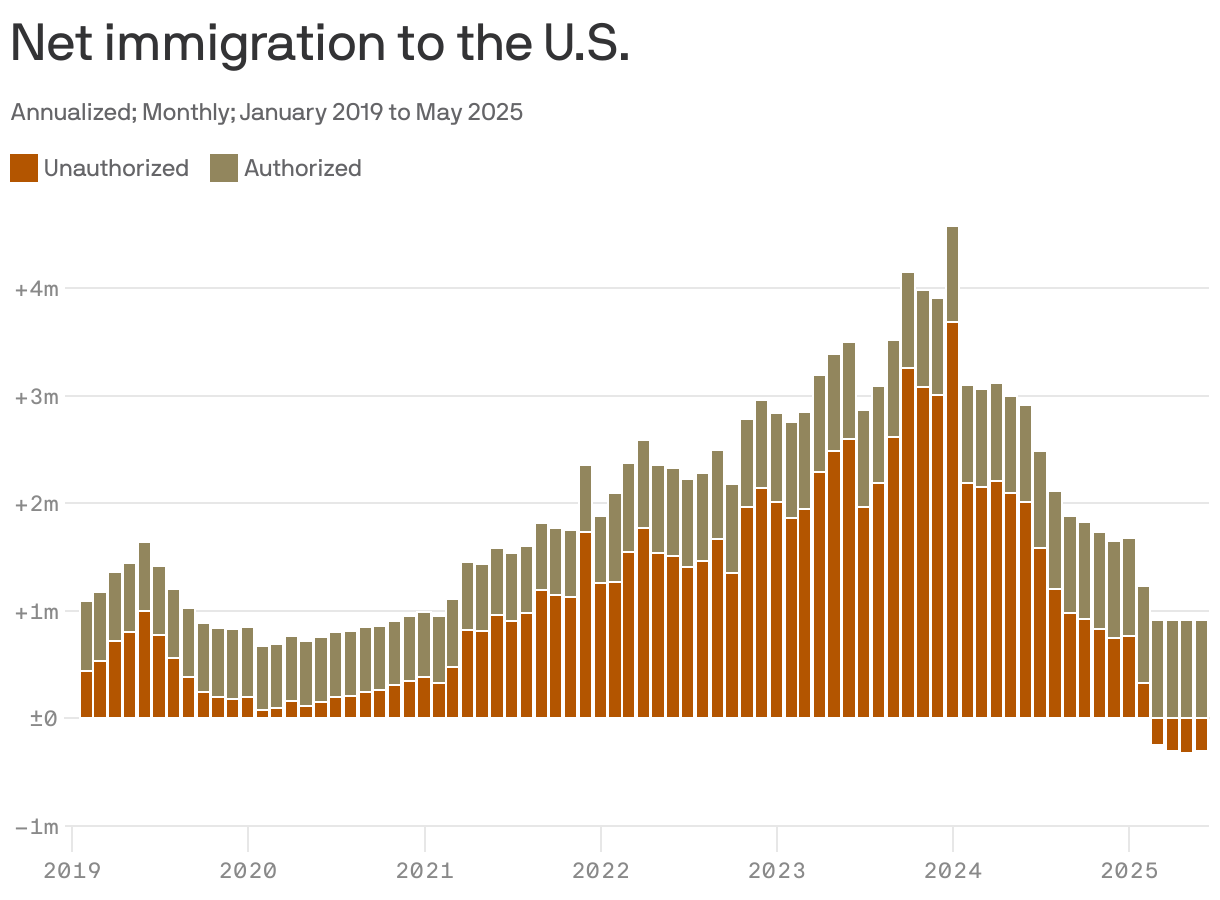
By the numbers: Net immigration started to fall last summer after the Biden administration took a harder line. This year, Trump's crackdown has been far more aggressive.
- Net immigration — inflows of people minus outflows — is running at an annualized rate of 600,000, down about a third from where it was in the last three months of 2024, per the analysis by Oxford Economics, which looks at several sources of public data.
- The decline is almost entirely due to a sharp drop in unauthorized immigration. Border crossings are stalled, and deportations are up.
What to watch: Yaros estimates in the long run, GDP will be 0.25% lower as a result.
- That's a relatively modest macroeconomic effect, but there's a wild card. The "big, beautiful bill" that passed the Senate contains about $175 billion for even more immigration enforcement.
Between the lines: Immigration's effects on the economy are a slow burn, and it'll take a while before it shows up in the macro data.
- For now they are rippling through industries that rely on immigrant workers, such as farms, hotels, construction and meatpacking plants.
Zoom in: Smaller cities are feeling the hit from deportations and ICE raids, places like St. Louis, Buffalo and Pittsburgh where immigration had boosted faltering economies, the Wall Street Journal reports.
- "The arrests cast a shadow over the local economy. Restaurant tables emptied. Kitchen workers stayed home. Fruit vendors disappeared from the streets. The number of shoppers at stores shrank, and those who still went didn't linger for long," the paper writes.
The nation's farms are in a tough spot, too, and employees are fearful of showing up to work.
- "That means crops are not being picked and fruit and vegetables are rotting at peak harvest time," farmers and farmworkers told Reuters.
ICE is also going through carwashes, construction sites and meatpacking plants, the Washington Post reports.
- In Los Angeles, immigration raids are slowing down rebuilding efforts from the fires earlier this year, the Los Angeles Times reports.
Even the horse racing industry is sweating the crackdown. "Scary times," a Louisville racehorse trainer tells a local news station about ICE raids.
Yes, but: Immigration opponents say the crackdown will translate into more and better-paying jobs for native-born Americans.
The bottom line: Until recently, surging immigration drove economic growth and a robust labor market. But now, policy is pushing it the other way.

2. Bonds chill while the dollar remains in free fall
The bond market just saw its best month since February, while the U.S. dollar had its longest monthly slide since 2017.
Why it matters: After a "tariff tantrum" sell-off, bonds are cool to buy again, making it look like the pushback on American policy has moved to the dollar.
Zoom out: Stocks and bonds are both getting bought by investors right now, which is atypical. Stocks are usually higher risk, and bonds are safe.
- If both are getting bought while the dollar is down, the greenback may be taking the brunt of the investor rebellion against U.S. assets.
By the numbers: The U.S. dollar is down over 10% year to date.
- Conversely, U.S. government bonds had their best first half in five years to kick off 2025, while stocks hit their fifth record high for 2025 on Monday.
What they're saying: It's not that bond investors have nothing to worry about.
- "The volatility has died down a little bit, compared to where it was, but other than that, it's more just a calm between the storms," according to Kathy Jones, chief fixed income strategist at Charles Schwab.
Reality check: There are some, particularly in the Trump administration, who are fine with a weaker dollar.
- White House economist Steve Miran said in April that "our financial dominance comes at a cost."
What we're watching: The "big, beautiful bill" would increase the deficit. Typically that would push up bond yields on the longer end of the curve.
- That's not happening, indicating bond investors are cool with the deficit, at least for now.
3. Does your portfolio need 10% or more in crypto?
Ric Edelman, a wealth management entrepreneur and crypto advocate, has raised his target for conservative investors to put at least 10% into crypto, but he actually thinks 25% is the more reasonable allocation for most people.
The big picture: In a new white paper, Edelman, who founded the Digital Assets Council of Financial Professionals, argues investors aren't properly considering the fact that they are likely to live 10% to 20% longer than their parents and grandparents.
- That changes how they need to factor in risk.
Reality check: "Longevity and our changing demographics (including the reduction in births almost everywhere in the world) is changing everything, and will have profound impacts on society," Edelman tells Axios.
- "Living to 100 means 60 is the new 30," he says.
Background: Edelman created DACFP, which educates other advisers, in 2018, and in 2021 he wrote "The Truth About Crypto," although at that time he only advocated for a 1% allocation.
- He is mostly widely known for the firm he founded in the 1980s, which ultimately became Edelman Financial Engines.
In the weeds: By and large, Edelman advocates for bitcoin, but he leaves the specific digital asset investment up to investors and their advisors.
- He says there are a number of ways to get exposure, aside from holding it directly, including ETFs, equity proxies, institutional platforms (such as retirement accounts) and risk management strategies that lean on crypto.
- He calls the "moderate portfolio" 50% stocks, 25% crypto and 25% bonds.
Friction point: Does six-figure bitcoin mean today's buyers are too late?
- Edelman notes institutions are buying up bitcoin right now faster than the blockchain can print new coins, so he does not think the plateau is here yet.
The bottom line: A 15-year track record of market-beating returns is enough for Edelman at this point.
Thanks to Ben Berkowitz for editing and Anjelica Tan for copy editing. See you tomorrow!
Sign up for Axios Markets