Axios Markets

February 26, 2025

🎢 Hump day! Today we look at what the first month of the Trump 2.0 has done to DEI, as CEOs pull back fast on whatever they were doing just weeks ago.
- Plus: The Treasury secretary has a gloomy view, and deflation hits the Tooth Fairy.
👀 Situational awareness: BP is abandoning plans to cut oil-and-gas production and slashing low-carbon investment targets, in a major pivot unveiled this morning, Axios Generate's Ben Geman reports.
- It's a huge (if expected) shift for the super-major, which also plans to cut capital spending and divest up to $20 billion of assets.
All in 1,000 words, a 4-minute read.
1 big thing: Companies stay hush on DEI
Companies, notably large employers, are pulling back and hushing up about diversity, equity and inclusion, per a survey of executives out today.
Why it matters: The survey from employment law firm Littler Mendelson was conducted in two waves — before and after President Trump's inauguration — and is a stark illustration of the outsized impact of the White House's broad crackdown on diversity initiatives.
By the numbers: After Trump took office last month, 53% of the executives surveyed said his anti-DEI policies will likely lead organizations in general to roll back diversity, equity and inclusion programs.
- That's a sharp increase from what executives said before January 20, when only 38% said this.
- 55% of executives polled said they are now more worried about the risk of DEI-related lawsuits, government enforcement actions, and shareholder proposals.
- Those fears are more widespread among federal contractors (74%), public companies (67%) and large employers (65%).
How they did it: 347 C-suite executives, including chief executives, legal officers and diversity heads, were surveyed in December 2024. Then 340 executives were surveyed again in early February.
The most common change firms are making in the DEI space: They're looking to stop talking about this stuff publicly.
- 61% of executives surveyed said they're weighing whether to remove or reduce DEI-related language from websites, proxy statements, and/or outward-facing communications.
- The share jumps to 70% for executives at federal contractors and public companies who are facing more regulatory pressure.
"Diversity has almost become a bad word," an unnamed general counsel told Littler Mendelson, though "we've managed to maintain several previously implemented initiatives regardless of what they are called."
Reality check: Companies are split here. 47% of executives said their DEI commitments remain the same or might grow.
State of play: On Tuesday afternoon, Apple shareholders rejected an anti-DEI proposal from an activist group, a victory for the company and proponents of diversity work in Corporate America.
- Anti-DEI shareholder proposals are becoming more common, more than doubling in 2024 to 13 from six the prior year, according to a tally from the Conference Board out this week. The group is advising companies to prepare for more in the coming months.
The bottom line: "I think the work on diversity will go on," Richard Edelman, CEO of communications firm Edelman, told Axios in an interview, unrelated to the survey, on Monday.
- For many firms it's a business imperative to foster a diverse workforce, he said. "It may be going on under a different name, but it will go on."
Editor's Note: This story has been corrected to reflect that surveyed executives were responding to a question about companies in general (not their own companies specifically).
2. Bessent has a gloomy economic view
Top officials tend to overhype how well the economy is doing under their administration's watch. Rarely is the assessment too gloomy, like that from Treasury Secretary Scott Bessent.
- Bessent said yesterday the private sector has been in a recession, but official economic data shows ongoing growth and hiring among private businesses.
Why it matters: Any disapproval of the Biden-era economy is now a shot at the baseline economic conditions this administration will ultimately have to own.
- Bessent put a dark cloud over the economy the Trump administration inherited and laid out how far officials want to go to remake it.
What they're saying: "Our goal is to reprivatize the economy," Bessent said at an investment conference in Washington.
- He said the Biden administration's regulatory and fiscal policies "left us with an economy that may have exhibited reasonable metrics but is ultimately brittle underneath."
- Huge government spending threw the economy and the labor market out of whack, Bessent said, in a way that put the private sector at a disadvantage. The Trump administration sees Elon Musk's frenetic cost-cutting efforts at DOGE as a way to reverse that.
- "This is about more than just reducing the fiscal deficit," Bessent said. "Government overspending brings distortions in the economy that inhibit dynamism and limit growth to a designated subset of favorite sectors."
Reality check: A private sector recession is a regular recession by another name.
- The private sector's economic footprint is so massive (roughly 89% of GDP) that significant weakness would be apparent in key economic indicators.
- Real final sales to private domestic purchasers, a measure of the economy's underlying growth dynamics, expanded at a healthy 3.2% rate in the last quarter of 2024.
- Bessent warned of over-concentrated hiring in government and sectors adjacent to government. But private sector employees account for 85% of the labor force as of January, a share similar to that in 2019, Trump's last non-pandemic year in office.
The other side: "The secretary's comment flies in the face of productivity, GDP, and jobs data," Jared Bernstein, the former Biden-era chair of the Council of Economic Advisors, told Axios.
- Bernstein added it is "very important that the economics team sticks to the actual facts."
What to watch: If Bessent were correct, it would mean that the U.S. was not coming in for a soft landing, especially as inflation looks more stubborn.
- February economic data begins to roll out next week with the all-important employment report, which will cover Trump's first full month in office.
3. Deflation: Tooth Fairy edition

Even the tooth fairy is pinching pennies these days.
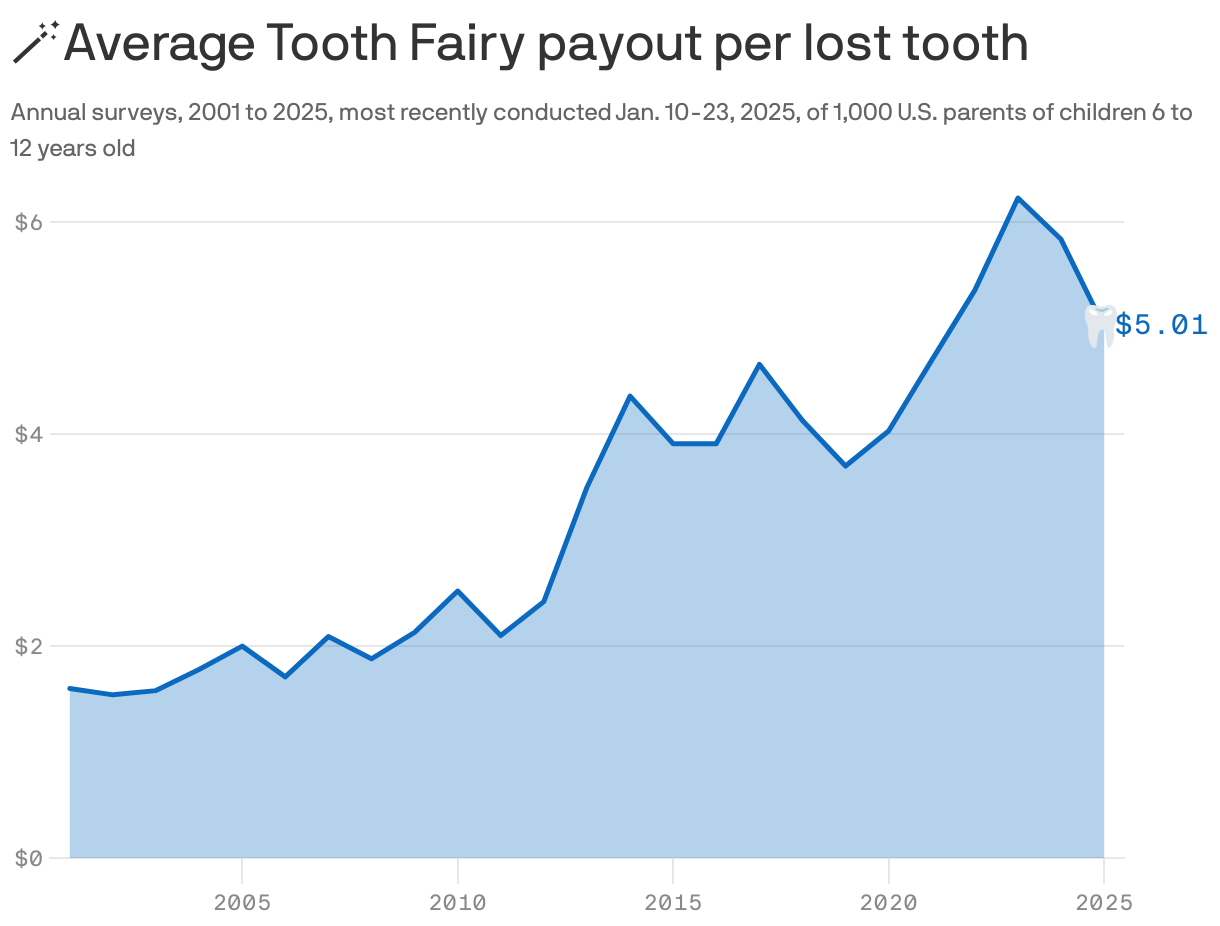
The big picture: For the second year in a row, an annual survey from Delta Dental found the tooth fairy is paying less for lost teeth than the year before.
- The average value of a single lost tooth declined by 14%, from $5.84 to $5.01, according to the survey of 1,000 parents of children ages 6 to 12.
- In 2023, the value of a single lost tooth reached a record high, when it was $6.23.
By the numbers: Lost teeth in the South had the highest value this year at $5.71, the only region to experience a year-over-year increase, per the survey.
- The West had the second-highest value at $5.69 a tooth, but it "experienced a significant 33% drop," Delta Dental said.
- The Northeast average was $4.59, marking the first time the rate there fell below $5 per tooth since 2020.
- The Midwest significantly trails the national average and had the lowest value at $3.46.
Thanks to Ben Berkowitz for editing and Anjelica Tan for copy editing. See you tomorrow!
Sign up for Axios Markets