Axios Markets

October 16, 2026


😎 Friday! S&P 500 futures are slightly higher, and Nasdaq 100 futures are flat this morning amid lingering weakness in AI-related stocks.
- The slight boost may be due to investors pricing in higher odds that the Fed stays on hold at its meeting later this month after chairman Kevin Warsh's comments overnight.
Today, after years of trying to ignore the corporate bond market, Emily explains why it matters — especially right now. Matt digs into the current market dilemma that is CoreWeave.
In 1,199 words, a 4.5-minute read.
1 big thing: Bond investors sound the alarms

The adults have entered the AI chat — bond investors this week looked up from their massive buying binge and asked themselves, "Hey, are we sure these investments are going to pay out?"
Why it matters: The AI boom is looking a little wobbly these days, at least when it comes to all the borrowed money that's fueling it.
- "Credit markets are where some of the AI boom's weaknesses can show up first," Robert Schiffman, a senior credit analyst at Bloomberg Intelligence, tells Axios.
- If you look back at the history of many big investing booms that later went bust — from railroads to housing — the first warning signs were with the bonds.
The big picture: Bond investors — the adults in the room — can often spot trouble brewing in a market.
- Why's that? Stock investors place a much higher value on growth. Their basic question is: How high will this go?
- But bond investors are all about risk. They just want to know: Will I get paid back?
Follow the money: A few factors have converged to cause bond investors to rethink AI debt.
- At the macro level, the Iran war that began earlier this year led to a surge in energy prices that drove up inflation.
- And that has helped drive interest rates higher, creating a potential problem for weaker borrowers that need to raise fresh money or refinance existing loans.
Zoom in: That's especially true for the so-called neoclouds, "the newest layer of the AI economy," as Mark Malek, chief investment officer at Muriel Siebert, calls them.
- These are companies racing, alongside Big Tech, to build and rent out AI compute. You've likely not heard of them — Crusoe, Nebius, Nscale, Lambda and, most prominently, CoreWeave.
- Unlike the hyperscalers — Microsoft, Alphabet, Amazon — the neoclouds are more dependent on borrowing to build data centers.
- "This is the subprime tranche of the AI trade," Gil Luria, head of technology research at D.A. Davidson, tells Axios.
Catch up quick: Investors have been selling off CoreWeave's bonds for weeks, worried that the revenues from AI may not be enough to sustain its growing debt burden.
- The prices for its bonds have now tumbled, pushing its yields (or interest rates on the bonds) into distressed territory.
- The accelerated deterioration shook the broader AI trade.
- Bonds issued to fund several different data centers have also fallen in recent weeks, as the Financial Times noted — one investor called it a "Darwin moment," where only the strongest would survive.
Between the lines: Luria, perhaps inadvertently, helped push the sell-off this week. He went on the "Prof. G Markets" podcast Wednesday, and warned that CoreWeave's stock price could go to zero if the AI investment cycle turns.
- Attention on the company started building the previous day when venture capitalist Chamath Palihapitiya posted a chart showing CoreWeave's record-high bond yield. To cap it off, Elon Musk replied, "Yikes."
- "All this stuff was coming together," Luria says. As for his quotes? "I don't know that they were the reason or the problem, but it probably didn't help."
Reality check: Investors and analysts still believe AI demand is strong enough to keep the cycle turning.
- But the recent weakness in CoreWeave and others shows where a break in the excitement is likely to start.
- It's unclear if there would be contagion from there.
Bonus chart: Swaps meet reality
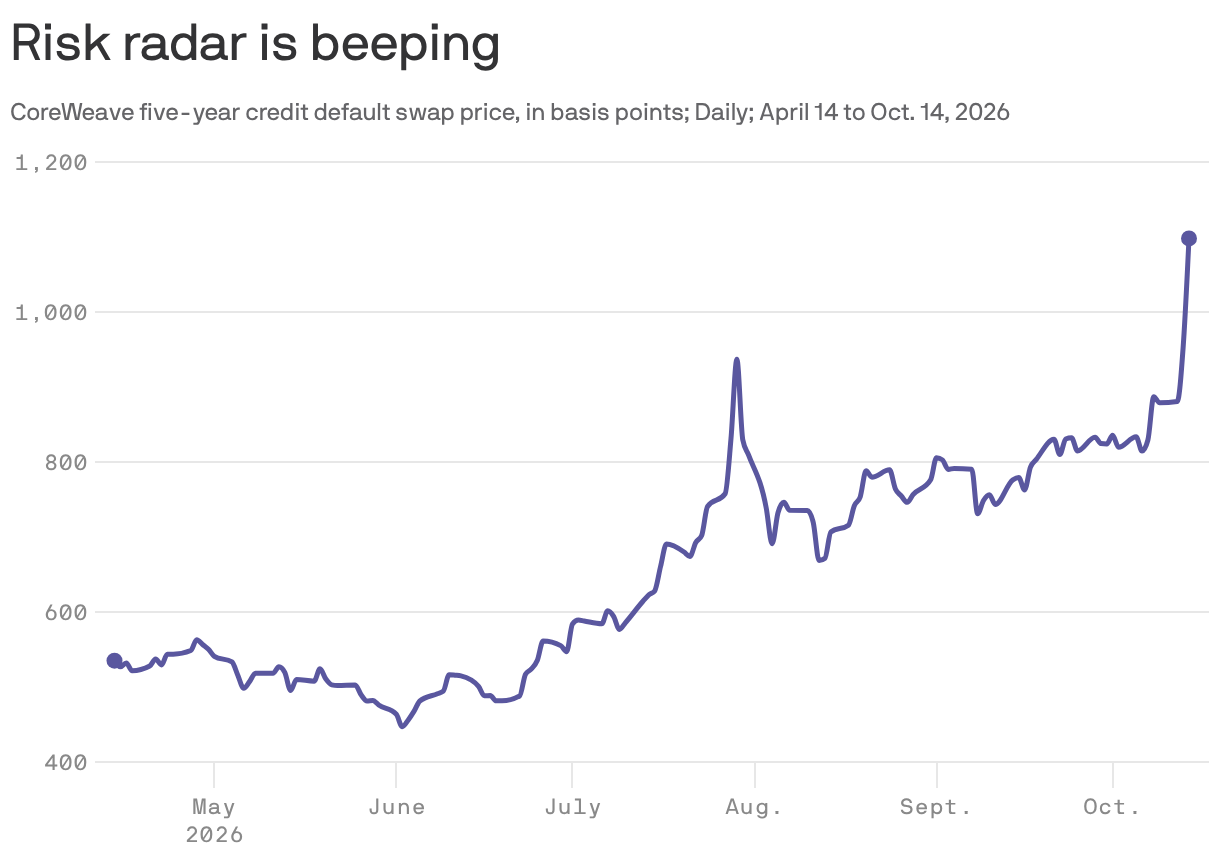
Five-year credit default swaps — a kind of insurance that investors buy to protect them against a company defaulting on its debt — on CoreWeave yesterday jumped to nearly 1,100 basis points (or 11 percentage points) for every $100,000 of debt to be insured.
- At that price, it would cost about $1.1 million a year to insure $10 million of CoreWeave bonds against default.
- The costs of such insurance did reverse later in the day as the company's share price bounced.
2. The trouble with CoreWeave
CoreWeave's huge debts, giant spending plans and myriad financial ties to giants like Microsoft, Nvidia and OpenAI make it an ideal test of whether the AI boom can stand up to serious market scrutiny.
Why it matters: If the recent sharp sell-off in CoreWeave's bonds means bond investors are less interested in funding the data center build-out, it could mark a major change for the AI boom that has been powering the U.S. economy and stock market.
Flashback: The data center boom was once paid for with massive profits produced by giants like Amazon, Meta and Alphabet. Now, it depends on cash raised in the bond markets.
Catch up quick: And bond market investors seem to be saying that they're no longer interested in providing easy money, at least to some of the heavily indebted players, like CoreWeave.
- Yields on CoreWeave bonds maturing in 2032 continued to hover near 15%, though prices did rally yesterday after a brutal drop earlier in the week. (Bond yields and prices move in opposite directions.)
- And its shares had a bit of a recovery, ending up nearly 6%.
- The price of insuring against CoreWeave's default shot sharply higher intraday yesterday, underscoring the doubts over its business model if its borrowing costs remain this high. (Like Coreweave's share price, it too reversed later in the day.)
Zoom in: CoreWeave borrows money to build data centers that it leases to those in need of more computing power and willing to pay up for it.
- That sounds like a pretty logical business model.
Here's the thing: Building data centers is really, really expensive. And CoreWeave has had to borrow a lot of money to do it. At the end of June, it had about $35 billion in debt and another roughly $16 billion in debt-like lease liabilities.
- But that's almost certainly not enough, as CoreWeave continues to burn through cash as it keeps building data centers.
- CoreWeave reported negative free cash flow of -$5.7 billion in its most recent quarter.
- What does that mean? More bond market borrowing! Or, alternatively, a cash infusion from a deep-pocketed investor. (It just so happens that Nvidia is CoreWeave's second-largest shareholder, with a $3.3 billion stake.)
What to watch: Whether CoreWeave's borrowing costs get significantly cheaper in the coming days.
- If they don't, the company will eventually have to adjust, either by slowing its investment, coming up with a new source of investment capital, or having a credible market player — if not Nvidia, perhaps CoreWeave's key customer Microsoft — make a gesture that convinces investors that it would backstop CoreWeave's obligations.
- But that would have to be quite a gesture.
Thanks for reading! Send us your thoughts, questions and suggestions for coverage or just say hello at [email protected] and [email protected] or reply to this email.
Thanks to Jeffrey Cane for editing and Carlin Becker for copy editing this edition.
Tell your friends to sign up here.
Sign up for Axios Markets