
Axios Markets

October 13, 2026

👋 Welcome back! U.S. futures are flat despite the fact that the AI trade had a rough night. South Korea's Kospi tumbled 5.5%, after Broadcom CEO Hock Tan's likening of AI investors to casino gamblers rattled confidence in the world's most important market theme, at least for a moment.
- U.S. stocks ended little changed Monday, and they're pretty much flat again "in the pre-market session."
🏈 Third-quarter earnings season kicks off today, and Matt stands back to admire the truly remarkable run-up in corporate profits that we've already seen.
- Emily, meanwhile, looks at the frustratingly squishy numbers surrounding available performance metrics for Anthropic and OpenAI, the pre-IPO AI labs at the heart of pretty much everything.
🐴 Giddyap. In 1,173 words, a 4.5-minute read.
1 big thing: A golden age for corporate profits
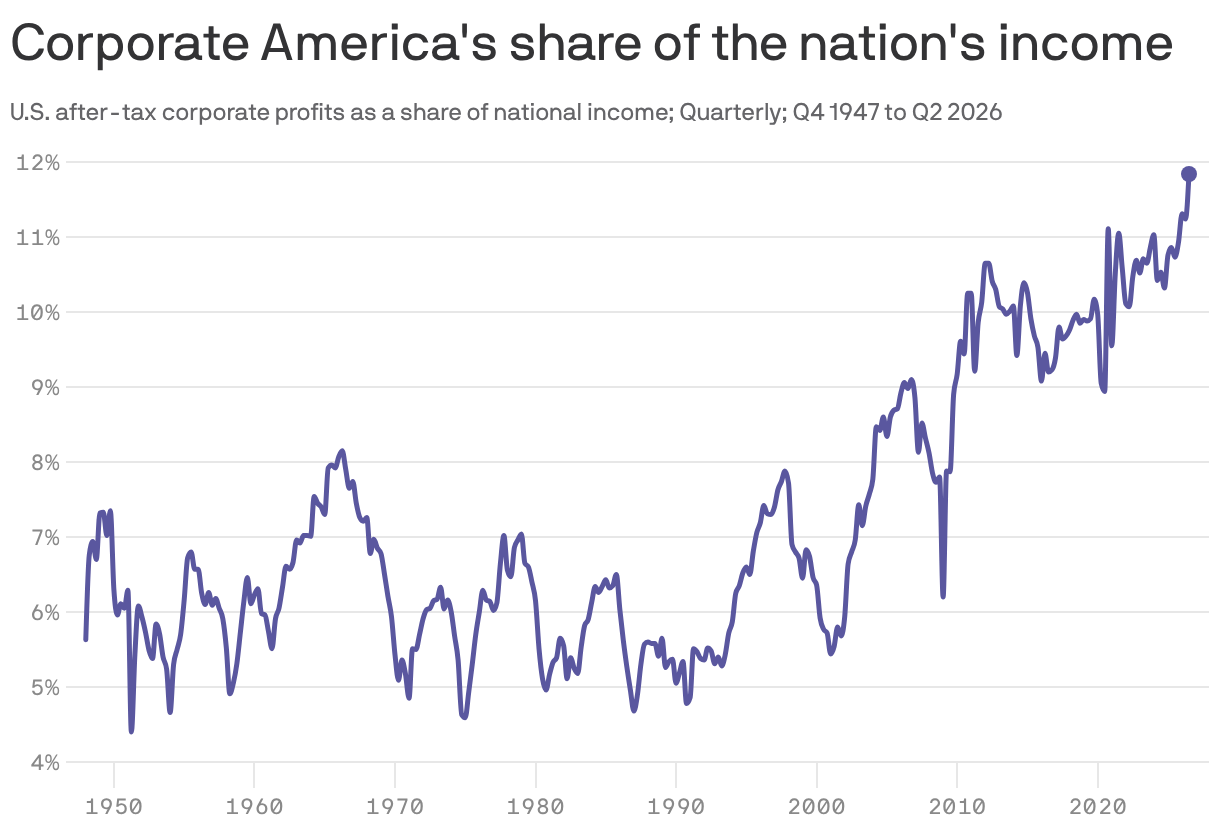
Corporate America is raking in record profits, luxuriating in luscious margins and capturing the largest chunk of the country's income on record.
Why it matters: The corporate bonanza is bolstering the stock market, but it may also be playing a role in the persistently sour sentiment among the American electorate.
The latest: Today is the unofficial start of third-quarter earnings season as JPMorgan Chase, Goldman Sachs and others report results.
Zoom in: Wall Street expects the members of the blue-chip S&P 500 index to continue to make it rain.
- Third-quarter earnings per share are expected to grow roughly 29% for the index, compared with the quarter in 2025, according to estimate data collected by FactSet.
- That's after a massive 50% annual increase in second-quarter earnings that was supercharged by the giant, non-operating gains on valuations of tech investments posted by Amazon and Alphabet.
- But even without those enormous gains, the numbers were quite strong, thanks to the AI boom that analysts expect to keep powering giant profits.
What they're saying: The market is still all about AI, but the gains are extremely concentrated.
- "At the stock level, AI infrastructure stocks are expected to drive more than half of S&P 500 EPS growth in Q3," wrote Ben Snider, chief U.S. equity analyst with Goldman Sachs.
- Snider noted that more than two-thirds of the total growth in S&P 500 earnings for the quarter is expected to come from just 10 stocks.
- What's more, Micron Technology and Nvidia alone are expected to generate more than one-third of the growth in earnings for the blue chips, Snider wrote.
The big picture: Broader measures of U.S. corporate profitability captured by economic — rather than stock market — data also seem to show remarkable strength.
- For the economy as a whole, after-tax corporate profits in Q2 jumped 18.2% compared with the same quarter of 2025.
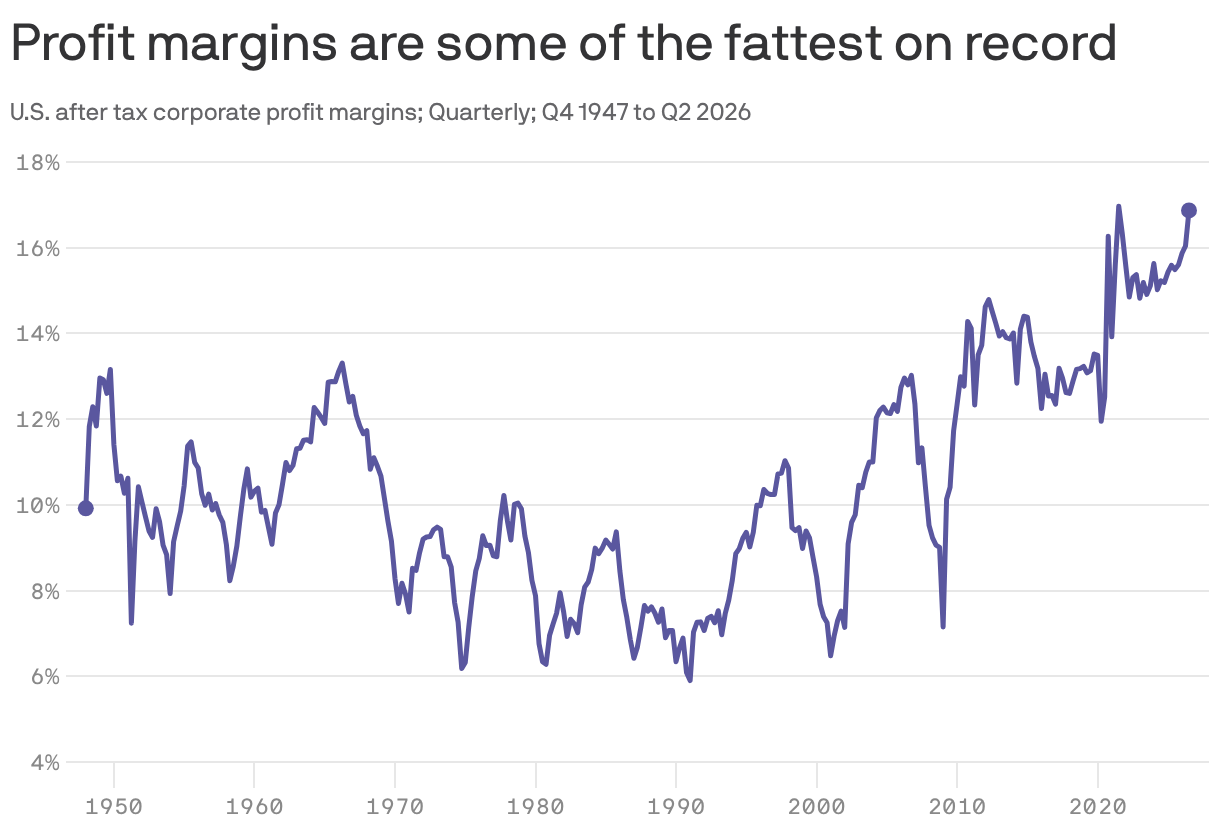
- And key measures of corporate profit margins across the entire U.S. economy are some of the fattest on record.
The other side: Boom times for corporate America have a flip side, however, with the so-called labor share of national income collapsing to some of the lowest levels on record.
- The labor share tells you what percentage of the giant paycheck produced by the U.S. economy goes to workers in the form of wages and benefits, rather than to corporate profits, dividends, rents and interest paid to other economic actors, commonly summarized as "capital."
The bottom line: That decline helps explain the persistently sour mood of the American public toward the economy and its deep skepticism toward the AI boom that's producing this bonanza for American corporations.
2. ARRrrrgghh!
Investors are treating news about OpenAI and Anthropic's finances as if they were earnings reports from public companies. They are not.
Why it matters: The stock market, and a significant part of the real economy, depends on whether these massive startups can earn enough to justify the billions of dollars being plowed into AI.
The big picture: The reality is we know little about these companies' expenses, cash burn and profitability. The revenue numbers we're hearing about are dimly defined.
- It's unlikely we'll know much more until their IPO filings become public.
Catch up quick: Last week, a Financial Times report suggested that OpenAI's annualized revenue was lower than some had believed, by about $20 billion.
- Tech stocks dropped sharply on the news.
- Yet it wasn't some ratcheting down or coverup, but apparently an effort to measure OpenAI's revenue the same way Anthropic calculates its numbers.
Between the lines: The confusion is a good reminder that the numbers getting tossed out don't always mean much.
- "It's like a completely absurdist theater," venture capitalist and blogger Paul Kedrosky tells Axios.
Friction point: The metric you hear most often now is annualized revenue or annual recurring revenue, known as ARR. Or maybe to Kedrosky it's ARRGH.
- In the context of the big AI startups, these metrics are "inherently arbitrary and capricious."
Zoom in: Annualized revenue is a snapshot. Companies take what they make over a select time period, say a month, and "annualize it," sometimes by just multiplying it by 12.
- But its flaws are pretty intuitive — for example, try calculating your annual income based just on December if you get an annual bonus.
Follow the money: Still, ARR is a fairly standard way of working out revenues for software companies that charge monthly subscriptions and expect business that's relatively steady.
- The issue here, Kedrosky says, is that the frontier model companies are changing quickly in a volatile business. So ARR, already a flawed measure, is even less useful, he says.
- "The variability of the revenues over the course of days or even weeks is so big that the window I choose is basically me putting my finger in the air and saying, you know, fuck it, go with that."
- Most important, ARR doesn't tell you anything about costs or expenses.
Zoom out: If these companies were public, we'd know how much revenue they're recognizing each quarter.
- Revenue and profits are calculated under standard accounting rules. Annual financial statements are independently audited.
Yes, but: That doesn't mean public companies are perfectly transparent, of course. There are often issues that pop up (like the current debate over off-balance-sheet debt obligations).
Flashback: Still, startup revenue hype can melt away once a company is forced into the harsh sunlight of the public market.
- Just ask Groupon, a former tech darling. After it filed to go public in 2011, the company had to cut its reported revenue in half to comply with GAAP standards. Or take WeWork, when its 2019 IPO filing exposed details about enormous losses and long-term lease obligations. Its IPO plans collapsed.
What to watch: The Anthropic IPO is reportedly expected for mid-November. By then, we should have plenty of financials to put to the test.
Oh, special thanks to the astute reader who pointed out that we left Alphabet out of Matt's estimate of the share of S&P 500 market cap that hinges on AI. You're right, that would indeed tip us over the 50% mark! 😬
Send us your thoughts, ideas, hopes, dreams, and suggestions for coverage or just say hello at [email protected] and [email protected] or reply to this email.
Thanks to Jeffrey Cane for editing and Carlin Becker for copy editing this edition.
Tell your friends to sign up here.
Sign up for Axios Markets