Axios Markets

February 11, 2025


⚡️ Our hugest apologies for our delay in getting you this newsletter. The vendor that sends Axios newsletters had a technical lapse — we're investigating to try to prevent a recurrence. Thank you for reading and trusting Axios!
🤖 It's Tuesday, and we're back with the sudden turmoil over the future of OpenAI, and Elon Musk's shock bid.
- Plus: A look at life without the CFPB, and what happens to transit when the government has an unexpected priority.
All in 1,110 words, a 4-minute read.
1 big thing: Musk makes a hostile bid



The only fight more hostile than Elon Musk vs. the federal bureaucracy may be Elon Musk vs. Sam Altman, CEO of ChatGPT maker OpenAI.
Why it matters: The victor could help determine the future direction of the world's most powerful technology.
Driving the news: Musk yesterday bid $97.4 billion to buy OpenAI's for-profit assets, which Altman is in the midst of cleaving from the company's nonprofit board.
- Altman exclusively told Axios' Ina Fried today at the AI Action Summit in Paris that OpenAI isn't for sale.
- For Musk, this is partially about trolling, partially about upstaging the Paris AI Summit, and partially about trying to slow down a strategic rival who's made recent inroads with President Trump.
The big picture: Either way, Musk wins.
- At a minimum, he makes life difficult for one of his most bitter rivals.
- And if Musk or his xAI somehow ends up with OpenAI's assets, which is unlikely for a slew of reasons, then he wouldn't kick them out of bed either.
Zoom in: It's unclear if Musk is offering more for the assets than is Altman, but it may not matter.
- OpenAI's board is mission-driven, meaning it doesn't have to take the most lucrative offer.
- This is unlike what happened when Musk bid on Twitter, which was chaired by the exact same person who now chairs OpenAI's board, Bret Taylor.
What they're saying: Altman was at a dinner in Paris when the news broke — sitting near Vice President Vance — and tweeted: "no thank you but we will buy twitter for $9.74 billion if you want."
- Musk clapped back: "Swindler."
- Altman told Axios "there's been like versions of Elon trying to, you know, somehow take control of OpenAI for a long time, so, it's like, okay, here's this week's episode."
The intrigue: One of the first things Trump did when he took office was to announce Stargate, intended to be a $500 billion effort to build infrastructure for OpenAI.
- Musk bashed the project, one of Trump's early big wins, claiming none of the players had the necessary money.
- If Musk controlled OpenAI, it would further entangle his business interests with his new position in the government.
The bottom line: This episode is likely to become a footnote to the ongoing feud between the tech titans, and highlights Musk's willingness to attack a company that Trump all but crowned as America's national AI champion.
2. What's at stake in the CFPB shutdown

The DOGE effort to effectively shut down the Consumer Financial Protection Bureau gets conservatives as close they've ever been to achieving a long-held goal, and consumer advocates are horrified.
Why it matters: The CFPB is a financial watchdog intended to protect people from being ripped off by banks and other institutions. Consumer advocates and former CFPB staffers say sidelining the agency would make it easier for bad actors to flourish.
The big picture: The shutdown of the agency throws into question the future of several pending lawsuits, as well as rules meant to lower credit card and overdraft fees.
- Pending lawsuits include one against JPMorgan, Bank of America and Wells Fargo over alleged fraud on the Zelle payment network.
- Another case is pending against a bank that helps disburse payments to unbanked Social Security recipients. Comerica is accused of charging them unnecessary fees, among other things.
- There's also a lawsuit charging the credit bureau Experian with failing to remove errors on people's credit reports, a move that can affect people's ability to land jobs, get mortgages or rent apartments.
What they're saying: The CFPB "has long functioned as another woke, weaponized arm of the bureaucracy that leverages its power against certain industries and individuals disfavored by so-called 'elites,'" the White House said in a statement on Monday.
- In his first term, Trump appeared to at least partially support the CFPB's practices, like when big fines were announced against Wells Fargo.
Context: The conservative Heritage Foundation's Project 2025, coauthored by acting CFB director Russell Vought, calls for the agency's abolition.
- The group argues that the agency uses the money it obtains in fines to fund "leftist nonprofits." The latter charge seems to refer to the CFPB's civil penalty fund, the money it collects from fines to financial institutions.
- If that money can't be paid out to victims of scams, it can be used to fund financial literacy and education programs. That appears to have happened once to date, per the agency's website.
- "It's a conspiracy theory," said Christopher Peterson, who worked at the CFPB during the Obama administration and is now a law professor at the University of Utah. The agency has returned billions to consumers.
Others in the financial industry have argued that the CFPB, particularly during the Biden administration, went too far in regulating the industry.
- Still, some in the sector said a total shutdown would be a bridge too far.
- It's "hard for us to see even the banks wanting the agency to go away," a note from TD Cowen said on Monday. "Biden's CFPB may have gone too far, but banks could be worse off if each state enforced policies without a federal entity in the lead."
3. Trump's transportation choices

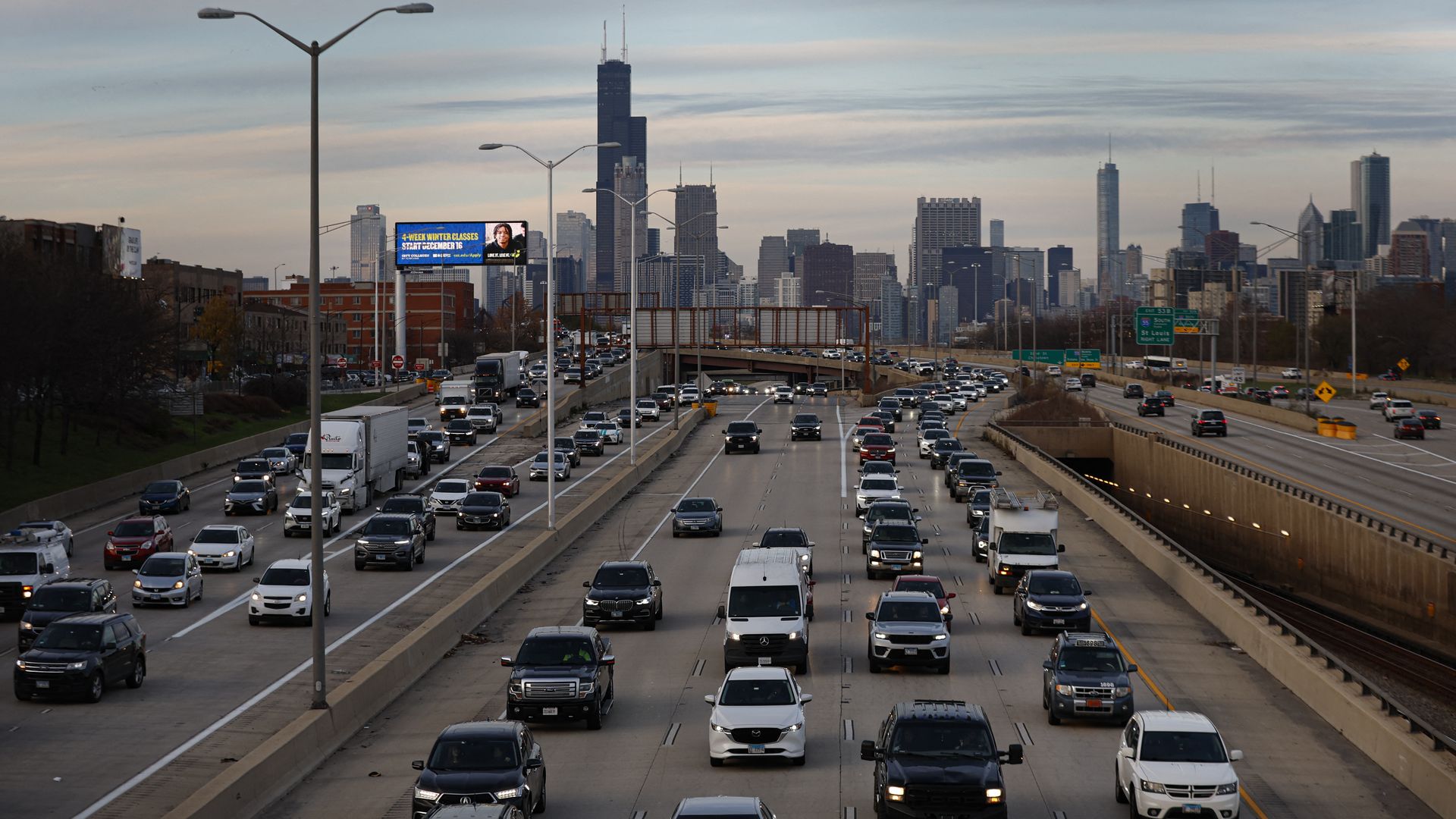
A recent memo from Transportation Secretary Sean Duffy, which prioritizes transportation projects in communities that have more married families with children, could end up deepening inequality issues.
Why it matters: The policy is likely to direct more funding to car-based projects in mostly white, higher-income areas far outside of cities, while depriving urban neighborhoods of funding for public transit, according to transportation researchers.
- "If the goal is to produce a transportation system that gives people more options, increases economic growth and ensures everyone has increased job opportunities, this policy is pretty much the opposite of what we want," Yonah Freemark, a senior researcher at the Urban Institute, told Axios.
Between the lines: The Urban Institute compared marriage and birth characteristics against data about how people get around at the state, county and local levels.
- In Chicago, neighborhoods where more commuters travel to work by walking, biking or public transit would be least likely to receive federal funding. Meanwhile, the city's exurbs, which are more car-dependent, would be prioritized.
Other disparities would also materialize, Freemark said.
- Census tracts with above-median marriage and birth rates tend to have higher household incomes, higher homeownership rates and less poverty.
- Residents of such areas are also much more likely to be white and much less likely to be Black or Hispanic.
What they're saying: "It's extremely unusual," Adie Tomer, a senior fellow at the Brookings Institution who specializes in infrastructure policy, last week told the New York Times. "We don't know if this aligns at all with the places most in need of federal support."
Thanks to Ben Berkowitz for editing and Anjelica Tan for copy editing. See you tomorrow!
Sign up for Axios Markets