
Axios Markets

November 02, 2026

đź‘‹ Welcome back! It's the first trading day of the month. Stock futures are pointing to a positive open, and oil is trading slightly lower after Axios reported that President Trump wants to let negotiations play out in the war for now.
đź‘€ There's much for investors to watch this week, including the October jobs report on Friday and another wave of corporate earnings reports. We get Apple and Palantir after the close today.
- But the main event will be tomorrow with the midterm elections. So, today: Matt gives a snapshot of the uncertainty they bring. Emily delves into their potential impact on data center development and, ultimately, the AI trade.
So, why not? In 1,007 words, a 4-minute read.
1 big thing: Wall Street's worries mount
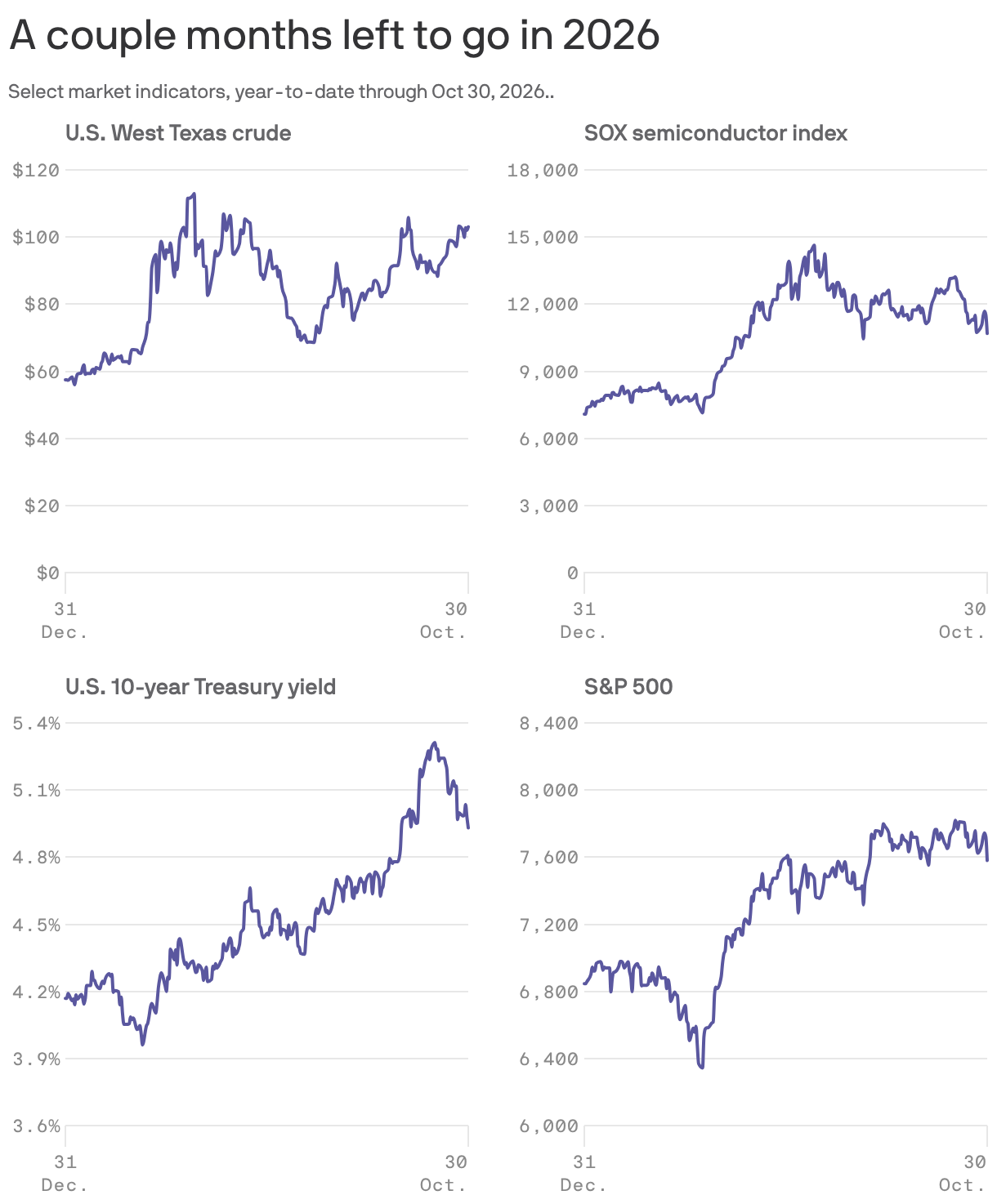
After another rough week for the AI trade, stocks seem to be bracing for more uncertainty in the days ahead.
Why it matters: While the AI trade has sputtered, the S&P 500 has managed to largely tread water thanks to strength from shares tied to the basics of the economy, like consumer staples, health care and utilities. (Soaring oil shares didn't hurt either.)
- But tomorrow's U.S. midterm elections and the potential reescalation of major fighting in the Iran war after the vote pose another potential hurdle to the market.
The latest: The S&P 500 finished October with a price decline of just less than 1%, a far better showing than the Nasdaq 100, which dropped by more than 6.7%.
- The SOX semiconductor index dropped more than 15% in October.
The other side: Investors' moves toward safety limited the impact on the S&P 500.
- The S&P consumer staples sector surged 11.4%.
- S&P 500 health care shares rose 9.8%, in part, pricing in a strong Democratic showing that could boost federal funding for the sector.
Context: But the looming vote could also pose headwinds for sectors.
- Tech companies are positioning for a shift in the regulatory winds coming out of Congress, for example, boosting lobbying strategies toward influencing Democrats.
- Additional scrutiny of the giant tech companies leading the charge — even if a Republican White House continues to make legislation unlikely — could be an overhang on the sector.
- Meanwhile, reports the U.S. could restart heavier attacks on Iran after the elections raise the risk of rising fuel prices and weaker spending from price-sensitive Americans.
What to watch: "Trump's and Democrats' and Iran's 'reaction function' to the midterm results holds the key," Julian Emanuel, equity strategist with Evercore ISI, wrote in a report on Friday.
- "Will it be the 'sudden impact' of a deal with Iran or a 'kinetic escalation' that spikes oil to a price high enough (over $120 for a month or a 'superspike' to $147), to stress the economy, stress credit and derail the equity bull?"
2. AI trade gets tested at the ballot box

Billions of dollars in planned data center construction hang in the balance tomorrow in the midterms — and investors are closely watching a few key races in states where projects are planned, but construction has not yet started.
Why it matters: If elections don't go Wall Street's way, you could see restrictions that disrupt key projects and rattle the AI trade.
Zoom in: Wall Street firms are tracking races closely, down to the makeup of local utility commission boards.
- "Investors are trying to interrogate this and really understand every single corner of this issue," says Ariana Salvatore, head of U.S. public policy research at Morgan Stanley.
Threat level: While a backlash is evident throughout the country, it is most meaningful in states and localities where a few factors intersect:
- Places where a lot of construction is planned, plus there's a competitive statewide race where candidates have a divergence of views on the issue, says Maxwell Shulman, a research analyst at Beacon Policy Advisors, a consulting firm.
Between the lines: It's the gubernatorial races that you want to keep an eye on, says Morgan Stanley's Salvatore. State leaders have the most explicit and tangible power over building.
Texas, where 25% of planned data center building is located, is the state to watch.
- Democrat Gina Hinojosa is challenging Republican Governor Greg Abbott. She supports a moratorium on new data centers until tougher rules are established. He has imposed a limited pause on permits — critics have documented permits still moving forward.
- "I'd say Texas is No. 1," Shulman says.
By the numbers: The results of 10 governors' races will help set the rules for 67.4 gigawatts of planned data centers — $2.5 trillion of AI infrastructure investment, according to an October analysis from Cleanview, a research firm.
- That's more capacity than is currently operating in the U.S.
Follow the money: The risks to investors are idiosyncratic: new restrictions on a project that hasn't yet broken ground, say, that then lead to delays putting loans or bonds at risk.
- Yet slower AI construction could reduce borrowing needs and help the credit markets by siphoning off some supply, Morgan Stanley notes.
- For the hyperscalers, a harsher regulatory landscape will mean they'll have to run around the country putting out political fires. But broadly speaking, they'll be OK.
- It's the smaller AI players who are more at risk — particularly the neoclouds who are already seeing higher costs and investor pullback.
Threat level: Partly due to the growing political backlash, the risk that one or more of these data center projects get canceled is rising. "For a bond investor, that's kind of a scary proposition," Andrew Szczurowski, strategic income portfolio manager at Morgan Stanley Investment Management, tells Axios.
- "I've been avoiding them."
What to watch: A midterm Democratic sweep, particularly alongside victories for anti-data center challengers at the state and local level, would be the most negative for AI investor sentiment, Morgan Stanley projects.
- Even that wouldn't necessarily mean a broad stock selloff or an end to AI spending.
- "The capex narrative is still intact," Salvatore says.
Thanks for reading! Send us your thoughts, questions and suggestions for coverage or just say hello at [email protected] and [email protected] or reply to this email.
Thanks to Jeffrey Cane for editing and Carlin Becker for copy editing this edition.
Tell your friends to sign up here.
Sign up for Axios Markets