Axios Markets

March 28, 2023

1 big thing: Badwill hunting


When government intervened to save Credit Suisse and Silicon Valley Bank, a lot of people lost a lot of money — shareholders and some bondholders are zeroed out; senior executives are unceremoniously fired.
- The acquiring banks, on the other hand — UBS and First Citizens — both ended up with extraordinary gains on their balance sheets, Axios' Felix Salmon writes.
Why it matters: This is the first banking crisis since the global financial crisis of 2008-09 — and it's easy to see what lessons have been learned. Governments are acting swiftly and aggressively, with the aim of strengthening the overall system rather than leaving it weak.
The big picture: Banks are public-private partnerships. Governments need banks to create money and economic growth; banks need government to prevent runs and act as a lender of last resort.
- In banking crises of yore, government was reluctant to support private sector banks. In the late 19th century, however, it became obvious to the British government that the cost of bank failures was vastly greater than the cost of keeping them alive.
- Over successive crises, more governments got involved earlier and with increasing aggression.
Where it stands: Credit Suisse and SVB were both effectively sold for a negative sale price — $60.7 billion and $16.5 billion, respectively. This so-called "badwill" represents the difference between the amount that the acquiring bank is paying for its new assets, and the book value of those assets.
- In both cases, much of that money was taken out of the hands of shareholders and bondholders.
Between the lines: Badwill of this magnitude is largely unprecedented in banking.
- In 2008, none of the largest bank failures were resolved in this fashion. Lehman Brothers was allowed to file for a chaotic bankruptcy; JPMorgan was arm-twisted into buying Washington Mutual for a sum that kept bondholders intact; Royal Bank of Scotland was nationalized.
- Other banks, including Goldman Sachs and Morgan Stanley, were kept alive through forced capital injections that kept executives in situ and bondholders unscathed.
- Such solutions did little to address festering problems that lasted for many years, and often cost billions of extra dollars before they were resolved.
What changed: The financial crisis introduced the world to the idea that investor money — or “loss-absorbing capital” — should go to zero in the event of a banking crisis. That's exactly what happened at Credit Suisse and SVB.
- While regulators cared deeply that bondholders be unscathed in 2008, they now seem almost eager to inflict losses on bondholders.
- And by structuring the deals in such a way that the acquirers get billions of dollars of new "badwill" equity capital, regulators are also demonstrating that they care about the strength of the remaining banks.
The bottom line: The post-GFC regulatory architecture created "crumple zones" around banks that were designed to hurt shareholders — and bondholders — while protecting depositors and the system as a whole. Those zones seem to have worked exactly as designed.
2. Catch up quick
3. 💬 Quoted: SVB hearings edition
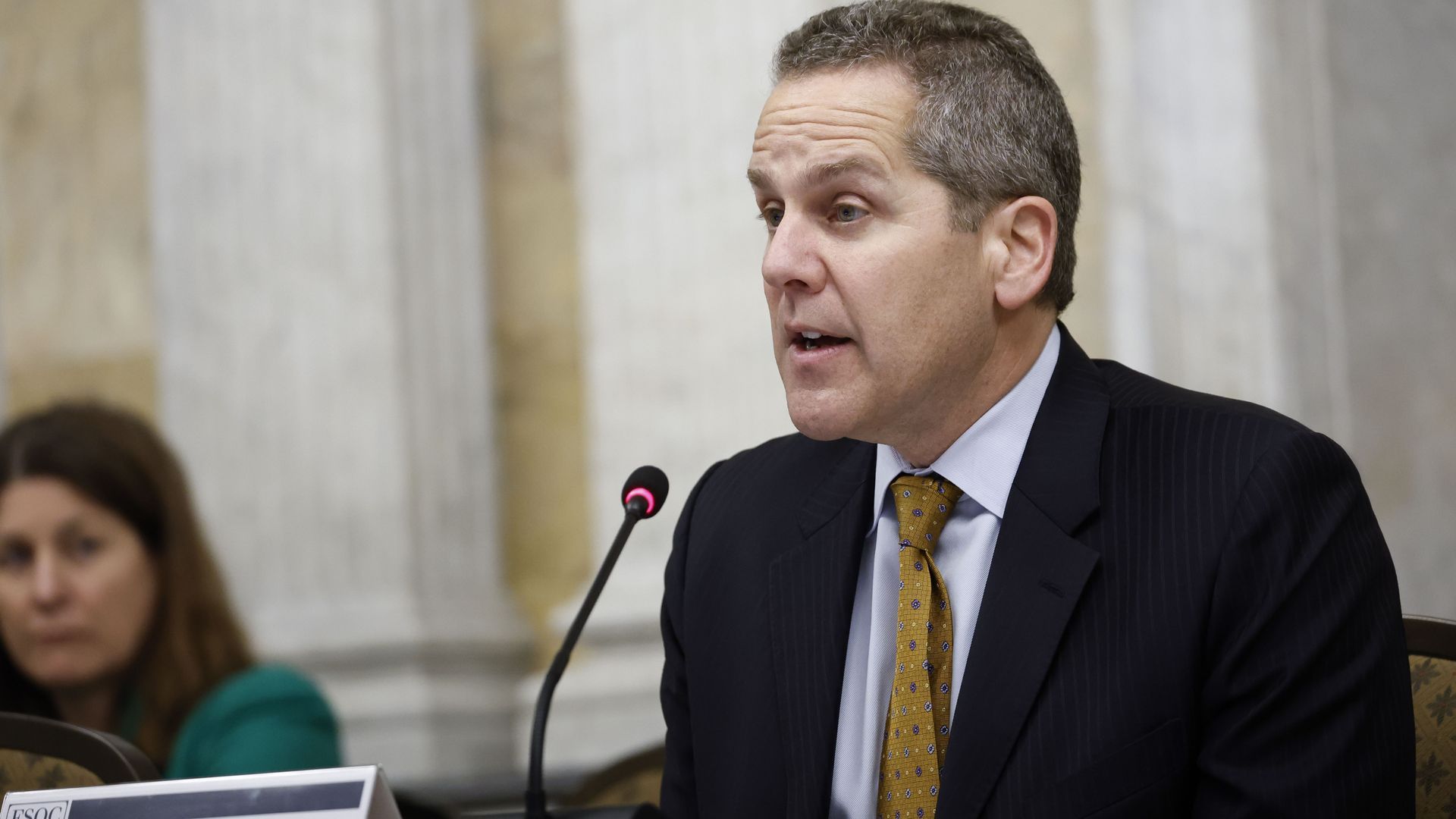
Michael Barr appears before Congress last year. Photo: Ting Shen/Bloomberg via Getty Images
4. "Latent vulnerability"


The chart above shows what amounted to a time bomb on banks’ balance sheets, Axios' Kate Marino writes.
- As interest rates rose violently over the course of last year, unrealized losses on banks' long-term, fixed-income assets piled up — losses that would be realized if banks had to sell them en masse to fund deposit withdrawals.
Why it matters: FDIC chair Martin Gruenberg includes this chart in his prepared testimony for today’s Senate hearing — and calls the historic level of paper losses a “latent vulnerability” that helped trigger systemic stress in the banking system.
- "[F]ire sales driven by deposit outflows could have further depressed prices," according to his remarks.
Go deeper: For a play-by-play of events surrounding the collapse, read Gruenberg's full testimony.
5. Human composting is a thing now

Illustration: Natalie Peeples/Axios
Axios Markets

Stay on top of the latest market trends and economic insights