Axios Markets

August 05, 2024

π It's contagion day. The surprisingly worrisome U.S. jobs numbers spooked global markets. We dive in below β plus, we explain why Janet Yellen & Company are defending one of the Treasury Department's critical duties.
The newsletter is 1,082 words, a 4-minute read.
1 big thing: Global markets plunge
An eye-popping selloff in Japan's Nikkei spread to European markets this morning β and threatens to envelop U.S. stocks in its downward spiral.
Why it matters: The bloodbath appeared to start in reaction to Friday's weak U.S. jobs report, which implied the economy is sicker underneath the surface than previously thought.
- The big question now is whether this is the beginning of a big global risk-off movement that will feed off of itself.
By the numbers: In Japan, the Nikkei average shed a staggering 12.4% β the index's worst showing in percentage terms since the October 1987 crash, Reuters reports.
- The Nikkei's 4,451-point loss was the biggest ever β eclipsing the 3,836 points it lost on Oct. 20, 1987, when the Black Monday crash hit Japan.
- European stocks plunged at the open this morning, experiencing their biggest drop in two years.
What we're watching: U.S. markets. Stock futures tumbled, with Nasdaq futures falling as much as 4% pre-open.
- Wall Street's fear gauge, the VIX, is trading at levels not seen since June 2020.
The bottom line: Friday's jobs report capped a series of worrying economic signs over the past few weeks, with clear cracks now visible in what had been a robust post-pandemic expansion.
2. The spat over how Treasury funds the government

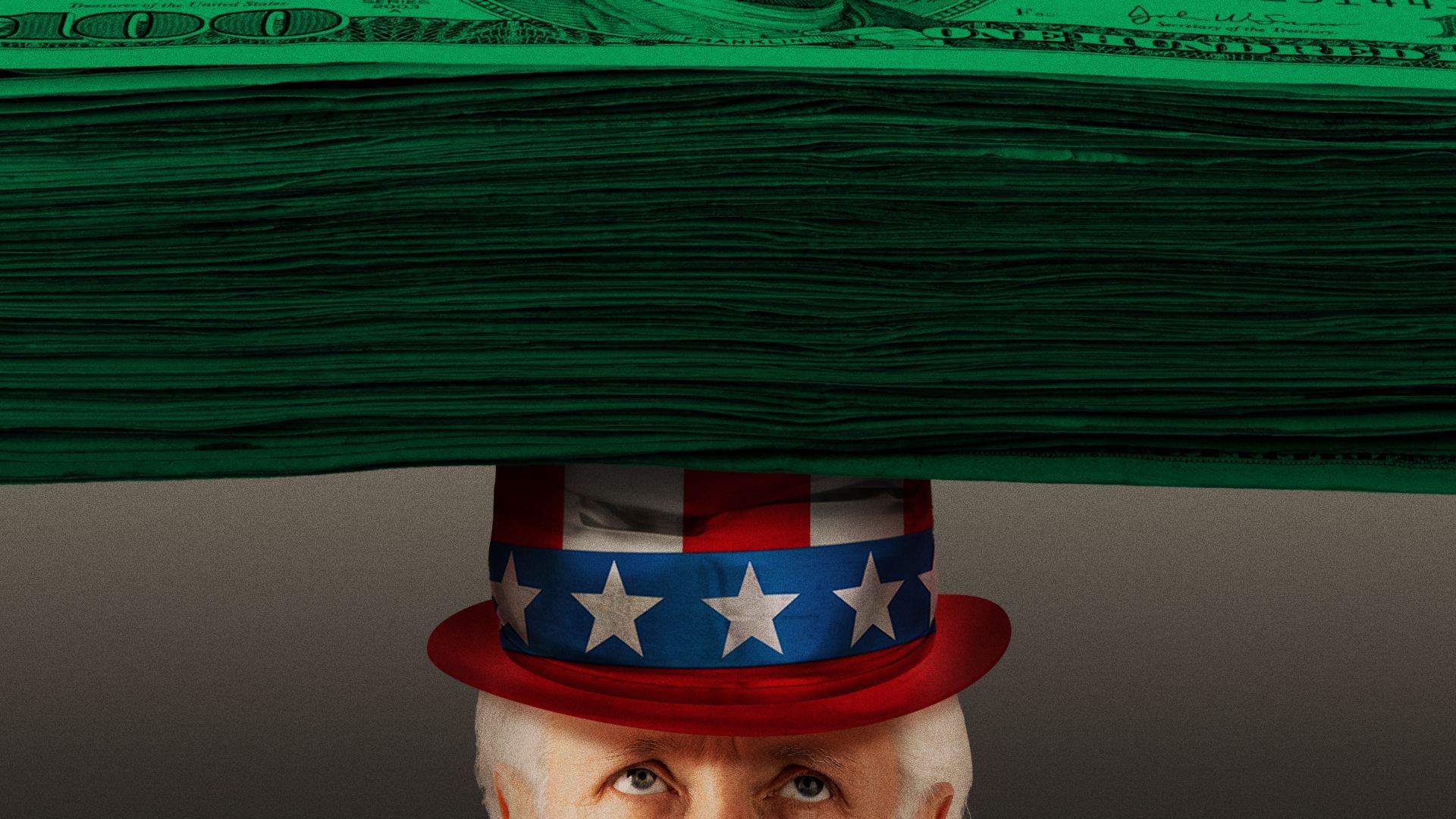
The Treasury Department is being accused of trying to juice the economy ahead of the election, by changing how it finances government spending.
Why it matters: This proves that everything β even wonky bond market auctions β can turn into a political fight.
The big picture: The Treasury tries to borrow money at the lowest cost to taxpayers and in the most boring, least attention-grabbing way possible.
- Now Republican lawmakers and at least one renowned economist say its strategy of late has been at odds with the Fed's goal of slowing the economy.
The accusation: Short-term debt is becoming a rising share of all outstanding debt, while the share of long-term debt β like 10-year or 30-year bonds β stays flat. In turn, critics say the lower supply is preventing long-term interest rates from going up. Those rates influence borrowing costs across the economy.
- Lower rates mean stronger economic activity β the opposite of what the Fed has been trying to achieve by setting overnight interest rates at a high level.
- Of course, if you believe the Fed has been behind the curve and has waited too long to cut rates, then the Treasury has been helping the economic cause rather than hurting it.
What they're saying: "Some people, including myself, believe this is being done to artificially stimulate markets in the run-up to the election," Sen. Bill Hagerty (R-Tenn.) said at a hearing last month.
- Two former Treasury advisers β prominent economists Nouriel Roubini and Stephen Miran β write in a new paper that officials are manipulating financial conditions and the economy, "usurping core functions of the Federal Reserve."
- "While we have no smoking gun, I would say if it walks and quacks like a duck, it must be a duck," Roubini tells Axios.
The other side: Treasury Secretary Janet Yellen said the paper "suggests a strategy that is intended to ease financial conditions, and I can assure you 100% that there is no such strategy. We have never, ever discussed anything of the sort."
Reality check: Treasury officials charged with debt management act not as politicians but as technocrats. A committee of private sector banks and liquidity providers meets quarterly to provide recommendations.
- The rise of money-market funds means more demand for short-term debt, and specifically Treasury bills. Treasury also needs to refill coffers drained by prolonged debt ceiling negotiations last year.
"There isn't malicious intent, but rather Treasury trying to prevent a full-blown bond market meltdown by issuing too much in the wrong spot and pushing interest rates sharply higher in the process," TD Securities rates strategist Gennadiy Goldberg tells Axios.
The bottom line: Toss theories of malicious intent on the part of Treasury officials to the side. It still leaves the interesting question of whether its issuance is impacting the economy.
- Miran and Roubini say the issuance strategy has pushed down the yield on the 10-year Treasury bond by a quarter of a percentage point over the last year.
- According to the two economists, the economic effect of the lower rates is similar to that of a 1-point interest rate cut by the Fed.
- "It is a backdoor form of quantitative easing," Roubini says. "You are achieving the same result of reducing long-term interest rates the way the Fed was doing β by manipulating not the demand for long-term bonds, but the supply of them."
3. Checking in on the yield curve

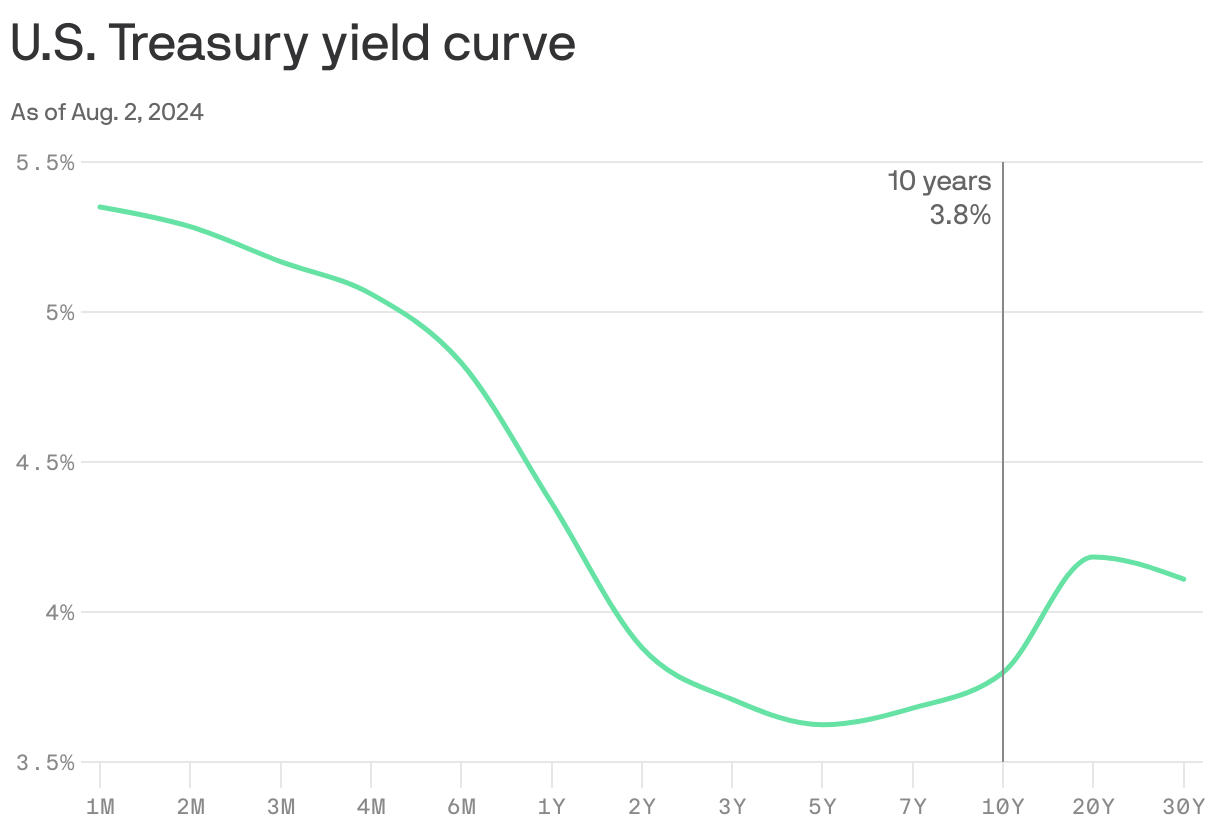
The yield curve is inverted, meaning short-term debt β or Treasury bills βyields more than longer-term bonds. Right now it's therefore pricier to issue bills.
- In theory, it would be advantageous for the Treasury to issue more long-term bonds, TD Securities' Goldberg says, but that assumes there would be as much demand for, say, $1 trillion worth of 10-year notes as there would be for the same amount of three-month bills.
4. Charted: How it works


Treasury conducts regular bond market auctions to sell debt, fund the annual budget deficit, and roll over existing bonds that are maturing.
- For the past year, short-term debt has been about 20% of all outstanding debt.
- That's at the high end of the old suggested range. Last week the range was updated to say that 20% should be the average, not the cap.
5. U.S. overtakes China on Fortune's Global 500 list
The 2024 Fortune Global 500 top 10 list
- πΊπΈ Walmart
- πΊπΈ Amazon
- π¨π³ State Grid
- πΈπ¦ Saudi Aramco
- π¨π³ Sinopec
- π¨π³ China National Petroleum
- πΊπΈ Apple
- πΊπΈ UnitedHealth Group
- πΊπΈ Berkshire Hathaway
- πΊπΈ CVS Health
For the first time since 2018, the U.S. has more companies than China on Fortune's Global 500 list, which ranks the world's largest corporations by revenue.
Why it matters: China's economy, the world's second-largest, has faltered lately, dragged down by a yearslong housing crisis and lackluster consumer demand.
The big picture: While China is still in post-pandemic recovery mode, the U.S. slipped those chains a while ago.
Zoom in: There were 139 U.S. companies on Fortune's list, which covers 2023, compared to 133 companies coming from Greater China, which includes the mainland, Hong Kong, Macau and Taiwan.
Stunning stat: Women comprised only 5.6% of CEOs at these firms β that's just 28 leaders, down from 29 last year. The U.S., fwiw, is home to 15 companies with female CEOs. France is in second place with four.
- CVS Health is the highest-ranked company with a woman in charge, Karen Lynch.
Thanks to Kate Marino for editing this newsletter and to Mickey Meece for copy editing it.
Sign up for Axios Markets