
Axios Markets

November 16, 2026

👋 Welcome back and strap in! This week is the Super Bowl for AI investors: Nvidia reports results after the close tomorrow, and shares of Anthropic are expected to make their trading debut on Thursday.
🗓️ U.S. air travel is largely returning to normal Monday after Friday's nationwide ground stop, and the FT reports that Jensen Huang is discussing the possibility of a return as CEO with allies.
Today, Emily explains the corporate structure that enabled Nvidia's board to oust the powerful tech titan from his role. Meanwhile, Matt notes that individual investors seem to be buying into Nvidia's decline, although a bit belatedly.
Allons-y! In 1,094 words, a 4-minute read.
1 big thing: Nvidia CEO's missing superpower

Huang appeared to have the same swagger, power and control over his company as his tech founder peers, but the former Nvidia CEO lacked one thing that may have sealed his fate: supervoting shares of stock.
Why it matters: Both Elon Musk at SpaceX and Mark Zuckerberg at Meta famously hold these special shares — they give founders more voting power even if they don't own a majority stake in the firm and make it much harder to fire or even to force CEO resignations.
The intrigue: The lesson that the tech industry is taking from Huang's exit isn't about the risk of having affairs or issues with U.S. export controls; it's that getting these super shares is absolutely critical, investor Paul Kedrosky tells Axios.
- "It's just nonstop right now that the main takeaway here is not, you know, keep your pants zipped. It's, 'I need a dual-class share structure.'"
How it works: There is a single class of common stock at Nvidia and most public companies, with each share conferring one vote. Shareholders use those votes to do a number of things, including elect a board of directors.
- The board can fire the CEO or convince them to resign.
- At a dual-class company, there are certain shares that contain more voting power. At Meta, Zuckerberg holds about 61% of voting power, but owns just a little more than 13% of the company via super shares.
- "Mr. Zuckerberg currently has the ability to elect all of our directors and to determine the outcome of most matters submitted for a vote of our shareholders," a recent filing says.
- At SpaceX, Musk, as CEO and board chair, controls more than 80% of the voting power.
Zoom in: Huang, by contrast, held just 3.58% of shares in Nvidia as of March.
- "Unlike many CEOs, I'm completely fireable," he recently told Bloomberg's Emily Chang.
What they're saying: "It's a way of insulating yourself from the consequences of your behaviors and trying to be public without having any of the consequences of being public," Kedrosky says.
- You're "basically a private company with access to the public market," says Andy Behar, CEO of As You Sow, a nonprofit shareholder group that advocates against the dual-class structure.
Reality check: It's certainly possible that even if Huang had super shares, his board would have turned against him. But it's hard to find an example of that happening to a CEO with supervoting control.
By the numbers: 36% of the 69 companies that became public in the first half of 2026 had dual-class shares (including SpaceX), up from 15% in 2022, and the highest share since 2017, when the Council of Institutional Investors started tracking.
What to watch: When Anthropic goes public this week, its seven cofounders will collectively control more than 61% of the voting power, thanks in part to a special class of shares.
- But there is an independent trust with authority to appoint and remove a majority of the board.
The bottom line: Huang was a superstar, but he lacked a certain superpower.
2. 📊 Dip buyers are trickling back into the market
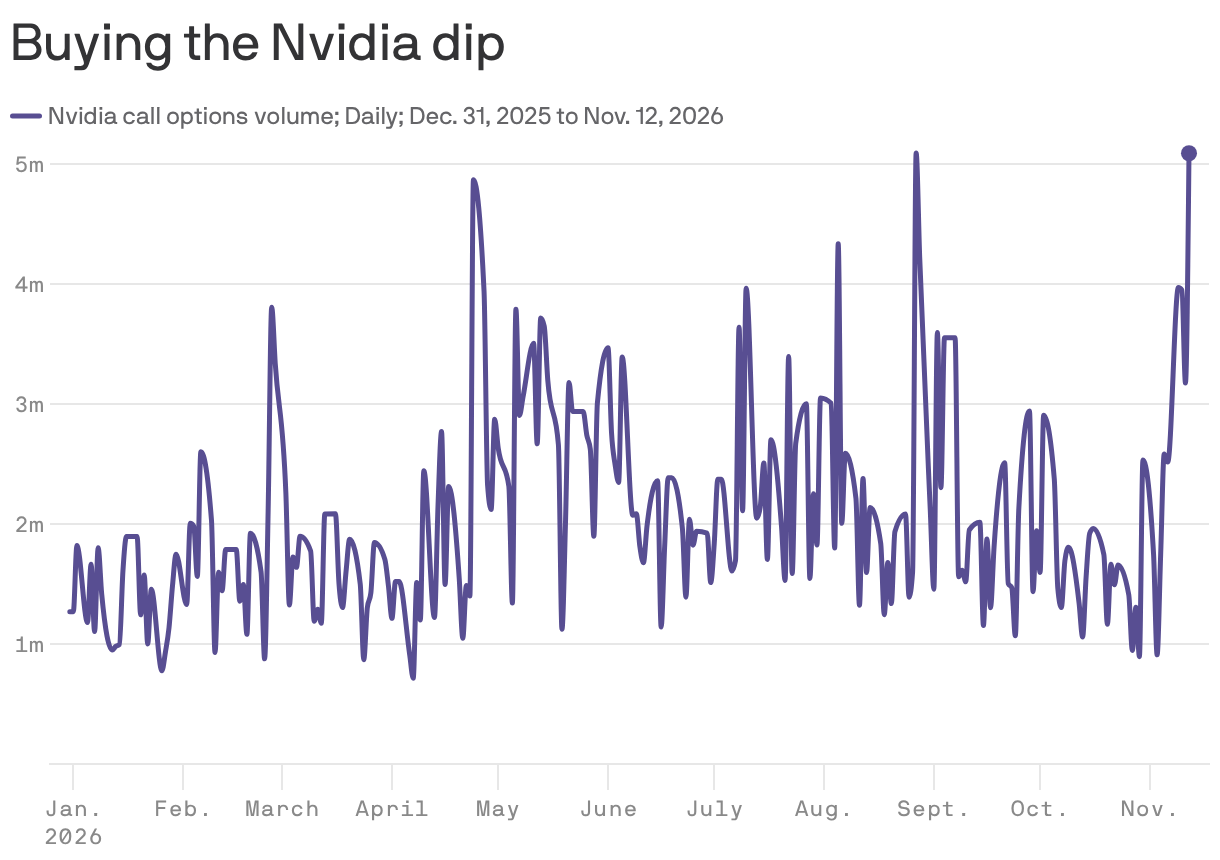
A rush of retail traders taking positions on Nvidia eased some of the shareholder pain caused by Huang's remarkable fall.
Why it matters: The return of dip buying suggests that some remnant of bullish animal spirits survives — even after a brutal month for the AI trade.
The latest: Roughly 5.1 million call options on Nvidia shares traded on Thursday after Huang's resignation was made public.
- That's the second-highest single-day volume of call options on the stock this year. (The proximity of Nvidia's earnings report — due tomorrow — could be playing a role. Call activity tends to spike around quarterly earnings time for the company.)
- The flood of call buying likely helped cut the losses for the stock from roughly 14% early Thursday to just 4.3% by the end of day. (On Friday, Nvidia was down 2%.)
Between the lines: It was something of a return to form for retail investors, who have seemed reluctant to buy the dip in recent days after weeks of losses for the AI technology stocks they often trade.
- "Retail seems to be engaging in, really, it's just the last couple days," said John Marshall, a partner at Carrick Lane, a firm that manages options trading strategies for high-net-worth families and individuals. "Single-stock options traders, which are typically retail, are back to buying calls."
How it works: In recent years, retail traders have embraced trading single-stock options, which are essentially bets on the direction and size of share price moves.
- A call option is a bullish bet that gives traders the right, but not the obligation, to purchase a stock at a designated price until a specific date. A put option is essentially a bet on a share price falling, and it gives traders the right, but not the obligation, to sell shares at a certain price by a specific date.
- Options trading appeals to speculators because these financial instruments can generate much larger percentage gains — and, of course, losses — than the underlying shares themselves.
Flashback: The strategy was popularized in January 2021, when traders who coordinated their buying on the Wall Street Bets subreddit generated a massive surge in the share price of struggling video game retailer GameStop.
Yes, but: The Nvidia rally wasn't just in options. Retail investors were also buying shares outright, according to Vanda Research, which tracks trading by individuals.
- The data provider reported in a research brief Thursday that in the first 30 minutes of trading, it "saw net buying of $111 million – the largest opening half-hour for NVDA in our data ... and more than 40x a normal open."
Thanks for starting your week with us. We'd love to hear from you. Drop us a line at [email protected] and [email protected] or reply to this email.
Thanks to Jeffrey Cane for editing and Carlin Becker for copy editing this edition.
Tell your colleagues, family members and frenemies to sign up here.
Sign up for Axios Markets