Axios Markets

February 20, 2024
Hi, it's Matt. Today we're diving deeper than usual to surface never-before-public documents. They form the core of an Axios investigation into a decade-long government effort to regulate a source of massive Wall Street profits. TL;DR: Wall Street banks viewed it as a serious commercial threat.
Read on ... it's 1,435 words, a 5½-minute read.
1 big thing: Wall Street's hold on a secretive trading business
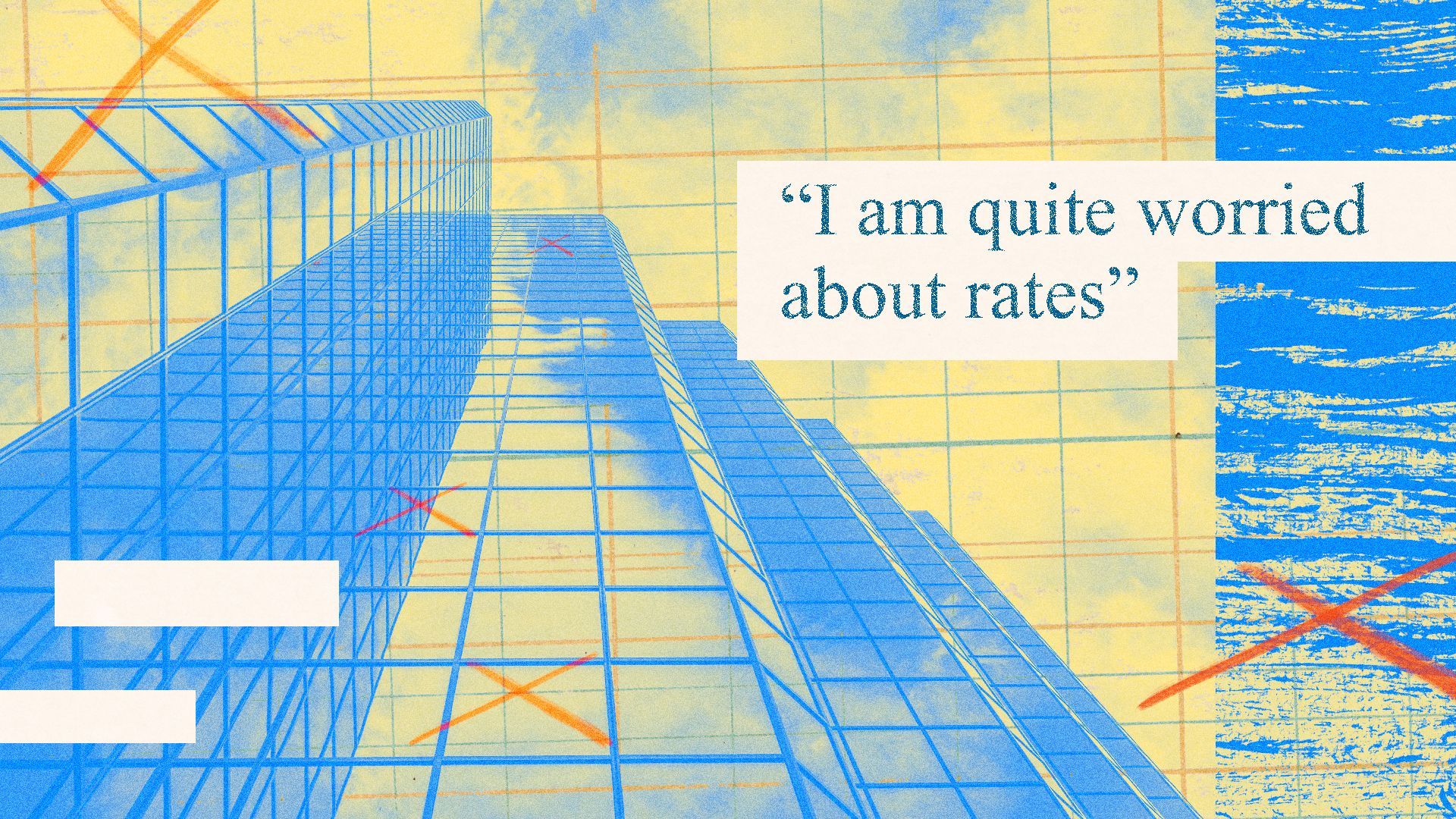
Illustration: Shoshana Gordon/Axios
Court documents reviewed by Axios show just how alarmed Wall Street banks were by efforts to regulate their derivatives trading desks after the 2008 financial crisis.
Why it matters: These emails, presentations and internal memos illuminate the financial sector's attempts to shape the rules and shield key profit centers — a technique alive and well today. They were produced during discovery in an ongoing litigation and later seen by Axios.
Flashback: When the Dodd-Frank financial overhaul became law in 2010, a major part of it directed agencies to write rules for the previously unregulated Wall Street derivatives trading business.
- Depending on how they were written, these rules threatened to transform the banks' highly profitable interest rate swap business into a low-margin business akin to stock market-style exchange trading.
What they said: "I am quite worried about rates," wrote JPMorgan Chase executive Jeremy Barnum — today he is the bank's CFO — in a 2010 email. He added that the business of standard interest rate swaps "has a significant risk of being 'exchangeified.'"
- "Obviously we are fighting this at every opportunity, but many of the battles are steeply uphill," Barnum added.
- In response to an inquiry from Axios, JPMorgan spokesman Brian Marchiony said the bank has "a long history of supporting transparent and orderly markets, so our main concern was that forcing some products onto exchanges didn't actually make things safer, better or easier for clients or the marketplace. Regardless, we certainly would have evaluated the impact to our core business as a result of new rules."
Background: The $160 trillion market for U.S.-dollar interest rate swaps — contractual bets on the direction of interest rates — is one of the largest markets in the world.
- Regional banks, mortgage lenders, hedge funds and a range of financial entities use swaps to hedge risks related to interest rate moves, or to make money by speculating on them.
- Banks typically don't disclose numbers on interest rate swaps trading. Those profits and revenues are usually combined with government bond trading, and Treasury futures trading, into so-called rates trading divisions.
The stakes: What few understand is that the sheer volume of interest rate swap trading typically dwarfs the traditional business of trading government bonds, according to multiple former traders in Wall Street rates trading divisions.
- And while rate swaps didn't cause the financial crisis, the structure of the swaps market contributed to making banks "too big to fail." Swap contracts connected all the big banks: If one bank failed, it threatened the entire system.
2. The 10-year anniversary


The new Dodd-Frank law set out, in part, "to turn the over-the-counter derivatives market from that opaque back room market operation to a more transparent public market, something more akin to the stock exchanges," said Massachusetts Rep. Stephen Lynch at a House subcommittee hearing on the new swaps rules in 2012.
- As part of the law, Congress required some highly standardized types of swaps be traded on swaps trading platforms "to benefit the public, broaden competition, and promote transparency," then-CFTC Chairman Gary Gensler said in 2013. (Gensler is now chair of the Securities and Exchange Commission.)
- Rules mandating that some swaps trade on electronic platforms — known as swap execution facilities, or SEFs — went into effect in February 2014.
Now: Ten years later, widespread exchange-style swaps trading that some envisioned still isn't a reality.
- Why? It's a question that's been at the heart of almost a decade of litigation.
- Multiple entrepreneurs launched new swaps platforms soon after Dodd-Frank that never caught on. And the entrepreneurs who started some firms, including Javelin, Tera and TrueEx, have been involved in yearslong lawsuits against Wall Street banks.
- They've been joined with several pension funds in a long-running case that alleges virtually every major bank on Wall Street violated federal antitrust laws by conspiring to prevent the market from moving to stock exchange-style swaps trading. (The documents we've cited emerged as exhibits in this case.)
The other side: Banks have been vigorously defending themselves against these allegations for years. In short, they say the claims are nonsense, there was no conspiracy, and these SEFs simply didn't attract enough business to survive.
The latest: In December, the Wall Street banks won a key victory in a putative class-action lawsuit about the interest rate swaps market in federal court in Manhattan, when a judge declined to certify the proposed class in the suit on technical grounds.
3. The information advantage

Illustration: Shoshana Gordon/Axios
What's clear from the dozens of internal bank documents reviewed by Axios, is that banks saw such exchange-style trading as a serious threat to their profitability and sought to shape rules to prevent it from becoming the dominant mode of trading swaps.
- For example: A 2010 Goldman Sachs presentation stressed that in dialogues with regulators and lawmakers "we have to make sure that ... electronic execution does not mean trading on a central limit order book."
- In a 2010 email, JPMorgan's Barnum wrote that "a major strategic objective of ours is to make SEFs be as different from exchanges as possible."
It might sound like semantics, but the difference between regulations calling for a "SEF" or an "exchange" for swaps might mean hundreds of millions of dollars for a bank.
- Exchanges like the New York Stock Exchange and the NASDAQ use computerized matching engines — known as limit-order books — to anonymously match high volumes of all buyers and all sellers quickly and efficiently (all-to-all trading).
- On the flip side: Swaps trading, before the Dodd-Frank rule, depended on investors calling multiple trading desks to even get a price estimate.
- Traders who sit in the middle of this type of over-the-counter (OTC) market, fielding those inquiries, have a huge information advantage. In theory, that should allow them to buy at lower prices, and sell at higher prices, than they would otherwise be able to do.
- For that reason, analysts and academics have long assumed it's much more profitable for banks to trade in these OTC markets.
Now, we actually know this is how it works because we have records of bankers saying so among themselves.
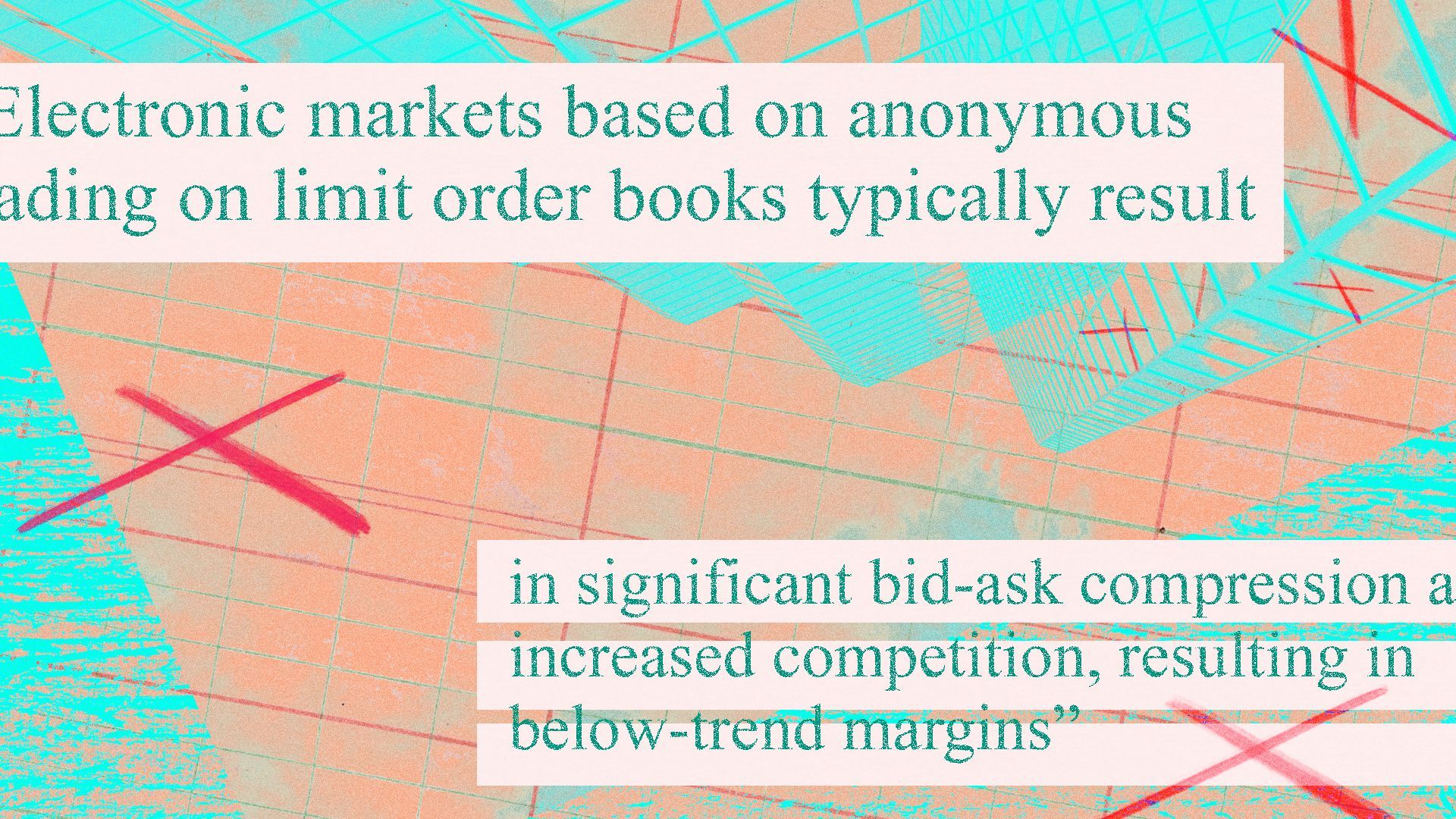
- All-to-all trading would be the "worst case," wrote Simon Maisey, then a JPMorgan executive, in June 2013. Such a system "implies a 90% spread compression."
- In 2010, JPMorgan employees prepared talking points for Jes Staley, then head of JPMorgan's investment banking division, who was about to field questions from an analyst about the new rules. The staff included a side note: "Not to disclose: Potential IB net income impact of approximately $500-$1B."
4. Where it stands
Illustration: Shoshana Gordon/Axios
Though the transformation isn't what some legislators first envisioned, there is a lot more electronic trading of interest rate swaps today. And provisions of the law mandating that swaps traders post some public prices have brought new transparency to the market.
- There's even one major success — an interest rate swaps trading platform that has emerged as the market leader: Tradeweb.
The intrigue: Tradeweb was created by a consortium of large Wall Street banks. These banks owned 46% of it until it went public in April 2019.
- In the decade-long regulatory wrangle for control of the markets, some at the banks indicated that they saw Tradeweb as a tool they could use to mitigate the worst-case scenarios of the new swaps regulations.
- "With Tradeweb, we own it, govern it and can use it to define market structure, so the risk of it going all-to-all is massively mitigated," wrote Barclays executive Andrew Challis in 2012 to counterparts at the bank, according to documents produced in the lawsuit discovery. (Barclays declined to comment for this piece.)
- "Tradeweb is a key asset in the battle for market structure," Goldman Sachs employees wrote in a 2012 presentation.
- Tradeweb spokesman Daniel Noonan told Axios: "The swaps market today is widely considered to be far more transparent, open and efficient than it was before Dodd-Frank. From pre-trade analytics to automated execution and post-trade reporting, electronic trading has played an important role in that evolution."
- Goldman Sachs declined to comment.
There has been a sharp increase in the amount of swaps trading done on the electronic platforms over the years. About $31 trillion in notional rates swaps trades were done via SEF in January.
- But, but, but: Critics argue that there's a big difference between the most common form of electronic trading — which still involves requesting prices from banks, albeit in a much faster process than before — versus the exchange-style, all-to-all, anonymous market that stock investors can take advantage of.
The bottom line: After more than a decade of legislative, legal, regulatory and business wrangling, big banks continue to dominate the business, and Wall Street's worst-case scenario hasn't come to pass.
Was this email forwarded to you? Subscribe here.
Axios Markets is edited by Kate Marino and copy edited by Carolyn DiPaolo.
Sign up for Axios Markets

Stay on top of the latest market trends and economic insights