Axios Markets

August 22, 2024

Welcome back! It's still summer, but the very autumnal pumpkin spice latte is here. We've got the latest on that and a huge freight rail lockdown up north in 1,100 words, 4.5 minutes.
1 big thing: Crypto dominates corporate election spending

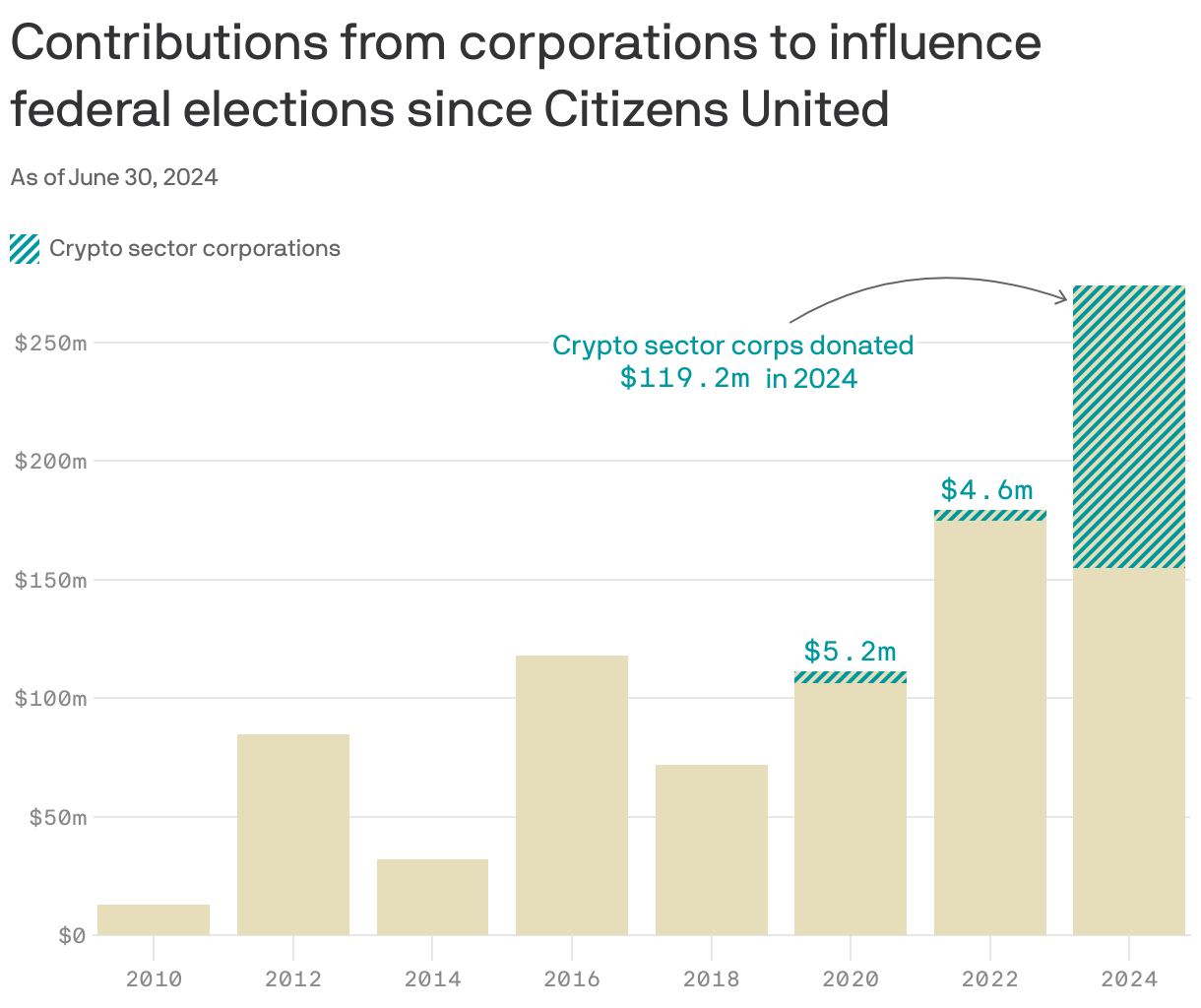
The crypto industry accounts for almost half the money contributed by corporations to political action committees so far in 2024, according to a new report from Public Citizen, a consumer advocacy group.
Why it matters: Crypto is pioneering a strategy for direct corporate election spending — and if it works, it could usher in a new era of spending by big companies to get the outcomes they want in elections, the organization argues.
By the numbers: Blockchain companies have supplied 48% of the $248 million of corporate money donated to influence federal elections this cycle, according to the research.
- Fairshake, the crypto industry's dominant political action committee, has raised a whopping $202 million.
- And though some of that money comes from wealthy individuals, Fairshake's been a magnet for business dollars, with nearly $114 million coming from corporate backers.
- Contributions have come primarily from Coinbase, the largest U.S. crypto exchange, and Ripple, the company behind a stablecoin called XRP. Both companies have been at the forefront of crypto's battle with regulators for legitimacy.
Zoom out: The crypto sector is breaking with the tradition of industries primarily siding with one party or the other.
- Fairshake has been backing or opposing candidates on both sides of the aisle, based on whether or not a candidate is viewed as helpful or harmful to crypto.
- It endorsed equal numbers of Democrats and Republicans in House races this year (for a total of 18).
- And its decision to back two Democrats and one Republican in the Senate races (so far) has drawn ire from partisans on both sides.
How it works: When it has engaged in paid media, Fairshake hasn't spent its money to make cryptocurrency itself an issue in elections.
- It ran ads against Rep. Katie Porter (D-Calif.) in her Senate primary race, and incumbent Rep. Jamaal Bowman (D-NY) in his primary.
- The ads were designed to smear the targets' reputations, without mentioning digital assets. (Both Porter and Bowman lost their primaries.)
- Fairshake's most high-profile pick is Republican Bernie Moreno in the Ohio Senate race — a move likely designed to defeat Sen. Sherrod Brown, the Banking Committee chair and a crypto critic.
What they're saying: "No industry has ever before so wholeheartedly embraced raising as much directly from corporations and openly using that political war chest...to discipline lawmakers toward adopting an industry's preferred policies," the report's author, Rick Claypool, writes.
- "The crypto sector strategy seems to be: give crypto corporations what they want, or your political career gets it."

2. Canadian rail lockout begins
Canada's two largest railroads formally locked out more than 9,000 workers last night — grinding freight rail to a halt — as labor talks with the Teamsters reached an impasse.
Why it matters: The shutdown is a huge blow to Canada's economy and depending on how long it drags on, could eventually spark inflation in the U.S.
- The country relies on Canadian rail for fertilizer, lumber and auto parts shipments.
By the numbers: Moody's estimates the shutdown will cost Canada about $250 million a day, a rate equal to about 4% of the country's GDP.
State of play: The two sides are deadlocked. The companies say the union isn't bargaining in good faith; the union says management is not seriously considering its offers.
What's next: The Canadian government, seen as pro-union, has the power to force the sides into binding arbitration, but so far has declined to act.
- There's hope that the economic fallout of the lockout will give the politicians cover to step in.
3. A smarter way for countries to restructure their debts
When companies are feeling rich, they buy back their shares. Similarly, when some countries find themselves with more money than they expected, they should buy back their bonds, per a new paper from sovereign debt experts Lee Buchheit and Greg Makoff.
Why it matters: Such a mechanism, if enshrined in bond documentation, would finally allow the borrower to see some benefit from making extra payments.
The big picture: When countries default, they generally exchange their old bonds for new ones that have a lower face value or longer maturities.
- The amount that the country can afford to pay in debt service six or more years down the line, however, is little more than "an exercise in occult divination," as Buchheit puts it. (Buchheit generally has co-authors, but certain parts of his papers are unmistakably him.)
- Creditors who participate in the restructuring therefore often require some kind of value recovery mechanism that will allow them to receive more money if the country's economy ends up booming.
The catch: Those mechanisms are generally valued at or near zero at the time of restructuring, and they don't help the country at all if and when they ever kick in.
- "The payments do not buy anything; they do not reduce any liability of the sovereign; they do not service the sovereign's debt; they often do not even reward the institutions that supported the sovereign in its time of need," write the authors.
How it works: Buchheit and Makoff propose that instead of countries just wiring extra money to bondholders, they should use that money to buy back their bonds, starting with the longest maturities.
- If the bonds are trading below par, that means an immediate capital gain for bondholders.
- The remaining bonds will have a lower average maturity and therefore will be worth more, assuming a normal upward-sloping yield curve. There will be a lower supply of debt outstanding, which will also serve to increase values.
- In all, the value for a mark-to-market bond investor should end up being higher than they would have received from a simple cash payment.
The other side: From the borrower's perspective, the prepayments improve the sovereign's debt dynamics and lower its borrowing costs.
The bottom line: A restructuring system that benefits borrowers as well as creditors — and that is less prone to litigation — is more attractive than the current system, which is based on weird constructs like GDP warrants.
4. Starbucks PSL drops


Starbucks' fall menu returns today, a huge moment for pumpkin spice latte lovers (and haters).
Why it matters: The coffee giant has been reeling from a slowdown in sales in recent months, recently bringing in a star CEO to help turn things around.
- Seasonal drinks and limited-time offers have driven sales and traffic in the past.
Fun fact: The PSL is now technically drinking age. The drink first debuted in 2003.
The big picture: Companies are increasingly starting the Halloween shopping season earlier and earlier.
- And folks are sweet on what they're calling "Summerween" — a term first spotted a decade ago on a Disney Channel show that recently gained steam on TikTok, per the NYT.
Thanks for reading and thanks to Kate Marino for editing and Mickey Meece for copy editing.
Sign up for Axios Markets