Axios Markets

July 14, 2026


1 big thing: 🛢️ The Hormuz workaround
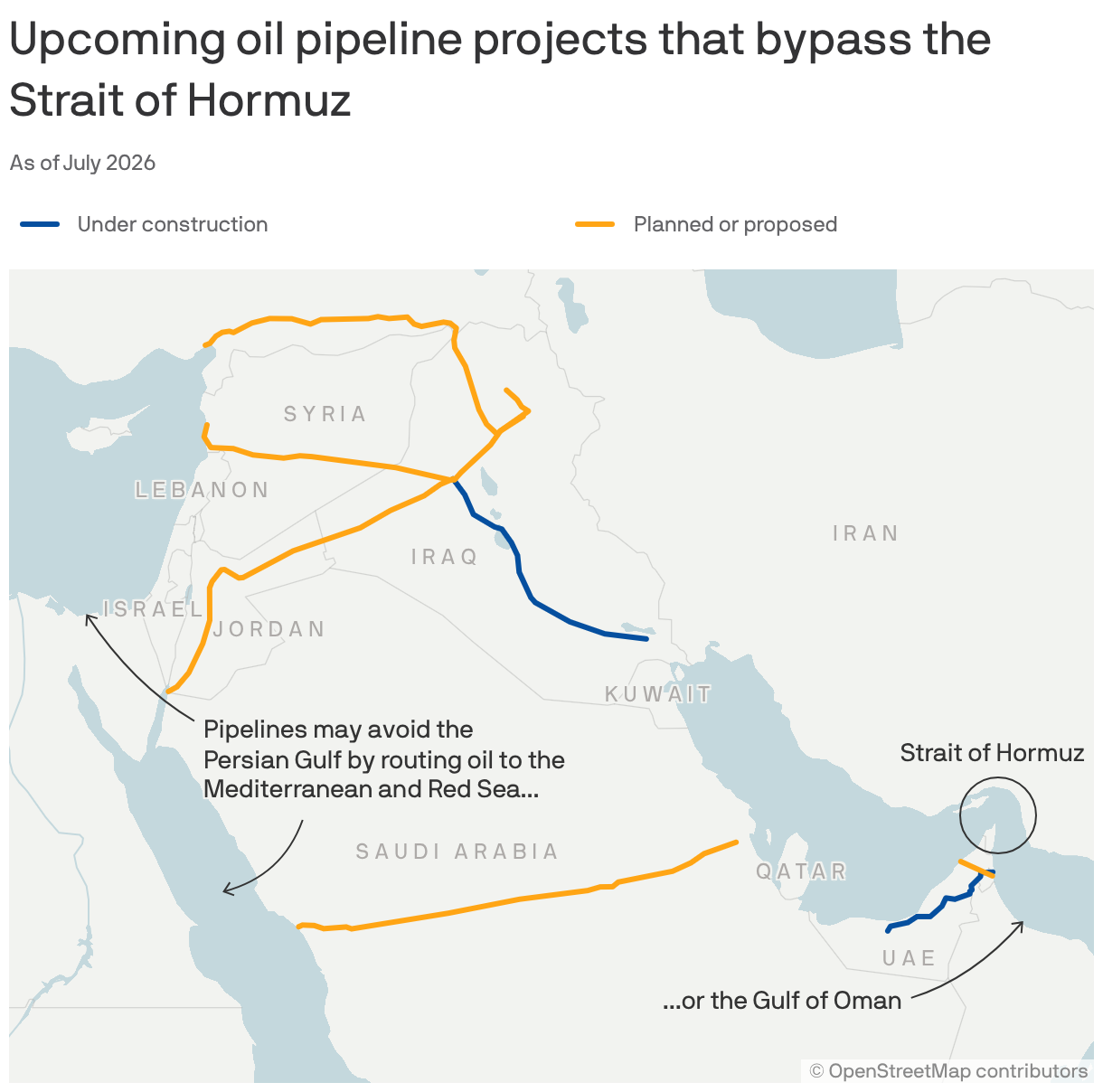
The oil market's top players aren't waiting around to see who winds up with control over the Strait of Hormuz — countries and companies are scrambling to bypass the waterway.
Why it matters: The Iran war threw a spotlight on the strait as the longtime center of the global energy trade, and the industry now has a huge incentive to reduce its dependence, regardless of the war's outcome.
- "The 2026 U.S.-Iran war and Strait of Hormuz disruption may ultimately be remembered less for triggering an immediate oil crisis than for accelerating global efforts to reduce dependence on the world's most important energy chokepoint," Bloomberg Intelligence analysts wrote in a report.
The latest: The ceasefire agreement between the U.S. and Iran is quickly unraveling.
- Yesterday, President Trump said the U.S. would reinstate its blockade of Iran in the strait and proposed charging other countries 20% of the value of cargo shipped through it.
- The threat may not actually materialize — the International Maritime Organization says there's no legal basis for a toll — but it certainly gives producers even more incentive to figure out alternative shipment methods.
Follow the money: Trump's remarks helped send oil up by more than 9%. The price of a barrel of benchmark Brent crude oil is at $86.57 — it fell below $70 after the ceasefire was announced.
- Still, this is far below the levels reached in the first weeks of the conflict.
What to watch: Commodity analysts at Goldman Sachs looked at seven pipeline and export-infrastructure projects that are under construction, planned or considered potentially feasible.
- By the end of next year, that capacity — plus existing pipelines — could insulate more than 45% of the pre-war level of Persian Gulf producers' exports from any potential future Hormuz shocks, they estimated in a note out Sunday night.
- By the end of 2028, the number rises to more than 60%.
Zoom in: Two projects are already under construction: the West-East pipeline in the UAE and the Basra-Haditha Pipeline in Iraq.
- And a Dubai-based port operator is in talks to develop a new port on the coast of the UAE to reduce the country's dependence on the strait, the Financial Times reported yesterday.
Zoom out: Construction for these pipelines is expected to be relatively quick — shockingly so for those used to the U.S. pace of infrastructure development.
- Goldman looked at nine other pipeline projects, mainly in the Gulf, and the median time to complete was 2.5 years. Plus, the analysts found that projects prompted by supply disruptions tended to move faster.
Reality check: For now, the world still needs the strait. The Bloomberg analysts noted that 7 million to 9 million barrels of crude and refined products per day would remain exposed to its risks even after a rerouting buildout.
The big picture: Roughly 20% of the world's oil flowed through the waterway at the outset of the war, and analysts forecast dire outcomes for the energy market with its disruption.
- Those proved overly apocalyptic, to say the least. To paraphrase Jeff Goldblum's character in "Jurassic Park," oil found a way.
Between the lines: Again and again in recent years, markets have proved far more resilient and dynamic in response to major shocks than analysts and economists had predicted.
The bottom line: The outcome of the war remains uncertain, but the global trade in oil is sure to be reshaped as a result.
2. 🍎 Wall Street warms to Apple's AI strategy



Apple's shares hit an all-time high yesterday, pushing the iPhone maker into pole position among the so-called Magnificent 7 year to date.
Why it matters: Apple's recent run — its stock is up more than 20% over the last three months, the best of the Mag 7 — reflects investors' growing appreciation for the iPhone maker's cautious approach to the AI boom, as doubts about the frenzy burble underneath the market's surface.
The big picture: Apple hasn't pursued the kind of investment binge that hyperscalers like Oracle, Microsoft, Alphabet and Amazon have undertaken.
- Without those costly investments, Wall Street sees Apple continuing to generate giant free cash flow over the next year.
- That's in stark contrast to formerly cash-rich companies like Amazon and Meta, whose spending on data centers is expected to push cash flow into the red. (See the above chart.)
Zoom out: Instead of pouring billions of dollars into data centers, Apple has signaled that it is content to leverage its position as gatekeeper for 2.5 billion devices to monetize AI, largely through two channels:
- Via the technical demands of AI, which will goose the need for new, higher-performance phones and boost device sales.
- By positioning Siri and Apple Intelligence as the de facto operating system that mobile users depend on to manage all their AI apps, which should boost services revenue.
Reality check: Simply put, Apple doesn't have to compete with OpenAI, Anthropic or Gemini to produce the best models.
- It just has to make sure its phones and devices are the main way that users interact with whatever AI they choose as easily as possible.
Threat level: The key risk for Apple, however, is that one of those model makers eventually challenges Apple on its home turf of hardware.
- That's the crucial context behind Apple's recent lawsuit against OpenAI, which is reportedly set to unveil a device of its own.
- Apple accuses OpenAI of stealing trade secrets.
What's next: Apple's next earnings report, scheduled for July 30, will be one to watch.
- Expect plenty of questions on its AI strategy and maybe some on the lawsuit.
Axios Markets