Axios Markets

January 07, 2026

🦾 A rally fueled by tech stocks brought the Dow and S&P 500 to record highs yesterday. What AI bubble, am I right?
- Today: A look at risks to the dollar as the global reserve currency.
- Plus: What the January effect in stocks is and why it may be here.
Let's get into it. All in 1,060 words in 4 minutes.
1 big thing: Dollar dominance could be in danger
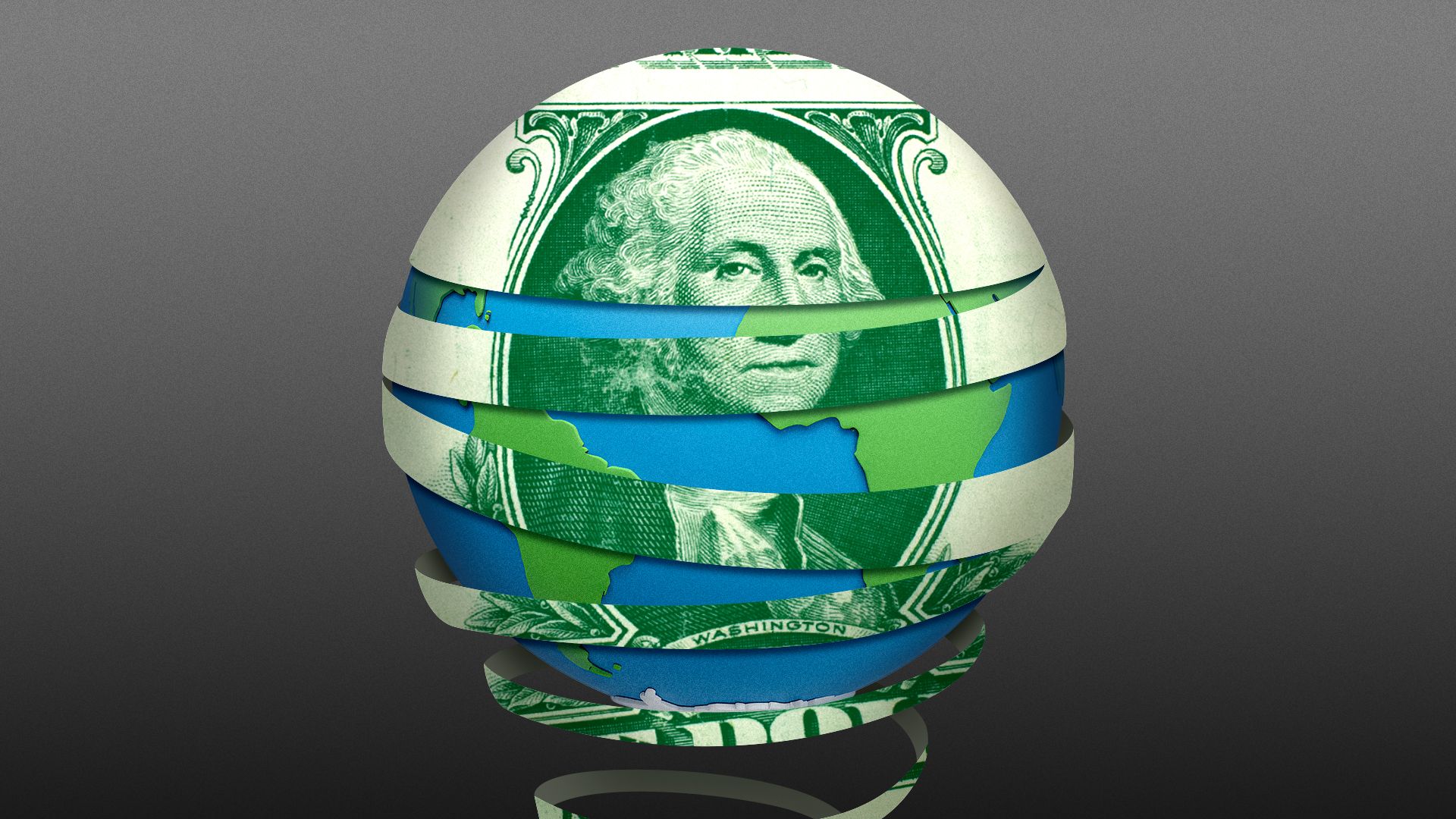
The U.S. dollar's role as the global reserve currency is increasingly at risk, as central banks and investors continue to see America prioritizing its interests, most recently in Venezuela.
Why it matters: It's an advantage to have the world's central banks keep their investments in your currency. Losing that would have broad implications for markets and the economy.
What they're saying: With the U.S. "very much doing whatever it wants…I think there's going to be a real push this year to for people to bring capital home," Jay Pelosky, founder of TPW Advisory, tells Axios.
- "In this environment, the U.S. is becoming less attractive," he adds.
- The seizure of Nicolás Maduro is the latest example of the America First focus of the Trump administration, a departure from the globalization that supported the U.S. dollar as the global reserve currency in the first place.
Catch up quick: Central banks are diversifying their holdings away from the dollar, in a move known as de-dollarization, which is also buoying alternative assets such as gold.
- The dollar has long been the go-to currency because of the dominance of the U.S. economy, the liquidity of its markets and trust in its institutions.
Threat level: Several factors have chipped away at that trust.
- The U.S. froze large portions of the central bank reserves in Russia after it invaded Ukraine and has increasingly used the dollar as a sanctions tool.
- Prolonged political and fiscal uncertainties, including tariff policy and debt-ceiling brinkmanship, have raised questions about policy predictability.
- In response, central banks around the world have gradually diversified and shifted some of their reserves into gold and other currencies.
- The U.S. dollar share of global foreign exchange reserves slipped to multidecade lows in 2025, with the dollar falling nearly 9%.
Reality check: The tech rally may have the opposite effect, luring investors to the states who want access to American AI goodness, notes Steve Englander, global head of G10 FX research at Standard Chartered.
- Those inflows into American equities would likely be dollar-positive, since foreign investors typically need to buy dollars to purchase U.S. stocks, and often do so without hedging against currency moves, increasing demand for the dollar.
The big picture: There are several important advantages to the U.S. maintaining its global reserve currency status.
- It lowers borrowing costs to run fiscal deficits and spending surpluses.
- It is a source of geopolitical power, enabling the U.S. to exert dominance over countries far from our shores without firing a shot.
- It helps American businesses, which can borrow and trade in their home currency with less risk of losing money due to fluctuations.
The bottom line: Economist Kenneth Rogoff emailed me to say Venezuela is "a clear win for the dollar's reserve currency status, but Trump has so many balls in the air, it is hard to know how important this will prove compared to say, undermining the rule of law and Fed independence (on the minus side) and advancing U.S. leadership in AI (on the plus side)."
- Nobody knows how this will play out. But the outcome is critical for the U.S. if it wants to continue enjoying its global reserve currency status.
2. The January effect in the market may be here
The stock market has a tradition of starting the year with a bang, especially for smaller companies. That pattern has a name: the January effect, which is already playing out this year with tech and the Russell 2000 index on a tear.
Why it matters: The first month of the year is viewed as an indicator of how the rest of the year will go for the market.
State of play: The January effect refers to the tendency for stocks, especially small caps, to outperform in January more often than in other months.
- The classic explanation is a mix of year-end tax-loss selling — when beaten-down stocks get dumped in December — and fresh inflows and rebalancing in early January that can lift riskier corners of the market.
- The Dow has already hit two record highs, and the Russell 2000, an index of smaller companies, is now up 3.2% year to date in 2026.
Between the lines: January has historically been more welcoming to cheaper and less-loved names than to the hottest market trends.
- But January hasn't been the strongest month for small caps in recent decades, Bank of America strategists have found, and January outperformance hasn't reliably predicted full year trends.
Reality check: In an era without much conviction, investors will grasp at anything for signals of meaning, and this January will be no different.
The bottom line: The January effect can be real enough to shape behavior, and there are historical patterns in what tends to outperform.
- But the best takeaway from the data is also the simplest: January is a month, not a forecast.
3. The Santa rally never came. That may be fine.


Stocks failed to rally in the final five trading days of the year and the first two of the new year, known as the Santa Claus rally by market technicians who monitor historic market patterns for clues about where stocks are going.
Why it matters: The Santa rally hasn't come for the last three years now. Stocks rallied for two of those years. Can it do the same this new year?
What they're saying: "If Santa doesn't make an appearance, the coming year has generally been underwhelming," Phil Segner, senior research analyst and co-portfolio manager at Leuthold Group, writes in a note.
- Still, he acknowledges that the Santa rally never came in 2024 and 2025, and both of those years saw double-digit market gains.
- Since 1972, the average historic gain in the S&P 500 over this time frame has been 1.15%. This holiday season, the index was down 0.4%.
What to watch: Stocks are trading positively so far this year. Will we be toasting gains next new year as well?
Got tips? Email me at [email protected]. I would love to hear from you about anything that may be of interest for our investor audience.
Thanks to Jeffrey Cane for editing and to Anjelica Tan for copy editing. See you tomorrow!
Sign up for Axios Markets