Axios Markets

August 22, 2022

1 big thing: Democratization is coming for private markets
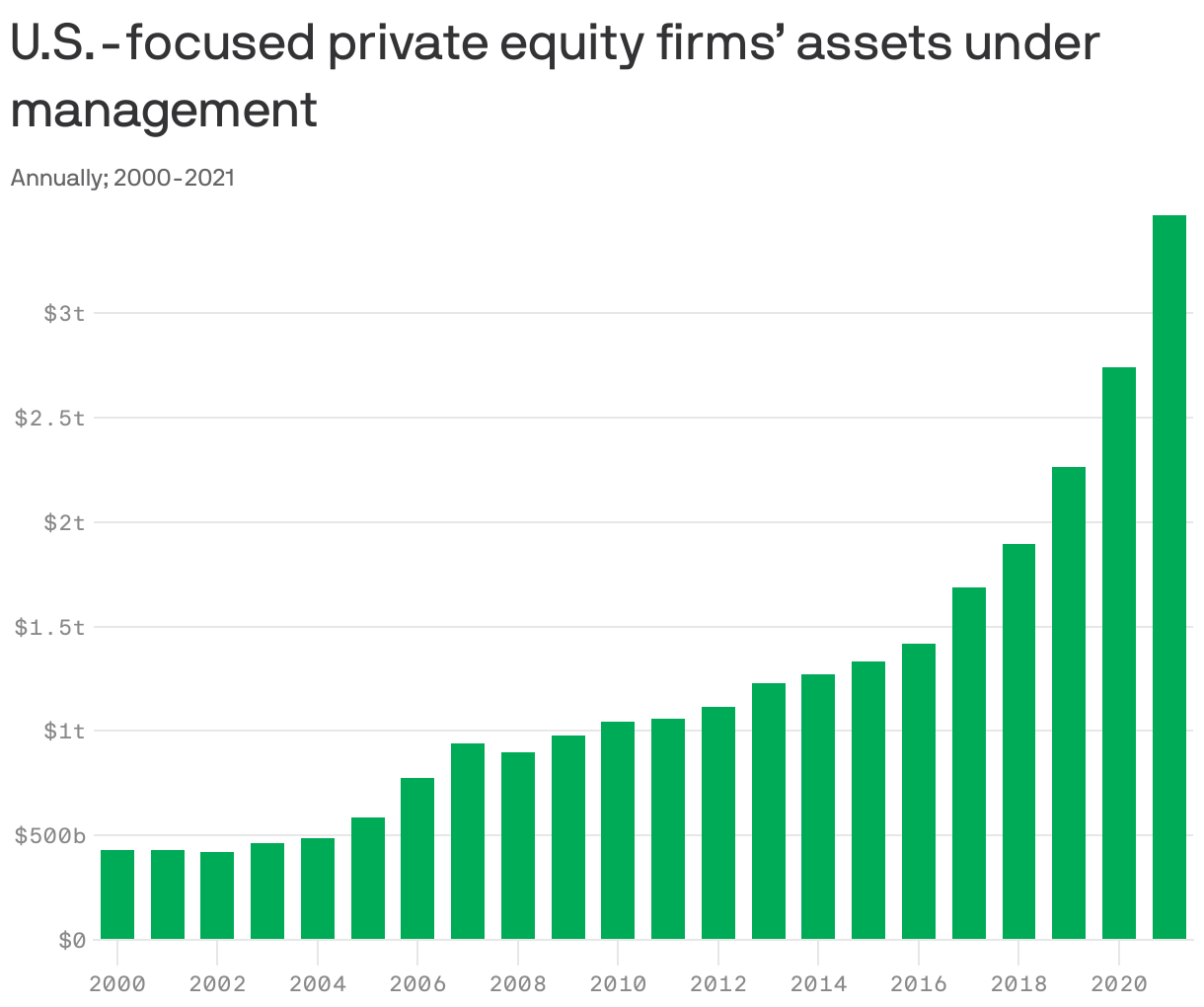
Trading stocks has gotten cheaper and easier in recent years — now something similar is happening in the once exclusive world of private equity, Axios' Kate Marino writes.
Why it matters: A majority of U.S. companies are private — and about a third of the benchmark S&P 500 index often consists of just 10 companies. Meanwhile, private equity assets under management have more than tripled since 2010 — putting even more midsize and growth companies outside the reach of public investors.
- Some PE firms rack up returns far in excess of the S&P, though the performance of the industry as a whole is hotly debated.
- The collapse of the traditional 60/40 portfolio this year has amplified the mainstream appeal of alternative assets, says Joan Solotar, who runs Blackstone's private wealth solutions business.
How it works: Private equity firms raise capital from institutions like pension funds and endowments, pool it together and buy companies — often purchasing them out of the hands of public shareholders.
- These firms usually aim to sell those companies at a profit a few years down the road and distribute the original money (plus gains) to investors.
The big picture: For most of private capital managers' history, their fundraising from individuals was focused on ultra-high net worth types who could write $15 million-plus checks at a time.
- That's now shifting in a big way, Jason Singer, partner and head of product innovation at Apollo Management, tells Axios.
State of play: Apollo manages a host of alternative assets, which includes private equity. It recently built out a team that helps serve individual investors — and that team has gone from a single-digit headcount to nearly 150 people in just the last year or so, he says.
By the numbers: Apollo raised an average of $1 billion annually from individual investors in 2018-2020 — and expects to lift that amount to around $15 billion per year through 2026.
- Meanwhile, at Blackstone, retail investors in 2018 represented $58 billion in assets under management, for 13% of total AUM. They're now $233 billion, and a 25% share.
These retail efforts so far have largely focused on real estate and credit strategies that have regular dividends or income streams.
- KKR has taken a similar approach — and sees it expanding. On its earnings call earlier this month, IR head Craig Larson said this about the firm's "democratized" products: "It feels to us like there’s real interest in expanding those opportunities into additional asset classes like [infrastructure] and PE."
The bottom line: “Even recently, we thought private equity reaching individual investors more broadly was a five to 10 year out trend," says Brenda Rainey, executive VP of Bain & Co.'s global private equity practice. "Based on the recent announcements of some of the large publicly traded firms, this could be in the next two years.”
2. Two PE trends to watch

Illustration: Sarah Grillo/Axios
3. Catch up quick
4. Last week was worst for stocks since early July


With a four-week winning streak ended last week, the market is a bit rudderless in the late August doldrums, Matt writes.
- The S&P 500's 1.2% drop last week, was its worst since the week ended July 1, when it tumbled 2.2%. It's down 11.3% for the year.
- The Nasdaq dropped 2% and is down 18.8% in 2022.
- The Russell 2000 declined by 2.1%, down 12.8%.
💭 Matt's thought bubble: Don't read too much into the meanderings of the market as the summer comes to a close. With corporate earnings season over and little top-shelf economic data due to give investors hard information, the markets can waffle around without providing much of a signal.
- For instance, Friday's market flop came amid the monthly expiration of options on S&P 500 futures contracts, a procedure that's known to add a bit of volatility as brokerage firms and traders settle contracts and close out positions.
Looking ahead: This week won't be much more active with key economic updates.
- We'll get a second take on Q2 GDP on Thursday, and an update on the Fed's preferred gauge of inflation on Friday.
- Also on Friday: Fed chair Jerome Powell is slated to deliver the keynote speech at the Fed's annual high-altitude gabfest in Jackson Hole, Wyoming.
5. Business economists give soft-landing the side-eye
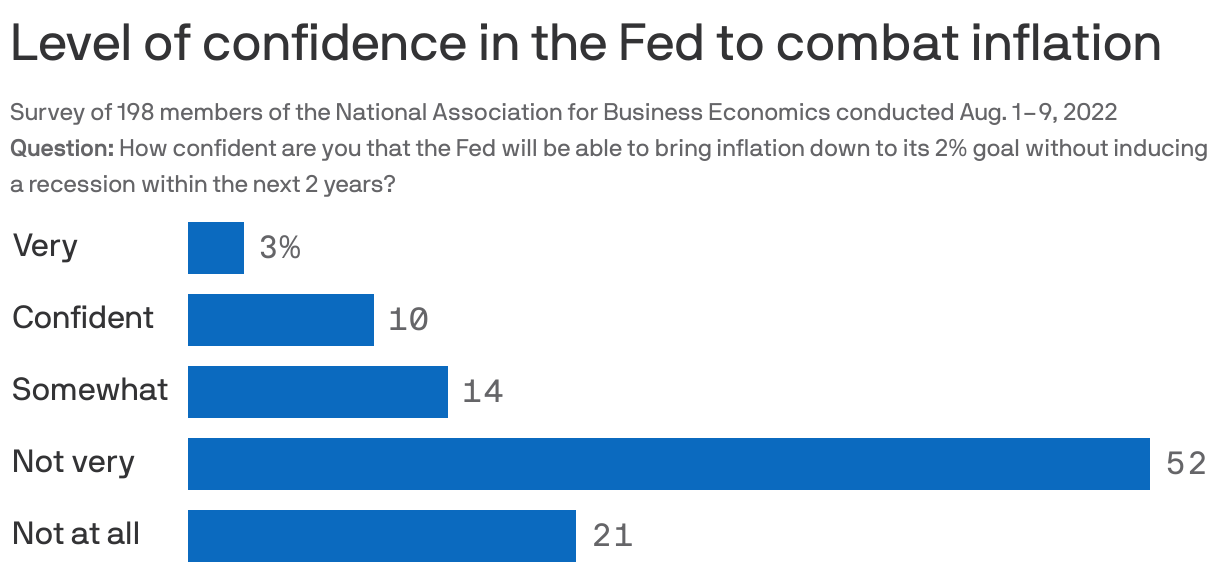
A new survey shows business economists are skeptical the Fed can bring inflation down to its target without sinking the economy, Matt writes.
Why it matters: The survey offers a bit of insight into the way the Fed's actions can affect the psychology of people who help make decisions in corporate America.
Driving the news: The numbers, published this morning, are from the National Association of Business Economists — a group of people who work largely for private-sector companies, rather than academia.
- Results show roughly three-quarters of respondents don't think the Fed could bring inflation down to its stated target of 2% without setting off a recession.
The impact: If private-sector economists are advising executives that a recession is likely around the corner, that could create something of a self-fulfilling prophecy, as executives delay new projects and investment, both of which make a recession more likely to come to pass.
Axios Markets

Stay on top of the latest market trends and economic insights