Axios Markets

July 17, 2024

Wednesday. Today's newsletter is 1,162 words, a 4.5-minute read.
1 big thing: ESG isn't going away
Surprise! Despite all the loud political rhetoric, ESG is still a central part of the dealmaking world.
Why it matters: Even as the practice of Environmental, Social and Governance investing comes under attack by conservatives, it has become standard practice for many corporate and private equity leaders to evaluate potential acquisitions along ESG lines.
Follow the money: Dealmakers and investors emphasize that their priority is making money — in other words, looking at ESG isn't about do-gooderism, it's about achieving strong financial performance.
- "We are focused on doing the right thing from a business imperative perspective," says Ken Mehlman, global head of public affairs at private equity giant KKR.
By the numbers: All 500 global business leaders surveyed by Deloitte this year said that they look at how their ESG profile would be affected by a potential acquisition or divestiture.
- 57% said they have defined metrics for evaluating ESG.
- Across a range of industries, leaders told Deloitte that they had walked away from an acquisition because of an ESG concern, including 80% in private equity, 70% in financial services, and 72% in consumer goods.
What they're saying: "While commercial or operational concerns are often the main reasons for walking away from a deal, ESG red flags are increasingly being considered with the same level of seriousness to either pause or end deal activity," Deloitte partner Brooke Thiessen writes in the report.
State of play: ESG is "is here and it's not going away," Adam Heltzer, head of ESG at Ares Management, tells Axios. As noisy as some voices are, "we've not seen huge impact on the ground."
- This has a lot to do with regulations, particularly in Europe.
- "The reality is that the companies that we invest in are still subject to a range of pressures that require them to think about ESG and how it gets reported, tracked and measured," says Heltzer.
KKR sometimes calls ESG "responsible investment."
- It could mean creating employee ownership programs, something that KKR is promoting, that give workers a stake in the company — and make it less likely they'll quit.
- Another core tenet for the firm is addressing "relevant climate-related risks and opportunities," as Mehlman writes in a recent investor note. Companies that reduce energy use, also reduce costs, he tells Axios.
The bottom line: As the initials ESG have become controversial, some shy away from using them.
- When Mehlman, a former chair of the Republican National Committee, talks to his investors he avoids acronyms and instead tries to explain how efforts around employee engagement or energy efficiency can "future proof companies."
- "No one has ever questioned these objectives — whether from red or blue states."
2. ESG investing continues to grow
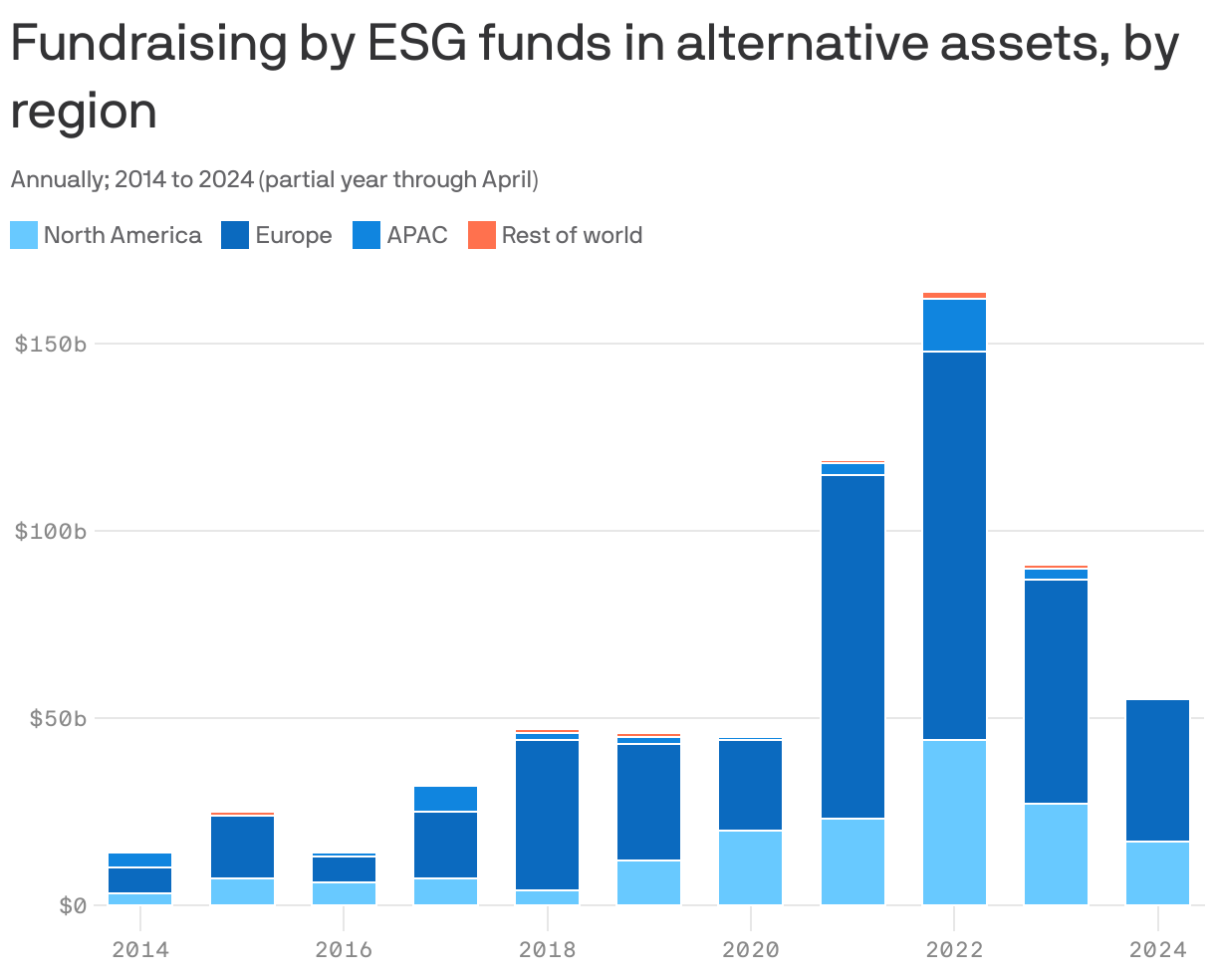
Beyond the ways in which private investors incorporate ESG into all of their investments, many of them also run dedicated ESG funds. Those have seen huge inflows in recent years — in stark contrast to the money flowing out of ESG mutual funds.
Why it matters: When money flows into private-capital vehicles like private equity, infrastructure, and venture capital, a significant proportion of that money ends up being directly invested into companies themselves, which then use it to turn their vision into a reality.
- By contrast, stock-market flows generally just get put to use by buying shares from already existing shareholders, and the company generally receives none of the money.
By the numbers: In the U.S., ESG stock-market funds saw $13.2 billion of outflows in 2023, and another $8.8 billion of outflows just in the first three months of 2024.
- In the world of alternative assets, however, U.S. firms raised $27 billion for ESG funds in 2023, and another $17 billion in the first four months of 2024.
- European firms raised even more — $98 billion in total over the 16 months.
The big picture: Investors are more likely to run dedicated ESG funds if they're European rather than American, and if they're institutional rather than retail.
Follow the money: ESG funds made up 21% of all alternative capital raised this year as of April.
- As of April, European limited partners make up 44% of all impact investors and 43% of all climate investors, while North American LPs represent 33% and 41%, respectively.
- This year, climate-focused funds have pulled ahead of impact funds both in terms of number of funds raised and total capital raised.
The bottom line: The money actively invested in ESG projects continues to increase, even as public-company ESG strategies run into political headwinds.
3. The PIK toggle is back!
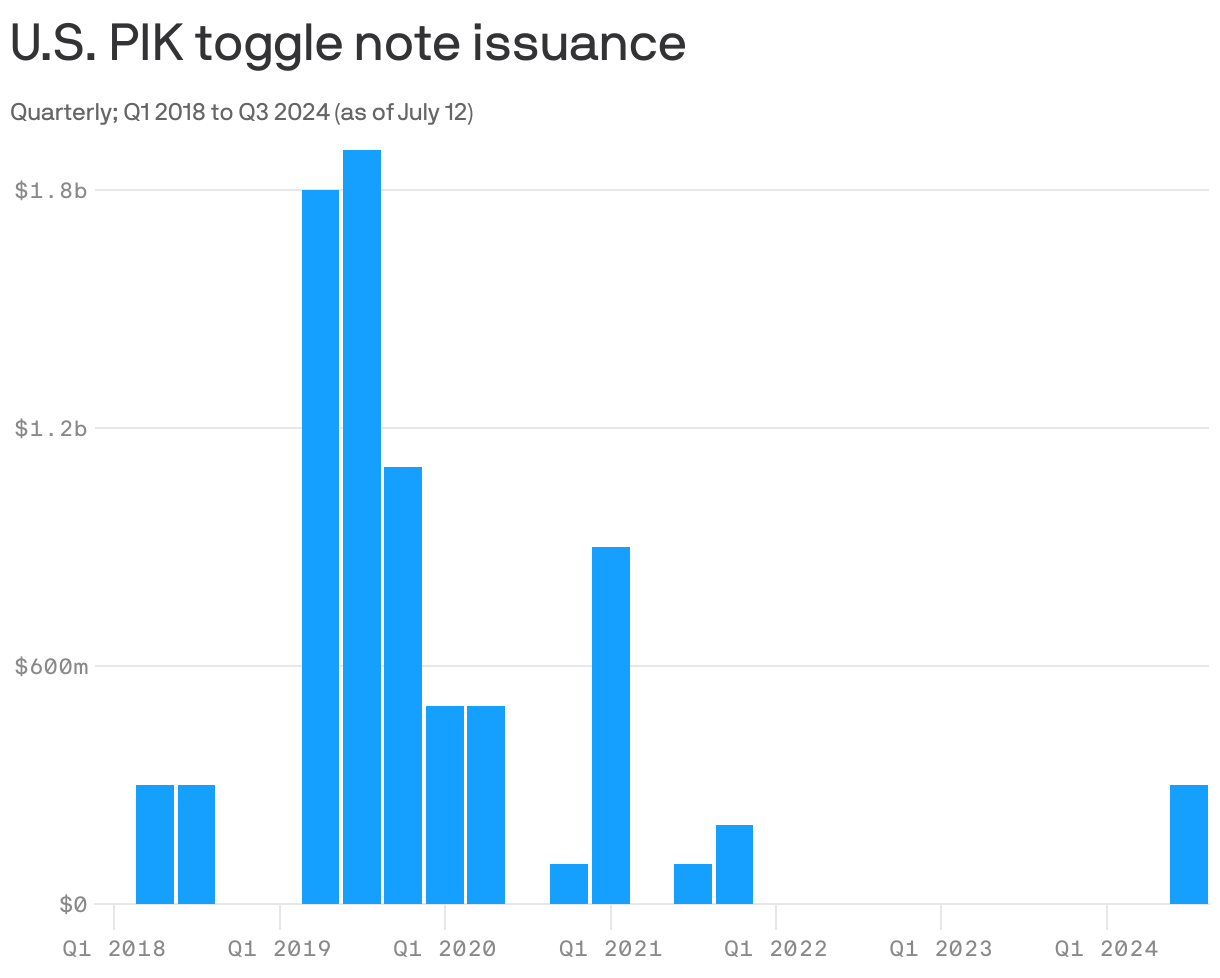
For the first time since the heady days of 2021, a company has issued a PIK toggle bond — which means if it can't make interest payments in cash, it can instead just give bondholders more bonds.
Why it matters: It's yet another sign of how frothy the credit markets are, despite the Fed's historic effort to tighten credit.
Driving the news: Calderys, a maker of heat-resistant clothes and casings, borrowed $300 million last week by issuing four-year bonds with an eye-popping 11.75% coupon.
- Because the bonds were issued at 98 cents on the dollar, their yield is actually 12.4%.
Between the lines: Calderys has to make a $17.6 million coupon payment on these bonds every six months. Alternatively, the company can issue $18.75 million of new bonds instead, and distribute them to bondholders in lieu of the cash payment.
- That option is known as payment-in-kind, or PIK. The ability to switch back and forth between PIK and cash makes these bonds known as PIK toggle.
- Calderys also has the option to buy back the bonds at 104 cents on the dollar in a year's time. If it does, that would represent an effective one-year yield for investors of 18.8%.
The bottom line: Risk-on, baby.
4. What we're reading: Trump meets Businessweek
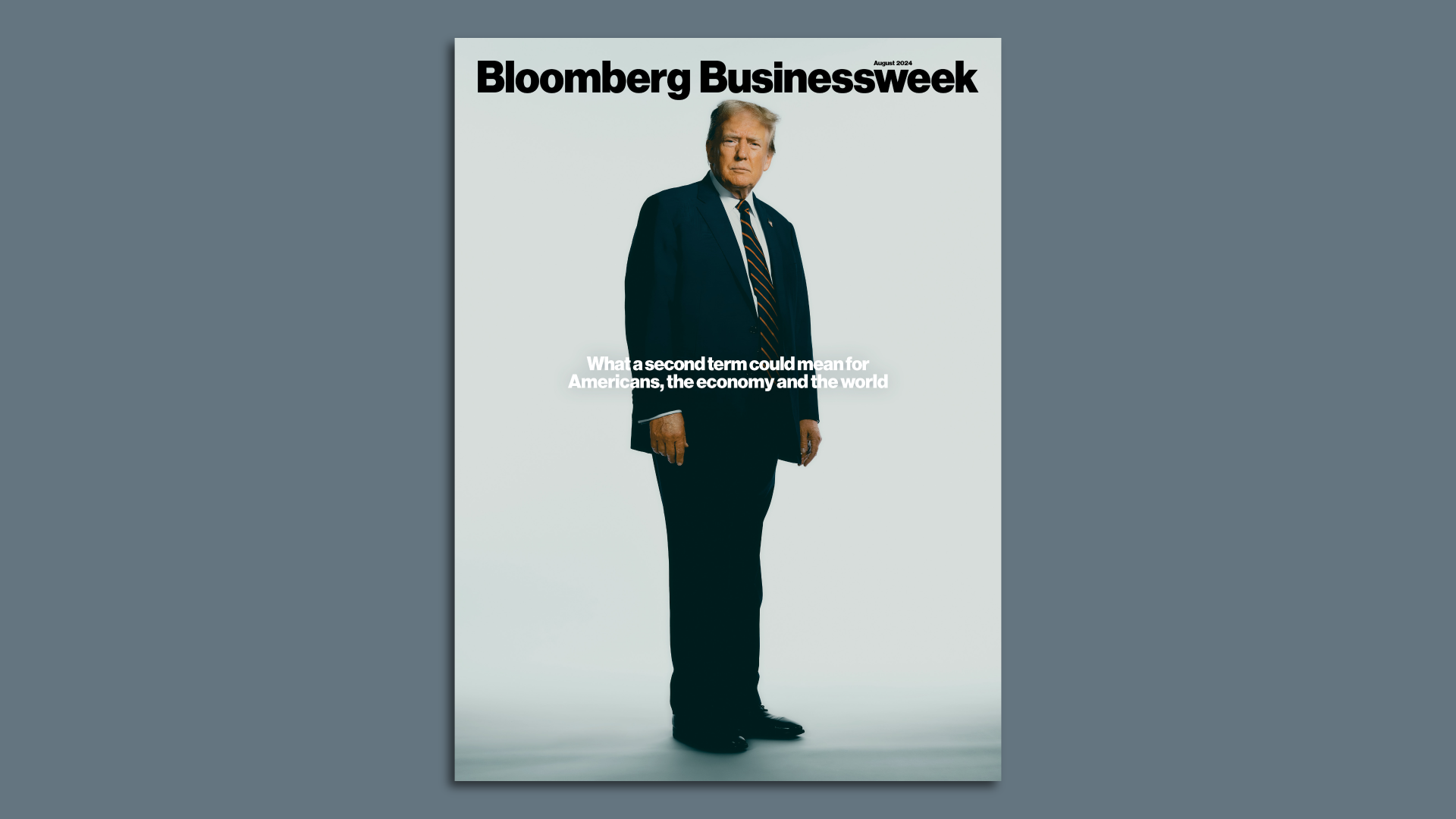
"Whoever's leading gets all the support they want. I could have the personality of a shrimp, and everybody would come."— Donald Trump, interviewed by Bloomberg Businessweek
Donald Trump is well aware of CEOs' desire to back whoever's likely to win the presidential election — which, right now, means himself.
Driving the news: He also, per a big new interview with Businessweek, says that:
- He will let Fed chair Jay Powell serve out his term;
- He would "consider" asking JPMorgan CEO Jamie Dimon to be his Treasury secretary;
- He would "love" to have Virginia governor Glenn Youngkin, formerly of the Carlyle Group, in his administration.
The big picture: Trump comes across in this interview as highly transactional.
- He is suspicious of Taiwan and the European Union, for instance, because he doesn't think the U.S. gets enough from them in return for their access to U.S. markets.
- Similarly, he wants TikTok to survive mainly because he wants to see more competition for Facebook.
- And he's now pro-crypto on the grounds that the alternative would be losing crypto dominance to some other country, possibly China.
The bottom line: In this interview, Trump comes across as very similar to the president we saw from 2017 to 2020 — if more obviously conversant with the levers of power and how to operate them.
Thanks to Kate Marino for editing this newsletter and to Mickey Meece for copy editing it.
Sign up for Axios Markets