
Axios Markets

September 13, 2022
🌅 Welcome back. We are so happy you're here. Let's go!
📺 Situational awareness: "Succession," the HBO drama that mirrors real-life sagas of media clans like the Murdochs, won an Emmy last night for best drama.
Today's newsletter is 1,054 words, a 4-minute read (and there's cat-related content if you read to the end).
1 big thing: The energy crisis revived coal

Illustration: Aïda Amer/Axios
Coal prices are soaring as the global energy crisis forces power providers worldwide to boost usage of the carbon-laden mineral, Matt writes.
Why it matters: A renewed embrace of coal represents a turnabout from the previous global focus on cutting emissions.
Driving the news: Coal prices around the world have reached new highs in recent weeks.
- Europe's benchmark coal futures price is up roughly 90% from last year to over $320 per metric ton.
- Australia's Newcastle coal, a benchmark for the Asian market, also hit a record of more than $450 per metric ton in recent days.
- U.S. coal prices are also hitting records of nearly $200 per short ton.
The big picture: For much of the last decade, dirt cheap natural gas prices and efforts to cut carbon emissions combined to drastically reduce the use of coal for power production.
- Now: The Ukraine war and a global drought are driving an unexpected uptake of coal.
Russia's complete cutoff of natural gas flows through its Nord Stream pipeline to Germany means more electricity will have to be generated with other fuels.
- Germany has restarted shuttered coal-fired power plants. Italy, Austria and the Netherlands have announced similar plans.
Meanwhile, drought conditions worldwide have also driven up demand for coal.
- In China, the world's largest coal consumer, drought has sharply reduced hydroelectric power production and boosted coal use.
- In France, the heat has left rivers too warm to properly cool its crucial fleet of nuclear plants, forcing a reduction in energy production, according to the Wall Street Journal.
- All that increased demand worldwide is helping to raise U.S. prices as well.
The impact: With production basically flat in recent years, the demand growth has generated a sizable price reaction.
- A July report from the International Energy Agency forecasts global coal consumption will rise 0.7% this year — and roughly match the all-time high for coal usage set in 2013.
What we're watching: Electricity-related carbon emissions over the coming year, as the uptick in coal usage will likely push them up from the record high level reached in 2021.
The bottom line: "That's the tradeoff that we face," says Harrison Fell, a professor of energy economics at North Carolina State University.
- "We have this alternative readily available source that's great for reliability, but at the cost of environmental outcomes."
3. Bonus chart: Global coal prices


3. What the holdouts want
Illustration: Sarah Grillo/Axios
Working conditions — more than pay demands — are holding up the resolution of a yearslong labor dispute between the nation's largest freight rail companies and their unions, Emily writes.
Why it matters: Their demands highlight how the pandemic deepened worker unrest. Beyond that, the possibility of a strike is now putting the nation's still recovering supply chain and economy at risk. A work stoppage would cost $2 billion a day, according to one estimate.
- "We were forced to work through this pandemic. We had no extra compensation for that. We had to work around the clock, potentially exposing ourselves and our family and friends to the virus," a machinist who works for BNSF in the Midwest tells Axios. (He declined to be identified, fearing retaliation from his employer.)
What's happening: The two largest unions, which represent about half of all the railway workers, are holding out for better terms. The other 10 unions (representing the other half) have signaled support for the current deal.
- Still, it's not clear if rank-and-file members, who still have to vote on the deal, would support it: "From what I see at the shop, it's an overwhelming 'no,'" says the machinist.
- While some close to the deal talks expressed optimism, others issued warnings: "I frankly think there's a high degree of likelihood that there is going to be a strike on Friday. And this will be unprecedented in our country's history," says one industry source, speaking on condition of anonymity as talks continue.
The holdouts: The Brotherhood of Locomotive Engineers and Trainmen, and The SMART Transportation Division say in statements that they need paid sick leave and better policies around work hours, before they sign onto the deal, according to a recent statement.
- Workers are penalized — even fired — for taking sick time or visiting the doctor, the unions said in a joint statement Sunday.
The other side: The industry emphasizes that workers have many ways to take off: "[A]ll railroads have policies designed to balance employees’ need to take time off with the need to maintain safe, ongoing operations," says the Association of American Railroads in a fact sheet about time off policy.
4. Minimum wage workers in 7 states are about to get a raise
Illustration: Brendan Lynch/Axios
Later this morning, we'll learn what inflation looked like in August when the CPI numbers are released. The data will be of particular importance to workers in seven states that peg minimum wage increases to the August-to-August percentage change in consumer prices, Emily writes.
Why it matters: 12 states and Washington, D.C., adjust their minimum wages based on inflation — a move that was of less consequence when inflation was minimal.
- Now: These kinds of adjustments have a real impact.
The states that adjust to today's numbers are Arizona, which has a current minimum wage of $12.80; Maine, ($12.75); Montana, ($9.20), Ohio, ($9.30), and South Dakota ($9.95)
- Vermont and Minnesota also index to the August number — but they cap increases to 5% and 2.5%, respectively.
- The raises will go into effect in January 2023. For more detail on how this works, check out the Economic Policy Institute's blog on the topic.
5. Watch for a holiday e-commerce surge
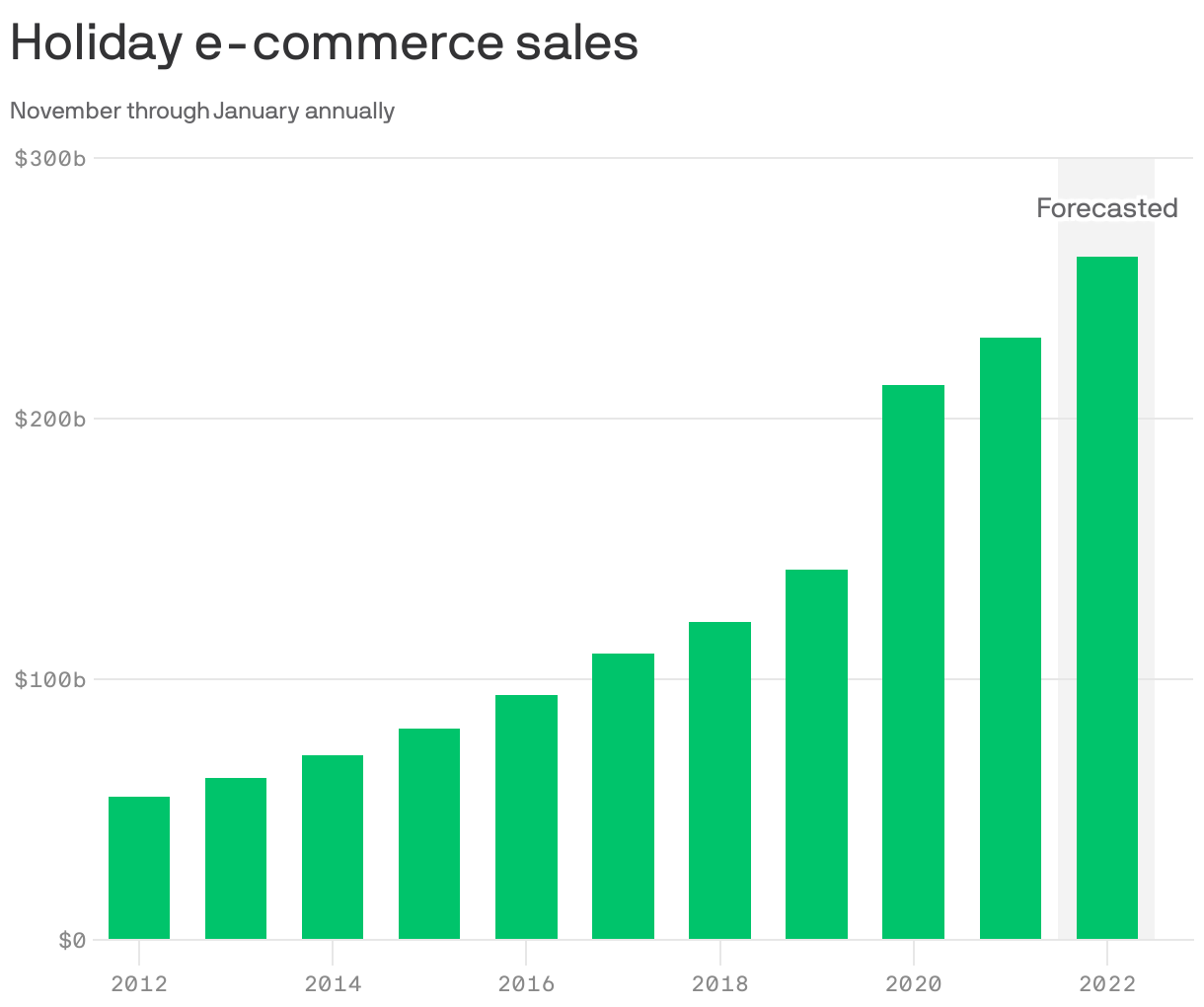
This holiday season, don’t look for e-commerce growth to slow down, Axios’ Kate Marino writes.
Driving the news: Economists at Deloitte forecast growth of 13.5% in e-commerce sales this holiday season, pushing sales up to $262 billion, according to a new report out this morning.
- That's an even bigger increase than last year when e-commerce grew 8.4% (2020 was the watershed year when online holiday sales jumped a whopping 50%).
The big picture: Online shopping was turbocharged by the pandemic, and it's one trend that's not going away.
- Worth noting: The expected e-commerce growth is in stark contrast to overall holiday sales, which Deloitte estimates will grow by a smaller 4%–6% — less than the current annual inflation rate (8.5%).
😻 1 thing Emily loves: Kitties! Yes, I am a cat person. (Don't @ me.) If you are also a friend to the felines, then I recommend: "Inside the Mind of a Cat," an extremely cute documentary on Netflix that will deepen your appreciation and even includes some tips on how to get cats to like you and train them.
This newsletter was edited by Kate Marino and copy edited by Mickey Meece.
Sign up for Axios Markets

Stay on top of the latest market trends and economic insights