Axios Markets

December 20, 2023

1 big thing: 📊 The economy grew


America's economic growth vastly outpaced expectations, Matt writes.
- Why it matters: The surprising pep in the economy helped keep corporate profits up and unemployment way down.
Between the lines: Even more surprising was the fact inflation slowed down sharply despite such robust GDP numbers — delivering (so far) the "soft landing" that economists once thought nearly impossible, and setting the stage for a strong recovery in the stock market.
2. 🏀 The big market rebound


The S&P 500 pulled off a near-total recovery from the interest rate-induced ugliness of 2022, Matt writes.
- The benchmark index is just 0.6% shy of a new all-time high. The 24% gain follows a 20% walloping last year.
The big picture: Besides being the repository for more than $35 trillion of investments from individuals and institutions, the stock market is traditionally a major driver of the overall mood of American consumers.
State of play: After an autumn stumble tied to a sharp upturn in Treasury yields, the market headed into Q4 with significant momentum.
- Behind the final surge: Wall Street came to believe first that the Fed's rate hikes were over — and more recently that significant cuts are on the way in 2024.
3. 🤖 AI goes boom


The AI boom arrived, embodied by chip giant Nvidia, Matt writes.
Why it matters: While much of the stock market's momentum was provided by expectations that rate hikes would soon end, excitement over artificial intelligence — stemming from the arrival of ChatGPT — offered investors a focal point for speculative excitement.
Zoom in: The poster child for the AI-oriented investor is chipmaker Nvidia, which is raking in massive profits right now by selling the silicon — essentially the picks and shovels of the AI gold rush — to those making big bets on the technology that may or may not eventually work out.
- Nvidia's profits have risen a ridiculous 1200%, and its market value has soared to more than $1.2 trillion.
The bottom line: A year ago, Nvidia had little name recognition outside the tech world — now, it's among the ranks of corporate giants like Apple, Alphabet and Amazon whose valuations dominate the U.S. stock market.
4. Egg price freakout


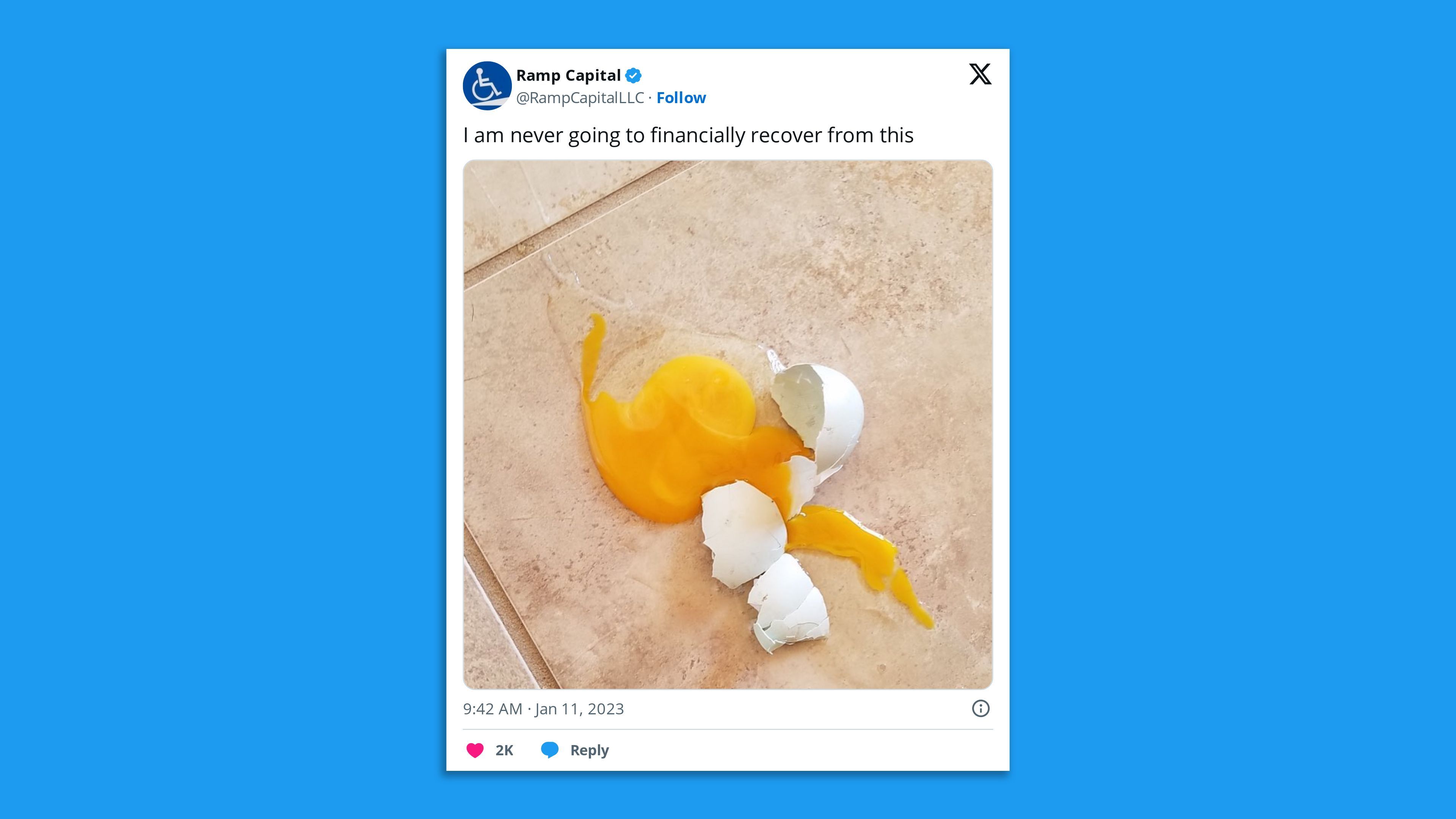
Egg prices peaked at $4.82 a dozen in January and then started, er, cracking, but falling prices for these staple ovoids didn't curb the Great American Egg Price Freakout of 2023, Emily writes.
Why it matters: That was the story of inflation this year. Yes, price growth slowed remarkably and no, people didn't quite notice — prices are still actually quite high.
- Also, the surge in egg prices, though undoubtedly painful for many, was just kind of entertaining — especially for beleaguered financial journalists hungry to cook up egg-cellent yolks, er jokes.
- Rising egg prices hatched some of the best inflation memes of our time — the potato industry even tried to make decorating Easter potatoes a thing. (C'mon. Stop.)
5. Home sales dried up


This was the year the housing market froze — some would argue it broke, Emily writes.
- With average rates on 30-year mortgages peaking at nearly 8% in October, home sales hit their lowest level since 2010 — when the U.S. was digging out of a real estate crash that broke the global economy.
The big picture: This time the story was all about rates. Not just the Fed's historic run of rate hikes, but the remarkable period of low and falling rates that preceded it.
- Most existing homeowners took advantage of those low rates — culminating in the fall of 2021 when you could get a 30-year mortgage for 2.8%!
- When rates started finally climbing again, those homeowners didn't want to sell, or couldn't afford to, since that would mean giving up their amazing mortgage.
The bottom line: With so little buying or selling happening — it's hard to get a clear picture of the housing market these days. Home prices haven't moved much — you'd expect them to fall, in a higher-rate environment.
The big question: If the Fed does start to cut rates next year, as many predict, will the market spring back to life?
- The NAR sees existing home sales rising 14% next year. The data on November sales will be out later this morning.
6. Don't forget the banking crisis


In case you've forgotten, we had a full-fledged banking crisis this year, Axios' Felix Salmon writes. Silicon Valley Bank, First Republic, Signature, Silvergate — all of them went to zero, amid real concerns about the solvency of the U.S. banking system.
Why it matters: The crisis seemingly dissipated as fast as it arrived, judging by the amount of emergency lending being done by the Fed.
Between the lines: A core function at any central bank is being the lender of last resort — "lending freely against good collateral at a penalty rate," in the immortal words of Walter Bagehot,
- The degree to which that's happening is a very good indication of the amount of stress in the banking system.
- The Fed's discount window is its main way of lending to creditworthy banks during a crisis — and those crises often coincide with recessions.
By the numbers: The amount the Fed lent out in discount window primary credit peaked at $111 billion in October 2008, during the global financial crisis, and then again at $51 billion in March 2020, at the height of COVID-19 panic.
- In March 2023, this year's banking crisis exceeded both previous peaks, topping out at $153 billion.
- Notably, however, there was no recession, and the crisis rapidly dissipated, partly thanks to the Fed.
💭 Felix's thought bubble: The crisis was partially caused by Fed actions, at least insofar as rapidly rising yields caused the value of banks' bond and loan portfolios — their assets — to plunge. But the crisis was also successfully contained by the Fed.
Axios Markets

Stay on top of the latest market trends and economic insights