Axios Markets

October 29, 2026


1 big thing: Stress shows up


There's trouble brewing in the leveraged loan market: The share of these loans trading at distressed levels has more than doubled since last year, and a lot of pain is showing up inside software companies dealing with the threat of AI.
Why it matters: When the economy sneezes, companies that have borrowed loads of money can get really sick — the rise in distress is a sign that more of them are at risk of defaulting on their loans.
How it works: The leveraged loan market is where investors trade loans made to heavily indebted companies with weak credit ratings.
- These are typically private equity-backed companies.
The big picture: Years of higher interest rates, including the increase this year, and rising economic uncertainty are weighing heavily.
- Many of these companies loaded up on debt during the zero-interest-rate era — ZIRP! — when borrowing was cheap, per a note this week from Corry Short, a credit strategist at Barclays.
By the numbers: $131 billion of loans in Morningstar's Leveraged Loan Index were priced below 80 cents on the dollar — a common threshold for distress, according to a new analysis from PitchBook. That's the most since May 2020, when the market was recovering from a pandemic sell-off.
- Put another way, 8.3% of all outstanding loans, by dollar value, are in the distressed bucket — up from 4.3% at the end of last year and 3.4% a year ago.
Yes, but: The level of distress is still well below where it was in 2020 and in the financial crisis of 2008.
How it works: Most leveraged loans have floating rates, meaning that when interest rates go up, borrowers are on the hook to pay more.
- Companies have had to devote more of their earnings to simply paying interest as rates have risen, says Marina Lukatsky, global head of research, credit and U.S. private equity at PitchBook.
- And the cost to refinance existing loans is also rising.
The intrigue: An increasing number of companies are doing restructuring deals to avoid bankruptcy — so-called liability management exercises.
- These can often turn out lousy for lenders — and investors are now pricing in that risk, per the Barclays note.
What to watch: It could get worse. Some 53% of distressed loan volume is set to mature in the next three years, per PitchBook — that means these companies will need to refinance.
- "It's a significant risk in our view," Lukatsky says.
Zoom in: This isn't just about interest rates — some heavily indebted companies are facing existential threats to their business models, particularly in the software sector.
- 32% of distressed loans are in the software sector, even though they make up just 12% of the index.
- The trading prices of loans made to software companies declined sharply earlier this year during the so-called SaaSpocalypse — when investors started worrying about AI's existential threat to the business.
- The stock market might have memory-holed that concern, as we've reported, but the credit market has a more elephant-like recall.
Stunning stat: 84% of stressed software companies are backed by private equity, per PitchBook.
- These businesses generally carry more debt and have less in the way of earnings to cushion interest rate increases than their publicly traded counterparts.
The bottom line: Companies that borrowed a lot when money was cheap are now paying the price.
2. Big Tech's AI flex gets mixed reviews
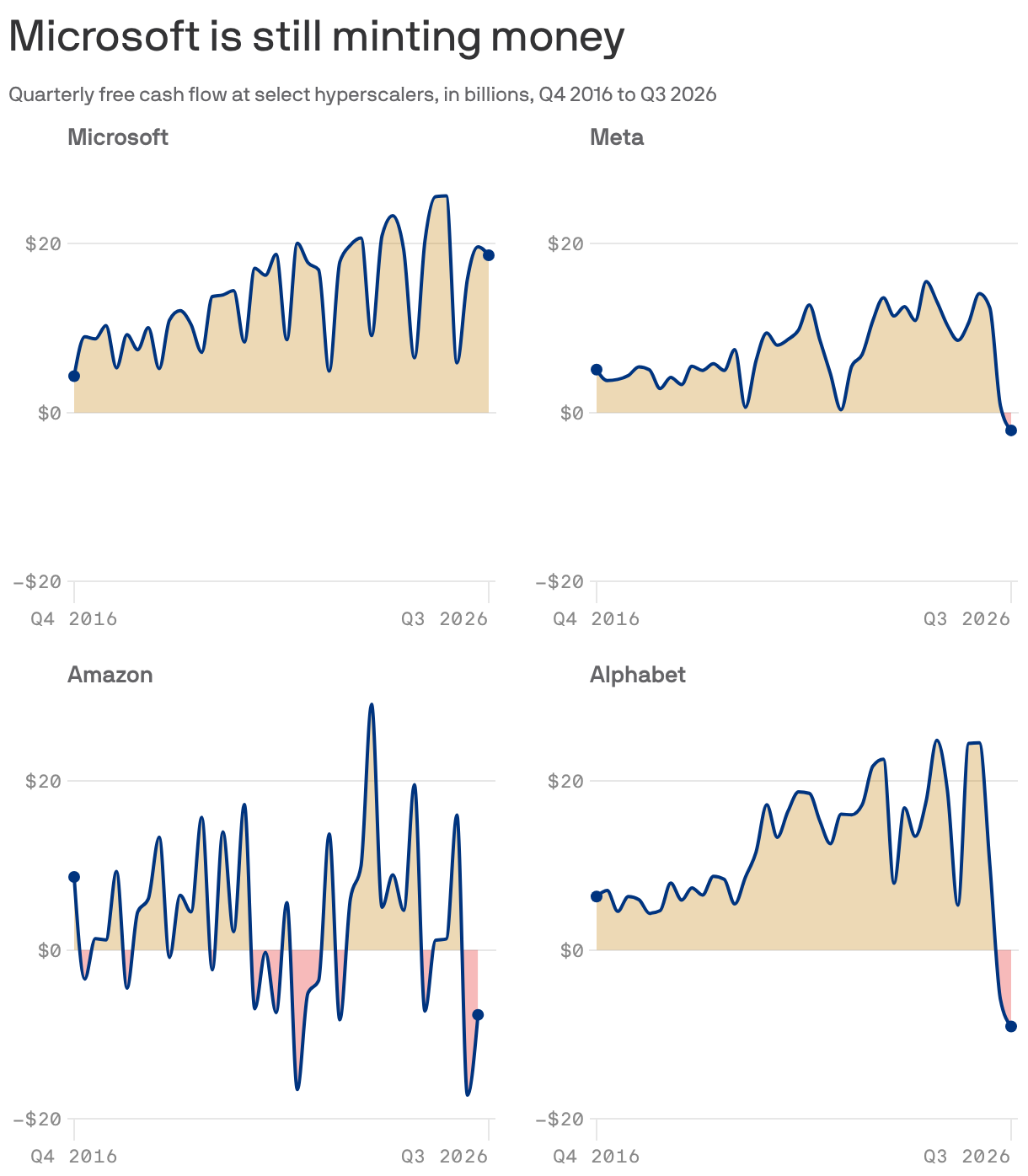
If you're making big bets on AI, you better have the revenue and cash flows to back it up.
The big picture: Starkly different market reactions to quarterly results from Microsoft and Google parent Alphabet illustrate the attributes that investors appear to be valuing at the moment.
The latest: Microsoft shares surged after hours yesterday as sales and earnings per share for the quarter that ended Sept. 30 both beat analyst expectations.
- Quarterly free cash flow — a key measure of the company's ability to continue pouring money into AI investments without consuming all its own cash — declined about 27% from the prior year to $18.63 billion.
- But that was better than the $7.99 billion expected by analysts, according to FactSet.
- Most importantly, it's still very much in positive territory, unlike other hyperscalers.
Alphabet, however, reported quarterly revenue that fell slightly short of expectations, as did its earnings per share.
- What's more, its free cash flow was even worse than expected at negative $9.1 billion. (Wall Street analysts expected negative $2.23 billion in free cash flow, according to FactSet.)
- Its shares tumbled 11% after hours.
The bottom line: The markets don't seem to mind big AI bets if revenues come through and if capital expenditure doesn't consume all the company's operational cash flow.
- But the results from Alphabet — once one of the greatest cash-producing entities in history — suggest that it is getting increasingly difficult to do.
3. Charted: Hyperscaler cash grab


The hyperscalers — Alphabet, Amazon, Meta, Microsoft and Oracle — have raised $326 billion so far this year in their race to dominate the AI space by issuing new stock and bonds, per data compiled by S&P Global Market Intelligence.
Why it matters: It's a ton of dough — more than three times as much as in 2025, which was already a record year.
Zoom in: Meta is still going — earlier this week, the company said it planned on issuing up to nearly $100 billion more in equity through the first quarter of next year.
Yes, but: Oracle, on the other hand, appears to be slowing its roll. Yesterday it told investors that it expects capital spending to peak over the next two fiscal years and that it would limit additional fundraising to $20 billion through 2030.
Axios Markets