Axios Markets

June 16, 2025

☕️ Welcome back to the week. Today we're digging into the increasingly tense intersection of immigration enforcement and the labor market: The scare that is also shaking white-collar employers, the real numbers on student visas, and how companies are now messaging the moment.
All in 1,150 words, a 4-minute read.
1 big thing: Immigration crackdown hits offices
The aggressive immigration crackdown by the Trump administration is striking fear not only among blue-collar laborers, but inside the country's white-collar offices, too.
Why it matters: Companies are making hard decisions about whether to spend time and money fighting to keep staff or fire them.
- Some multinationals are even outsourcing jobs to other countries.
Where it stands: Companies are reluctant to talk publicly about immigration, but lawyers and HR consultants are fielding calls for help from employers with immigration anxieties regarding their professional employees.
- For the first time in her 20 years of advising white-collar employers on immigration law, clients are now asking, "'What do we do if there's an ICE raid?'" says Lori Geisinger, senior counsel at law firm OGC.
- Her typical clients employ those with at least a Bachelor's degree in professional fields such as IT and medicine.
Friction point: White-collar employers are perhaps most nervous about those who have work authorization under humanitarian programs — temporary protected status, asylum or parole — now under fire from the White House.
- These might include people from countries like Venezuela, Afghanistan, Ukraine or Haiti. "Even if they're legal today, they don't know if they're going to be legal tomorrow," says Jina Krause-Vilmar, CEO of Upwardly Global, a nonprofit that offers career assistance to immigrants.
Yes, but: Over the weekend, the Trump administration shifted tactics. Bowing to pressure from businesses, the White House paused raids and arrests of those working at hotels, farms, meatpacking plants and restaurants, suggesting the fervor of the past few weeks may not be sustainable.
- Those exclusions aside, however, Trump late last night ordered ICE to increase its deportation efforts in large Democratic-run cities.
By the numbers: There are about 8.5 million undocumented workers in the U.S., according to an estimate, soon to be published, provided by Matthew Lisiecki, senior researcher and policy analyst at the Center for Migration Studies.
- "There's a fairly high share of undocumented workers in fast-growing occupations like data scientists and software developers," he says.
State of play: Many firms are now undertaking I-9 audits to make sure their workers are authorized.
- "Employers are scrambling to figure out who they can employ because one of their obligations is to verify someone if their employment authorization is ending," says Daniel Pierce, an immigration lawyer at Fragomen.
Zoom in: Some companies are proactively trying to help employees obtain green cards or other work authorizations. Others are letting people go, a process that observers say could accelerate in the coming months.
- There are also costs to consider. "I have to have hard conversations with clients, about how much they want to spend to keep people here, and whether they can find a U.S. worker to replace them," Geisinger says.
Zoom out: The goal of these restrictive immigration policies is ostensibly to funnel more jobs to U.S. citizens.
- But in many industries there simply aren't enough qualified native-born workers to employ. As the population ages, it's a situation that will only intensify.
- Instead of hiring Americans, some multinationals with offices outside the U.S. are just hiring more workers overseas, says Krause-Vilmar. "The reality is this is not good for America. It's in our national interest to keep jobs here."
The bottom line: Add immigration uncertainty to the list of known unknowns that U.S. companies are now handling.
2. Companies are silent amid raids and protests
Immigration and Customs Enforcement raids in Los Angeles County have led to public unrest, with Home Depot and Waymo as the backdrop.
Why it matters: Corporate America's muted reaction is in stark contrast with the way it responded to protests during the first Trump administration.
What they're saying: Home Depot directed questions to ICE and declined to expand when asked how the retail giant is supporting stores, employees and customers.
- Waymo suspended service in Los Angeles. A spokesperson told Axios that "safety is our highest priority…both for people who choose to ride with us and with whom we share the streets. We are in touch with law enforcement and will retrieve our vehicles at the appropriate time."
Between the lines: Trump's 2017 immigration policies and travel bans prompted many CEOs to take a political stance. Now, however, corporate America has recalibrated to strategic silence.
Yes, but: Moments arise when companies should be prepared to comment. They must have a plan in place, says Paul Argenti, a professor of corporate communications at Dartmouth's Tuck School of Business.
- "If you think about it conceptually, what is in it for a company to go up against Donald Trump?" he says. "Zero, nothing…unless it's an issue connected to you directly or there is a strategic need to comment."
- It's an example of why all corporate communications teams need to anticipate being dragged into societal or political matters, he adds.
The big picture: Despite a penchant for silence, stakeholders expect business leaders to engage on matters that affect employees, customers or the business.
- 69% of business leaders say they feel pressure from employees to engage on immigration policies, a recent Axios Communicators Pro-Gravity Research survey found.
- 31% say they feel pressure from policymakers, while 15% say shareholders and customers demand engagement on the issue.
What we're watching: The reaction to ongoing "deportation wars" could signal corporate America's appetite for wading into political crosshairs. It's either the moment companies begin to engage or continue to retreat.
3. Foreign students out-earn native-born peers
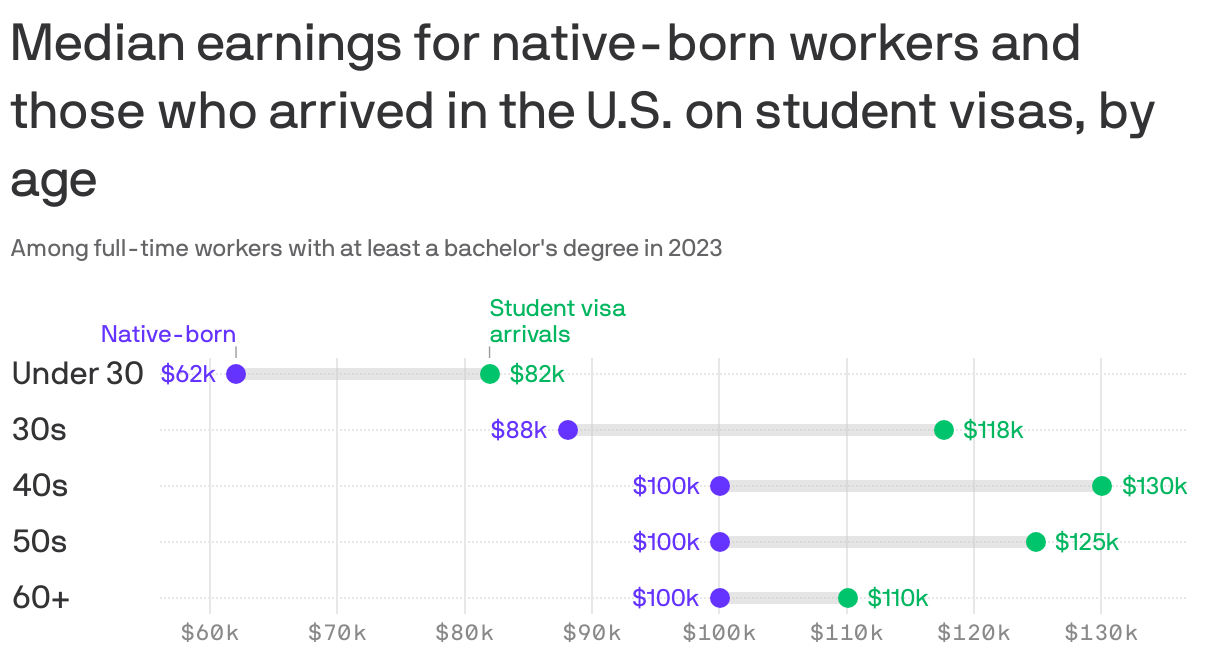
Workers with college degrees who come to the U.S. on student visas out-earn their native-born peers, but also do more of the research and development work critical to the economy, per a new analysis of data from the National Survey of College Graduates.
Why it matters: The Trump administration is using student visas as both policy tool and negotiating leverage on trade, potentially forcing a sharp decline in the number of foreign students in coming years.
By the numbers: As of 2023, there were about 2.1 million year-round full-time workers in the U.S. with Bachelor's degrees who first came here on a student visa, according to the Economic Innovation Group, which did the research.
- They earned a median salary of $115,000, compared with an $87,000 median for native-born workers with at least a college degree.
- The salary gap holds firm across age groups, the analysis finds.
The intrigue: 27% of those who came here on student visas are engaged in research and development work, compared with 12% of native-born workers, a sign of how critical students from outside the U.S. are to innovation.
- "Further impeding international students' ability to stay and work after graduation would be a major blow to the United States' R&D ecosystem," according to the report.
Zoom out: "The story here is that people who come here on student visas are very talented and ambitious and hardworking," Connor O'Brien, research and policy analyst at Economic Innovation Group, tells Axios. "They offer skills that employers are willing to pay a premium for."
- "It doesn't necessarily say anything about the skills or those qualities of native workers," he adds.
Thanks to Ben Berkowitz for editing and Anjelica Tan for copy editing. See you tomorrow!
Sign up for Axios Markets