Axios Markets

April 11, 2025

🙏 The week, we assure you, is almost over. But first, let's talk about China and trade wars, where the U.S. could really use a friend or two.
- Plus: What happens when foreign investors lose their U.S. nerve, and the volatility that's overtaken the markets.
📉 Situational awareness: After U.S. markets sold off yesterday, things are calmly lower this morning. Japan's Nikkei fell 3% overnight, and European indices are 1% to 2% lower. U.S. stock futures are down 0.5%.
- U.S. 10-year Treasury bonds, closely watch by the White House, surged as high as 4.488% overnight but came down to around 4.411% this morning.
All in 1,430 words, a 5-minute read.
1 big thing: How to fight a trade war
To fight a trade war against China, most foreign policy experts would say that you need allies.
Why it matters: Over the past few months, the White House has antagonized pretty much all its friends on the global stage, making it that much harder to carry out what is now a full-blown tariff battle with China.
The big picture: China is a formidable economic force, the second-largest economy in the world, with significant resources like a vast labor supply, manufacturing heft, a growing electric vehicle industry and expanding military might.
- "On critical metrics, China has already outmatched the United States," write the authors of a sobering new piece in Foreign Affairs.
Zoom in: The best shot the U.S. has at holding its economic edge is in forging partnerships, Kurt Campbell and Rush Doshi write: "China possesses scale, and the United States does not — at least not by itself."
- "Because its only viable path lies in coalition with others, Washington would be particularly unwise to go it alone in a complex global competition."
The intrigue: The authors, who both worked on foreign affairs in the Biden administration, wrote the piece before "Liberation Day."
- But we "kind of saw that coming," Doshi, now a professor at Georgetown University and director of the China Strategy Initiative at the Council of Foreign Relations, tells Axios.
Zoom in: Such a coalition would go beyond the traditional post-Cold War frame of the U.S. playing a protector role. This would be more about forging economic partnerships.
- "I'm talking about us all getting together with our allies, putting tariffs or regulatory barriers up together to protect our industries from China's massive export capacity," Doshi says.
- "Ideally the U.S. would lower barriers between its allies, to put market share together so that our companies have a bigger playing field."
But right now, U.S. allies have the tariffs of Damocles hanging over their heads, says Wendy Edelberg, a senior fellow in economic studies at the Brookings Institution.
- On Wednesday, President Trump announced a 90-day pause on his "reciprocal" tariffs, and it's not the kind of pause that refreshes.
- "It's not like other countries know for certain that they even have a reprieve," Edelberg says.
By the numbers: U.S. tariffs on China now average 134.7%, per a calculation from the Peterson Institute for International Economics.
- China's been retaliating, this morning raising tariffs on U.S. goods even more to 125%. It could end very badly, though many expect some kind of deal or postponement.
- "At current tariff levels, U.S. exports to China are no longer marketable," China's tariff commission said in a statement quoted this morning in the Wall Street Journal. The statement adds that China will "fight" if the U.S. persists in harming its interests.
Yes, but: "We can put America first and work with other countries at the same time," a White House official tells Axios. "The U.S. is not acting alone in acting on China's unfair trading practices."
Flashback: The trade war with China during the first Trump administration ended with an agreement. Among other things, China said it would buy $200 billion worth of American imports.
- That didn't happen. Partly, the coronavirus pandemic got in the way, but other factors were also at play.
- "Today the only undisputed 'historical' aspect of that agreement is its failure," Chad Bown wrote in a 2022 piece for the Peterson Institute.
Reality check: The current Chinese economy is in a bad place. Consumer prices declined for the second month in a row, per data out Wednesday, a worrying sign that deflation might be setting in. Unemployment is rising.
- A trade war with its biggest foreign trading partner is only going to add to its woes.
- Still, Chinese leaders believe their country is better able to withstand the fight, Han Lin, the Asia Group China country director in Shanghai, said on BBC Business Matters on Wednesday.
The bottom line: "They believe they could endure pain longer than the U.S. could. Of course, we'll see that thesis tested over the next several months."
2. When the world sells America
When the rest of the world no longer finds U.S. assets attractive, it starts selling, not over a matter of days but over years.
Why it matters: That's why the falls we've seen in the stock and bond markets, as well as the dollar, could be the start of a long-term trend.
The big picture: What we're seeing in 2025 is setting itself up to be the Reagan revolution in reverse, says David Rolley, a portfolio manager at Loomis Sayles.
- President Reagan stimulated the economy with tax cuts, which attracted foreign investors who were broadly underweight the U.S. at the time.
- President Trump, by contrast, unveiled a massive tax hike (tariffs are taxes paid by U.S. importers), while foreign investors are now overweight in U.S. assets in the wake of a decades-long bull market in both bonds and stocks.
Follow the money: In 2024, foreigners owned 17.8% of the shares traded on U.S. stock markets, per the Federal Reserve, an investment of $16.5 trillion.
- Compare that to 1980, when foreign shareholdings came to just $75 billion, or a mere 5% of the total market. Overall, foreign holdings of U.S. financial assets rose from 7.9% of the total in 1980 to 14.9% in 2024.
Between the lines: Historically, America's greatest export has been its debt.
- U.S. corporations, alongside the U.S. Treasury, issue trillions of dollars of debt every year, much of which is snapped up by foreign investors at very attractive rates to the borrowers.
- That money is invested in the U.S. economy, where it generates returns far greater than the cost of servicing the debt. That is one of the main reasons the U.S. economy has outperformed the rest of the developed world over many decades.
- Economists call that flow of money into America the "capital account surplus." It's the mirror image of the trade deficit. If our trade deficit falls, our ability to get the rest of the world to finance our growth will also fall.
How it works: Most of the time, tariffs tend to result in a stronger currency, as Emily has explained, a result of fewer dollars being sold to buy foreign goods.
- Those trade flows, however, are much smaller than portfolio flows. So if international investors lose faith in the U.S., sell their American financial assets, and convert those dollars back to their local currency, the effect of that could easily dwarf the effects of tariffs.
The bottom line: If the rest of the world loses faith in the U.S. as an attractive place to invest, that will drive down stock prices and the dollar, and drive up interest rates, including mortgage rates.
3. Bring on the noise

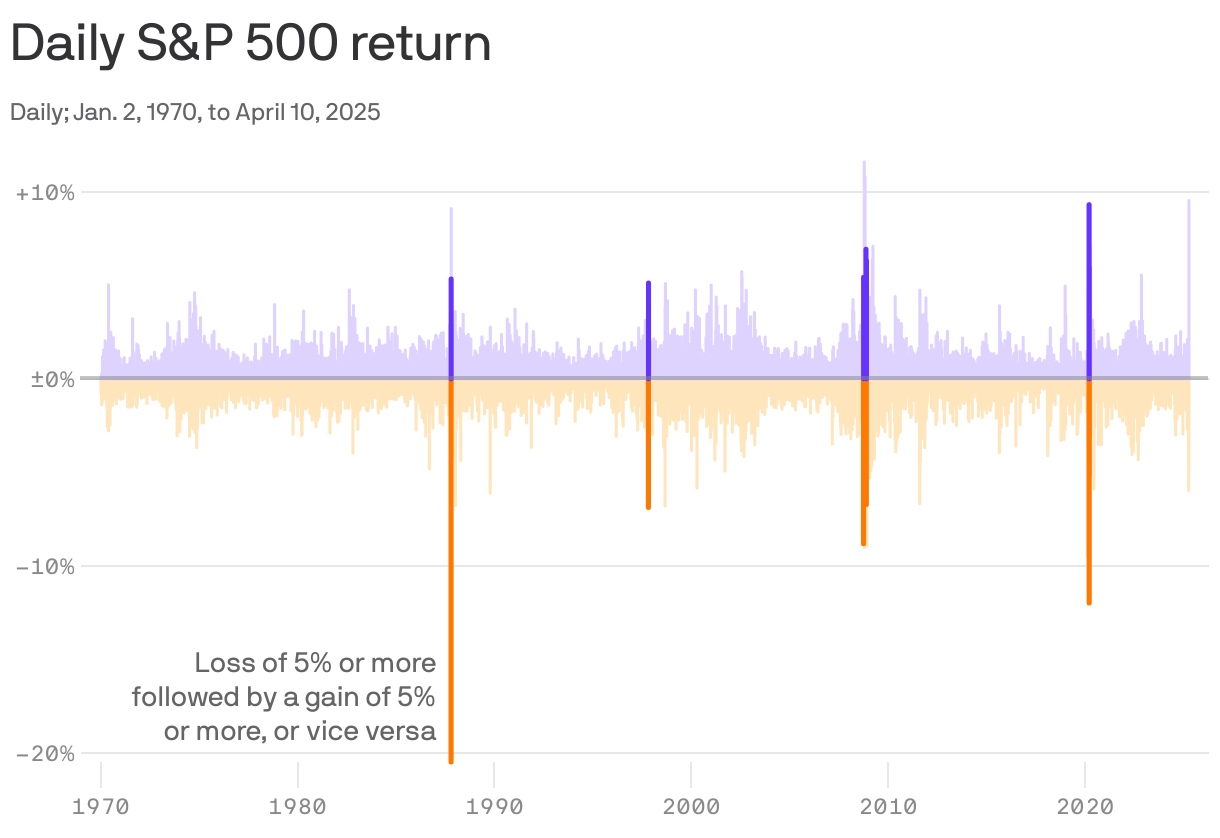
We've now had more than a week of stock market gyrations grabbing headlines, and there's no end in sight.
Why it matters: As Interactive Brokers strategist Steve Sosnick says, "volatility breeds volatility."
Where it stands: Investors simply can't work out what stocks are worth in a world dominated by Trump's trade war. A quick recap might be in order:
- Thursday, April 3: Stocks reacted to the "Liberation Day" tariffs by opening down 3.1%. At their lows for the day losses reached 4.9%, a big move, but understandable given the magnitude of the news.
- Friday, April 4: Stocks dropped another 6%, over and above their losses the previous day.
- Monday, April 7: Stocks continued to fall early but then surged 8.5% on a curiously prescient yet apparently false headline about National Economic Council director Kevin Hassett. Then they fell back down.
- Tuesday, April 8: With nothing solid to anchor to, stocks dropped 6.8% from the intraday high to the intraday low.
- Wednesday, April 9: Stocks closed up 9.5% in the wake of Trump pausing most reciprocal tariffs and narrowing his focus onto China.
- Thursday, April 10: Stocks fell as much as 6.3% from the previous close, for reasons of a market nature.
TLDR: The quietest day in the markets was actually the day right after the big Rose Garden announcement.
Between the lines: Most observers believe at least in some weak version of the efficient markets hypothesis, where stock prices represent the wisdom of the crowds in terms of how much companies are worth.
- As such, they assume that stock prices move in reaction to new news, and that a large movement in stocks means something important has changed in the world.
- In a world of radical uncertainty, however, stocks can move huge amounts for no particular reason at all. Especially in down markets, rallies are often "short, sharp, and ferocious," per Sosnick.
The bottom line: This market is heaven for volatility junkies.
Thanks to Ben Berkowitz for editing and Anjelica Tan for copy editing. See you next week!
Sign up for Axios Markets