Axios Markets

March 04, 2022
๐ท๐ฉ๐ฝโโ๏ธ๐ผ It's jobs Friday! When the employment report drops in an hour, Wall Street expects to see that 400,000 new gigs were created in February. Think they're right? Email us your guesses at [email protected].
Today's newsletter is 1,119 words, 4.5 minutes.
1 big thing: Domino effects
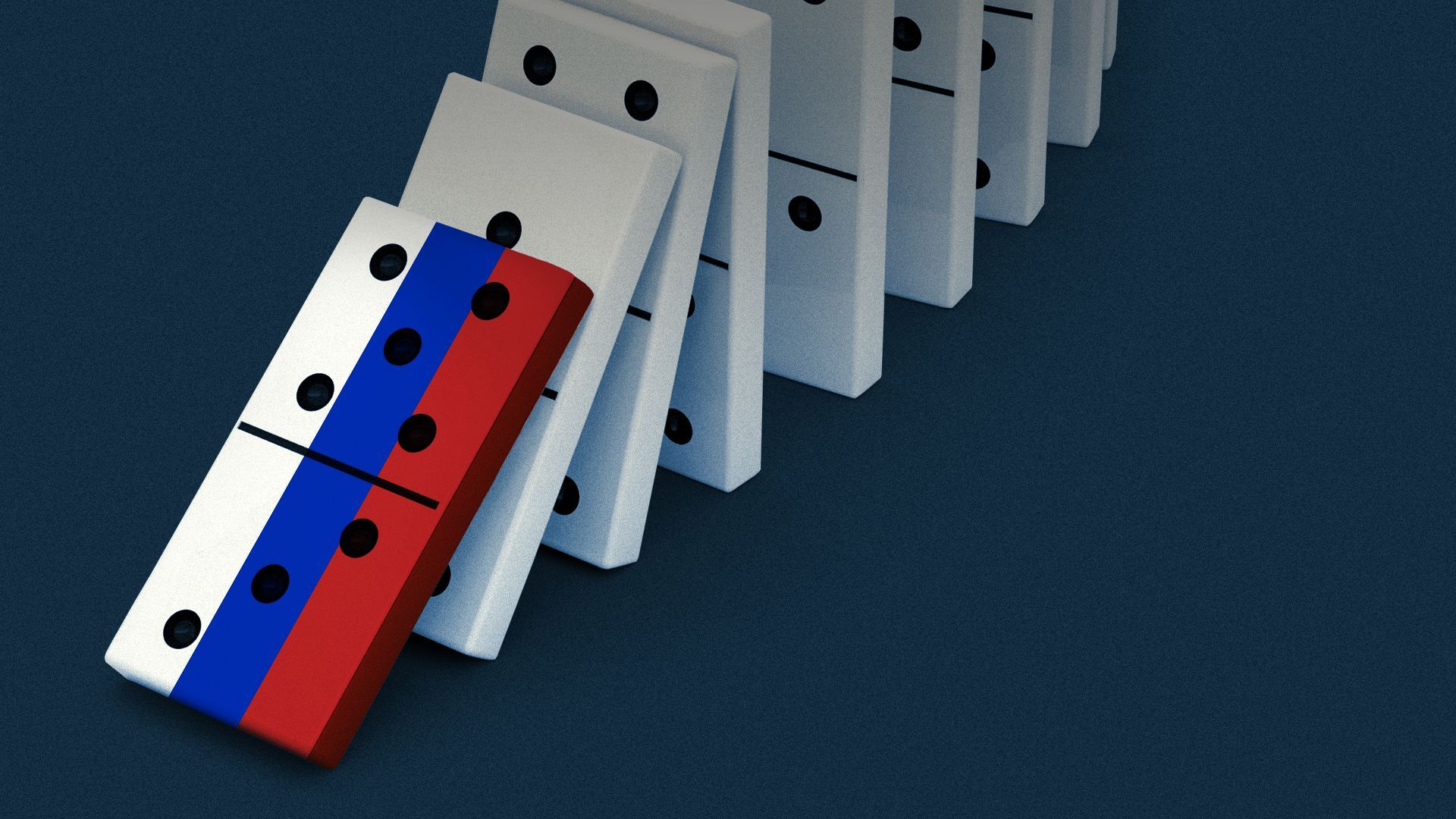
Illustration: Shoshana Gordon/Axios
Ripping Russia โ the world's 11th largest economy โ out of the global financial system is bound to cause collateral damage, Emily writes.
Why it matters: Even the most targeted bombing campaign can strike bystanders, and economic war is perhaps more indiscriminate โ and harder to control.
- โWar has unintended casualties. Economic war is the same,โ said Aaron Klein, a senior fellow in economic studies at Brookings.
Case in point: Already, oil and gas prices have skyrocketed even though energy was purposefully carved out of sanctions. And shares of Sberbank, Russia's largest bank, are trading for pennies โ perhaps surprising since it wasn't cut off from the SWIFT global payments network (though it is subject to other sanctions).
Catch up fast: Since Russia invaded Ukraine last week, the U.S. and its European allies moved fast to levy some of the harshest sanctions ever imposed.
- The strikes were targeted. The West tried to keep the energy sector โ a massive part of the Russian economyย โ out of the most severe penalties, so European countries could continue to buy oil and gas.
The big picture: Broad shifts in the way the world financial system works could take years to emerge.
- "The fallout for global trade and finance is enormous," said Justine Walker, the global head of sanctions, compliance and risk at ACAMS.
- "It will essentially spur conflicts in other regions," on top of food insecurity, she said, if countries can't get the resources they need.
And once you put sanctions in place, it's hard to go back to the before-times.
- Russia will start to operate in different ways, carving out an alternate financial system to work in, for example โ much like Iran has done after being cut off from SWIFT by the Trump administration.
What we're watching: The consequences for the rest of the world are only starting to shake out.
- After the first Gulf War, the rise in oil prices helped create a recession, Klein at Brookings pointed out. He ruled out the possibility that this would happen now in the U.S., but Europe will feel rising energy costs more acutely.
- The bigger unforeseen consequence could come in the payments arena, Klein and others have warned. The sanctions against Russia "weaponize payments," and that could push Russia and other countries into alternate systems โย making it harder to wage economic war the next time around.
- There's also the possibility of a Russian economic collapse hurting some other financial institutions or markets. Back in 1998, the collapse of the Russian economy toppled a hedge fund that wound up threatening the entire financial system.
The bottom line: "One thing I've learned is you don't know what you don't know," Klein said.
3. ๐ค๐ผMetal prices soar

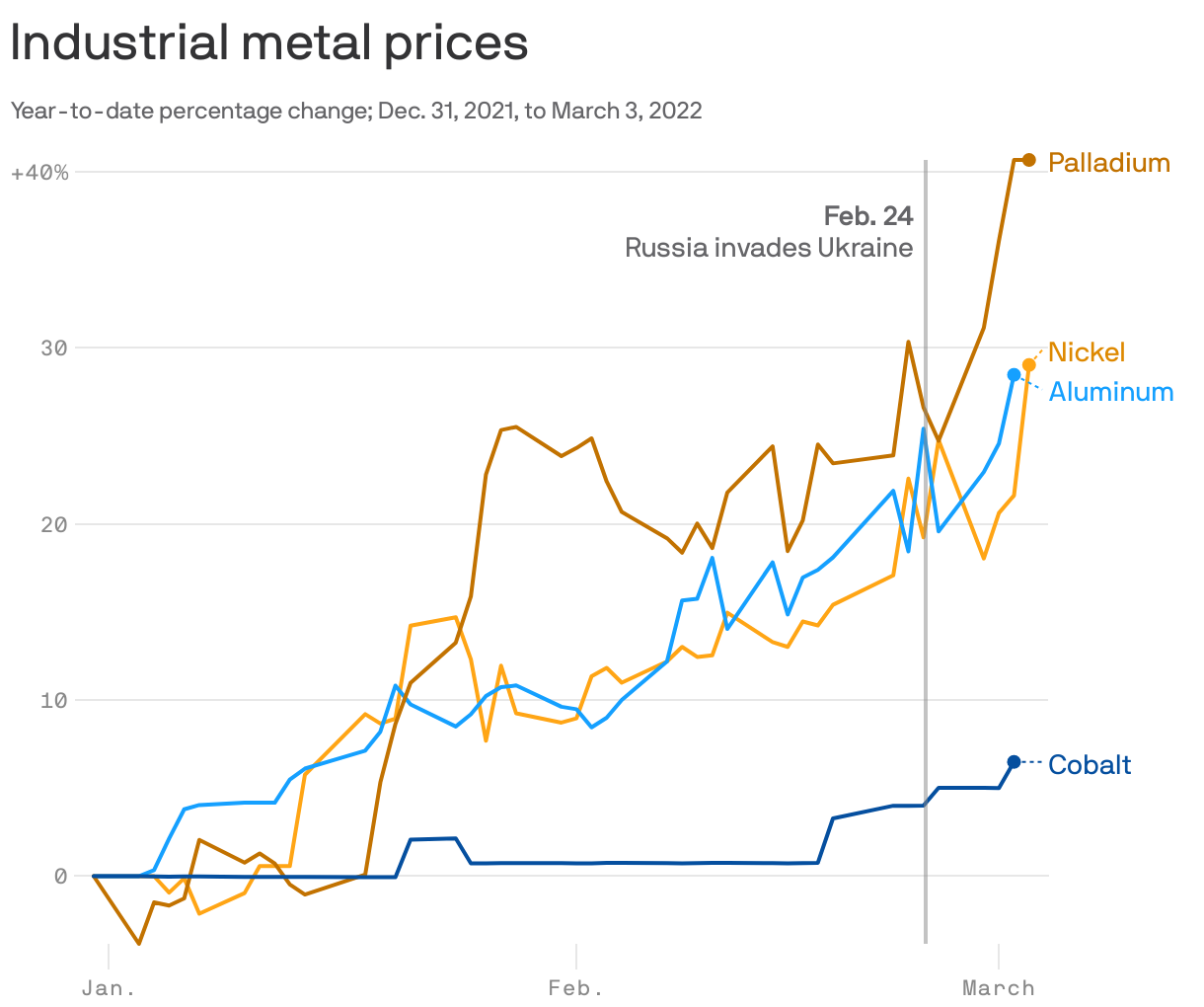
Prices for metals crucial to manufacturing โ especially the auto industry โ continued to soar, Matt writes.
Why it matters: This is part of the inflationary shock of Russia's invasion of Ukraine, and the world's response to it, which could disrupt supplies.
Palladium: A key metal used in catalytic converters that automakers install to scrub engine emissions. It's up roughly 40% this year.
- Russia, the world's largest producer, is responsible for 40% of global output.
Nickel: A central ingredient in stainless steel and rechargeable batteries for electric vehicles. It's up about 30% in 2022.
- Russia is the third-largest producer, mining roughly 10% of the world's nickel.
Aluminum: The lightweight metal is vital to industries across the economy from consumer packaging to aerospace and defense and construction. This year it's up more than 30%.
- United Company Rusal โ formerly led by oligarch Oleg Deripaska before he was sanctioned in 2018 โ is one of the world's largest producers.
Cobalt: Another key ingredient of electric vehicle batteries, for which demand has surged in recent years. It's up more than 7%.
- Russia is the world's second-largest producer of cobalt, much of which is mined by Norilsk Nickel, a mining giant whose oligarch president Vladimir Potanin is close to Russian President Vladimir Putin, making it a potential target of sanctions.
4. Mapped: America's spotty paid sick leave laws
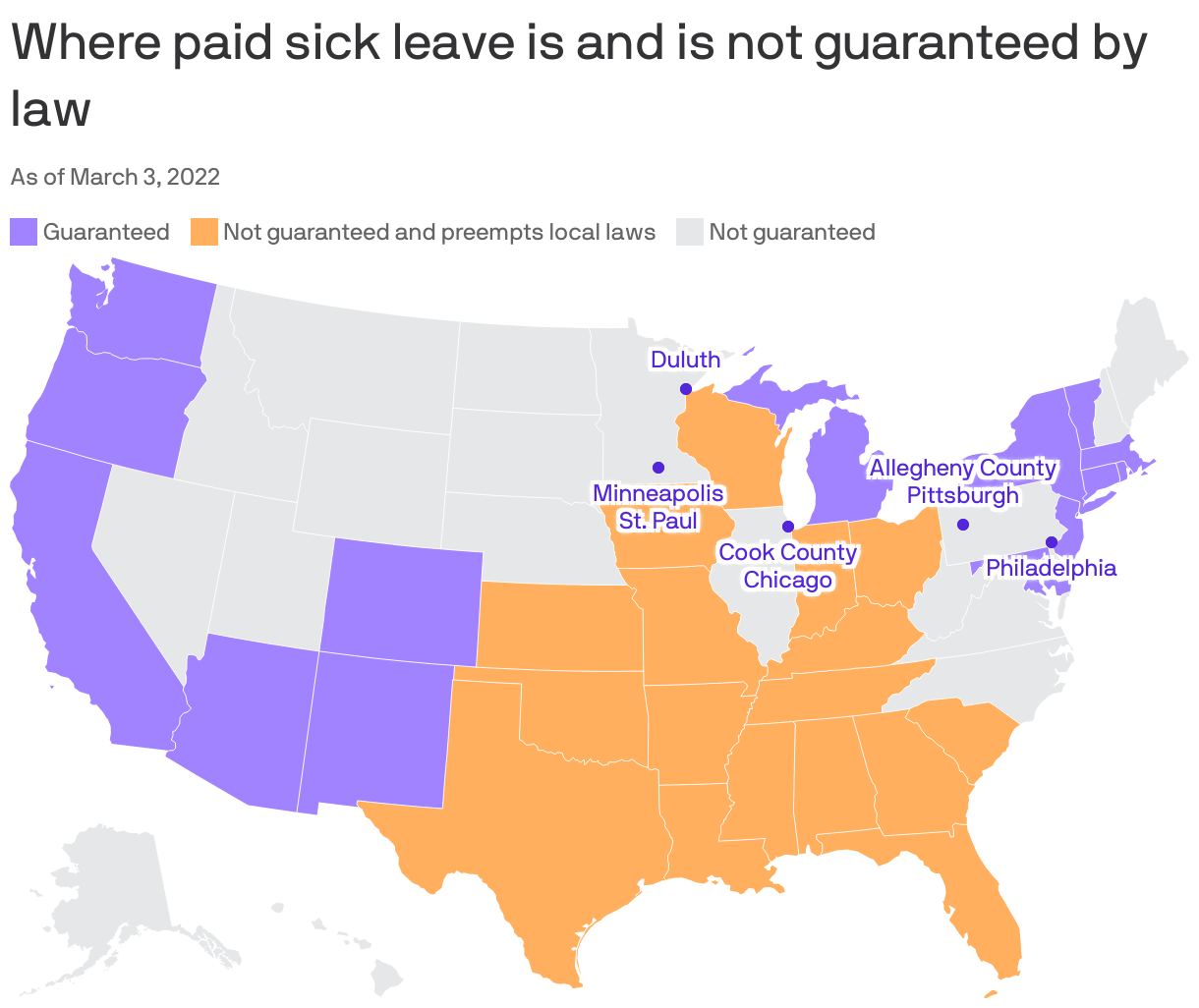
After Crystal Phillips, a 47-year-old youth counselor in Louisville, asked for time off to quarantine in 2020,ย her employer tried to fire her. But she hung on to her job by tapping into an emergency paid sick leave provision passed that year by Congress to deal with the COVID crisis, she tells Emily.
Why it matters: The Biden administration now says it wants to revive some version of that emergency sick leave policy, which expired at the end of 2020.
- "I couldn't believe that a company would do something like that," Phillips said this week, reflecting on what happened.
- Phillips lives in Kentucky, one of 18 states that not only don't have a paid sick leave law but also passed legislation that prohibits any city or county from doing their own sick leave.
State of play: Some states have tried to fill the void. A total of 15 states, as well as dozens of cities, have passed sick leave laws.
- A new report, released this morning by advocacy group A Better Balance and provided exclusively to Axios, compiles all the details. The group estimates that thanks to these laws, now 55 million workers do have guaranteed access to leave.
Yes, but: Approximately 33 million low-wage workers in the U.S. don't have access to paid sick days, creating all kinds of personal challenges for workers โ and public health issues for everyone. The U.S. is the only advanced economy in the world that doesn't guarantee paid sick leave to workers.
The other side: The Chamber of Commerce tells Axios it doesn't support paid leave policies that force the employer to foot the bill for time off.
The bottom line: Sick leave advocates were optimistic that some kind of permanent provision would finally pass in the U.S., after the onset of COVID. That never happened.
5. Ukraine crisis puts D.C. crypto lobby in hot seat
Illustration: Shoshana Gordon/Axios
Russia's invasion of Ukraine is highlighting the dark side of crypto, right as the industry's lobby ramps up efforts in D.C. to protect it from regulation, Axiosโ Peter Allen Clark reports.
Why it matters: The crisis provoked a sharp and nearly united response globally from the very institutions โ governments and banks โ that cryptocurrencies seek to sideline. It's also amplifying the perception that crypto helps bad actors escape penalties or detection.
The intrigue: The crisis unfolded just as crypto lobbyists in D.C. were cranking up a campaign to dissuade lawmakers from enacting new restrictions.
By the numbers: A cryptohead.io study, released last month, showed that the industry's lobbying expenditures increased by 116% in 2021, rising to $4,925,000.
Sign up for Axios Markets

Stay on top of the latest market trends and economic insights