Axios Markets

August 26, 2026


1 big thing: A $3 trillion baby

To paraphrase Justin Timberlake in his iconic turn in the 2010 film "The Social Network," a trillion dollars isn't cool. You know what is? $3 trillion.
The big picture: That's roughly how much money seven Big Tech companies, including Google, Microsoft and Nvidia, have committed to spending on AI-related infrastructure in off-balance-sheet commitments, according to a new analysis from Morgan Stanley.
- And that's on top of the estimated $770 billion in debt and lease obligations that are on the balance sheets.
Why it matters: The analysis finds that the total amount of spending on AI is much bigger than the already-mind-blowing headlines suggest, and — more of a red flag — it's more leveraged than is perhaps appreciated.
How it works: Off-balance-sheet commitments are essentially financial obligations that don't show up in a company's official tally of what it owns and owes — it's not an official debt but an obligation to pay someone something in the future.
Zoom in: Morgan Stanley looked at filings from the hyperscalers Google, Meta, Microsoft, Oracle and Amazon, as well as the chipmakers Nvidia and Broadcom and broke down their off-balance-sheet commitments.
- The hyperscalers have committed to $1.1 trillion in payments for data center leases that haven't yet begun.
- All seven companies have also agreed to buy $1.7 trillion of other stuff — purchase commitments for chips, memory and networking gear.
- These purchase agreements have ramped up this year — Google's commitments totaled $707 billion in the most recent quarter — from $72.5 billion in all of 2025, per the research.
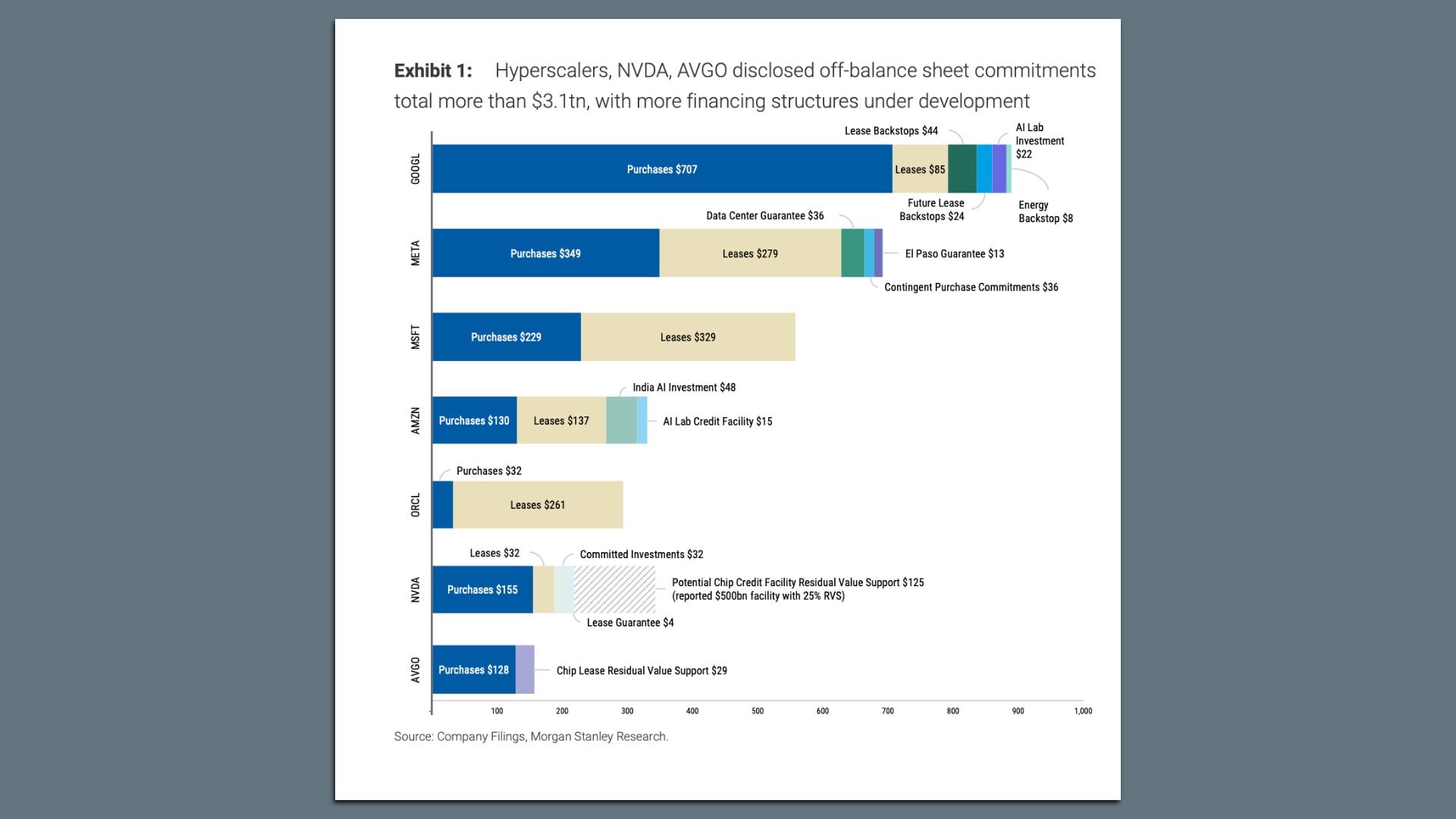
Follow the money: This is future revenue for memory chipmakers like Micron Technology and help explain the phenomenal growth in that business.
The intrigue: These commitments are a jumping-off point for suppliers and data center developers who take that guarantee of future payments and use it to borrow more.
- Here's how the researchers explain it: "Suppliers and data center developers can borrow against long-dated leases, guarantees, or purchase commitments from investment grade hyperscalers, allowing capacity to be built before the hyperscalers make any payments or recognize liabilities."
Between the lines: What this essentially means is that Big Tech companies with decent credit ratings are leveraging that status to generate an absolute ton of lending that can be difficult to track.
Yes, but: Each of these companies is doing slightly different kinds of spending with different levels of risk.
- And it's not totally clear over what time period that $3 trillion gets spent — or if it gets spent. These are commitments, often contracts, but they could theoretically be renegotiated.
What to watch: At some point these obligations will start showing up on official balance sheets.
- By that time, will these investments be paying off? Timing is the question on investors' minds, says Todd Castagno, head of global valuation, accounting and tax at Morgan Stanley who coauthored the analysis. This is, after all, a new market.
- "It's like we are developing a car market without ever having seen the capabilities of car before, and everyone's going to get a car — and how do we finance it, and how do we know what that car is worth in five years?"
2. Nvidia takes the spotlight



Nvidia snapped a seven-day losing streak in the stock market yesterday. But its mini slump has raised questions over the AI darling's growth trajectory.
Why it matters: Nvidia is trying to use its massive pile of capital to keep the good times rolling — through a wide assortment of investments and capital deals (see above) — while continuing to feed the growing chip needs of the AI hyperscalers.
Zoom in: The company will report second-quarter earnings after the bell today, and investors want to see a blowout performance.
- Nvidia is expected to book $92.1 billion in revenue for the period, and more than $100 billion in the current third quarter, per S&P Capital IQ estimates. That would be its first 12-digit quarter.
- Q2 net income is estimated at $51.2 billion, with gross margins at 75%.
Friction point: Mounting bipartisan opposition to data centers — many of which draw substantial computing capacity from Nvidia chips — poses a threat to the company's continued momentum.
Yes, but: Nvidia CEO Jensen Huang has been moving to use the company's massive balance sheet to invest in AI companies and guarantee financing on deals like a sprawling ChatGPT data center slated for Ohio.
- "A lot of attention will also be paid to the off-balance-sheet activity," wrote Brian Mulberry, chief market strategist at Zacks Investment Management, noting that Nvidia has already made 66 investments totaling about $40 billion.
- Those investments have raised concerns about circular financing posing a systemic threat to the AI economy — concerns that Huang has roundly rejected.
The bottom line: The CEO will be under pressure to deliver a rosy outlook at a time when the public's support for AI is wobbling.
- "This shareholder meeting is now beginning to feel like the old Berkshire Hathaway events where people around the world would hang on every word that Warren Buffett had to say," Mulberry wrote.

Axios Markets