Axios Markets

February 04, 2025


1 big thing: Serenity now (for Trump)


Given unprecedented levels of turmoil within the federal government over the course of the first 15 days of Donald Trump's presidency, it's worth taking a beat to note how placid and sanguine the stock market has been in comparison.
Why it matters: The stock market is Trump's metric of choice when it comes to objective measures of how he's doing.
- So long as it remains somewhere in the zone between "unworried" and "sanguine," it will essentially send a message to Trump that Wall Street is perfectly fine with his actions.
- And compared with the last close before he took office last month, the S&P 500 is about as flat it can be.
Between the lines: The markets broadly believe that Trump's bark is worse than his bite.
- Multiple sell-side analysts forecast over the weekend that the tariffs on Mexico and Canada would be short-lived, for instance. In the end, they didn't come into force at all.
- In that respect the new levies are similar to Trump's announced then rescinded tariffs on Colombia a week ago or, for that matter, his announced then rescinded tariffs on Mexico in the spring of 2019.
- The modest dip with which stocks opened yesterday was largely erased by the end of the session.
The big picture: The stock market's fast-twitch reflexes are well honed, but for the time being it's almost impossible for analysts to net out the potential upside from deregulation against the potential downside from tariffs and isolationism.
- On top of that is the even knottier question of whether large-scale government dysfunction will have a significantly different effect on corporate profits than small-scale government gridlock, which is generally seen as bullish for the market.
How it works: The stock market reacts quickly to perceived changes in easily quantifiable risks like, say, the probability that the Fed will raise rates at its next meeting.
- It's much worse at weighing out the effects of, say, a long-term rethinking of democratic norms and civic society institutions.
- While such developments would undoubtedly have profound implications for the mechanics of U.S. capitalism, the market implications tend to reveal themselves only slowly, over years rather than days.
The bottom line: Opponents of Trump's policies have often hoped that a panicked response from the market might suffice to get him to change his mind on something.
- But in practice, the market seems disinclined to panic.
2. Tariffs and the working class
President Trump ran on the Oprah promise of "you get a tax cut" for lots of different people: tipped service workers, retirees, overtime workers.
Why it matters: His first tax pitch out the gate — broad tariff increases on America's top trading partners — will likely raise the cost of living for those folks instead.
Where it stands: The U.S. struck deals yesterday to pause looming tariffs on Canada and Mexico for 30 days.
- But the threat of tariffs remains a core Trump tactic, and eventually something is likely to stick around.
How it works: Tariffs are a tax typically paid by importers, but they don't generally eat those costs. Companies pass them on to consumers in the form of higher prices.
- In a new analysis out Tuesday, the Conference Board projects that the combined impact of Trump's tariff proposals would increase inflation by 0.6 percentage points over a one-year period.
- That's not near the sky-high inflation of 2022, but people, particularly middle-income earners, will feel those cost increases, says Dana Peterson, the group's chief economist.
Between the lines: A lot of the tariffed items aren't discretionary, or stuff people can just do without, such as food, energy, clothing and auto parts.
- Lower- and middle-income folks spend more of their money on these items and will feel those cost increases more than wealthy people, who spend a smaller percentage of their money on goods. The same thing happened with inflation.
Follow the money: Tariffs can cause prices to rise even on goods that aren't directly affected by the increases, says Wendy Edelberg, a senior fellow in economic studies at the Brookings Institution.
- If the price of, say, Canadian whisky goes up, then that can give other booze retailers an excuse to "take price" on competitive products. "There are going to be some companies that make out like bandits," she says.
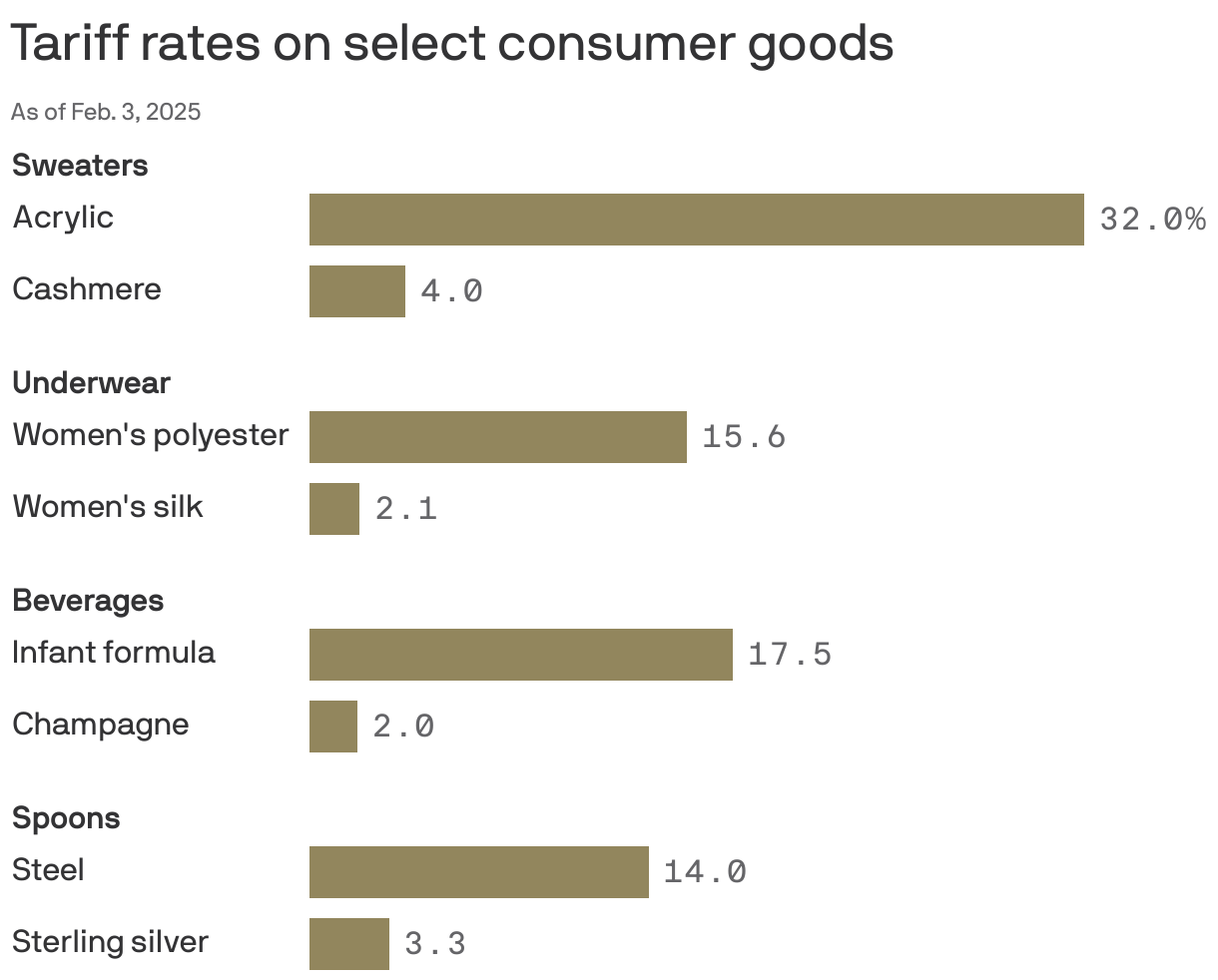
Zoom out: Even as it stands now, the U.S. tariff system is skewed in favor of the wealthy. Cheaper items face higher tariff rates than luxury goods, as outlined in a report last year from the Progressive Policy Institute.
- There's a 4% tariff on imported cashmere sweaters, and a 32% tariff on acrylic sweaters, per the institute's analysis.
- That's because U.S. companies that make less-expensive products lobby for higher tariffs to keep out cheaper goods from overseas, while firms that sell luxury goods are less worried about price competition.
The big picture: The theory behind higher tariffs is that the increases will force more manufacturing to happen at home, creating more jobs for Americans.
- In practice that's hard to pull off, Edelberg points out. Manufacturers often need raw materials from other countries and the costs of those inputs would rise in a trade war scenario.
- "It's entirely possible you could see lower, not higher, employment in the manufacturing sector," she says.
The bottom line: Trump said he'd bring costs down, but tariffs don't do that.
3. The states facing the brunt


Businesses in some states — many near the country's northern and southern borders — would feel Trump's tariffs on goods from Canada, Mexico and China most acutely, per a new estimate shared with Axios.
Why it matters: Trump and others view tariffs as political cudgels to extract concessions from targeted countries. But they're also likely to make stuff more expensive as companies pass higher costs along to everyday Americans.
Driving the news: The tariffs as originally issued Saturday would have had an estimated $232.7 billion national impact, per economic research firm Trade Partnership Worldwide and based on trade from January to November 2024.
- That impact would be largest for businesses in Texas ($47.1 billion), California ($32.6 billion) and Michigan ($27.8 billion).
How it works: The estimates are based on census data for foreign imports and reflect "the composition of current trade based on existing company-to-company relationships," Trade Partnership Worldwide president Daniel Anthony tells Axios.
What they're saying: "Canada and Mexico account for over 90% of all Montana imports, versus just 5% for Hawaii," Anthony says. "So virtually anything that Montana companies import from the world could be subject to new tariffs in the immediate future."
- "Similarly, states where Canadian energy imports are large see reduced impacts from the lower energy tariff. But even 10% is a huge cost when you look at a state like Illinois that imports tens of billions of dollars annually in Canadian crude oil," he adds.
Caveat: Tariffs may lead to less trade overall, Anthony notes, meaning past data isn't necessarily indicative of future tariff effects.
Axios Markets