
Axios Markets

November 17, 2022
It's almost Friday! Let's go.
Situational awareness: U.K.'s finance minister announces tax hikes and spending cuts and says the country is in recession. (CNBC)
Today we're at 859 words, 3.5 minutes.
1 big thing: Crypto dominoes
Illustration: Aïda Amer/Axios
The collapse of FTX and Alameda Research continues to reverberate through the crypto world — and more dominoes are falling, Matt writes.
- The latest: The crisis touched a high-profile crypto lender run by the billionaire twins Cameron Winklevoss and Tyler Winklevoss yesterday, forcing them to halt withdrawals from their Gemini Earn crypto lending program.
The big picture: It's a classic case of contagion. That’s when the failure of one institution sets off a rush among customers to redeem their money, which makes the institution's lending and borrowing impossible — ultimately generating a cascade of similar closures from other firms.
- The U.S. banking crisis of 1930-31 is perhaps the textbook case of financial contagion (as anyone who's watched "It's a Wonderful Life" knows).
- The financial crisis of 2008 — triggered by the collapse of Lehman Brothers — was a similar episode.
State of play: The Gemini Earn program allowed users to deposit their coins in exchange for regular interest payments — typically at generous rates that could be as high as 8%.
- In a note to clients posted on its site, Gemini pointed out that its lending partner in the Earn program — a separate crypto lender known as Genesis — had "paused withdrawals and will not be able to meet customer redemptions within the service-level agreement (SLA) of 5 business days."
What's happening: Since FTX filed for bankruptcy on Friday, the crisis has caused problems for a growing list of firms, some considered cornerstones of the crypto industry just last week.
- Crypto lender BlockFi is considering filing for bankruptcy, according to the Wall Street Journal.
- Bankrupt crypto brokerage firm Voyager Digital, whose assets FTX founder Sam Bankman-Fried agreed to purchase for $1.4 billion, has reopened bidding to find a replacement buyer.
- Crypto hedge fund Galois Capital said roughly half its capital is stuck in FTX, according to the Financial Times.
- Travis Kling, who ran crypto hedge fund Ikigai Asset Management said on Tuesday that "a large majority of the hedge fund's total assets" had been ensnared in FTX.
Yes, but: While the cascade of problems is generating pain among investors and traders in the highly speculative, largely unregulated world of crypto, "tradFi" — or traditional finance, in crypto speak — so far doesn't seem to have much at stake in these companies.
What we're watching: Any sign that the carnage in crypto land makes the jump to the real world of Wall Street and actual economic activity. So far, there are few signs that's happening.
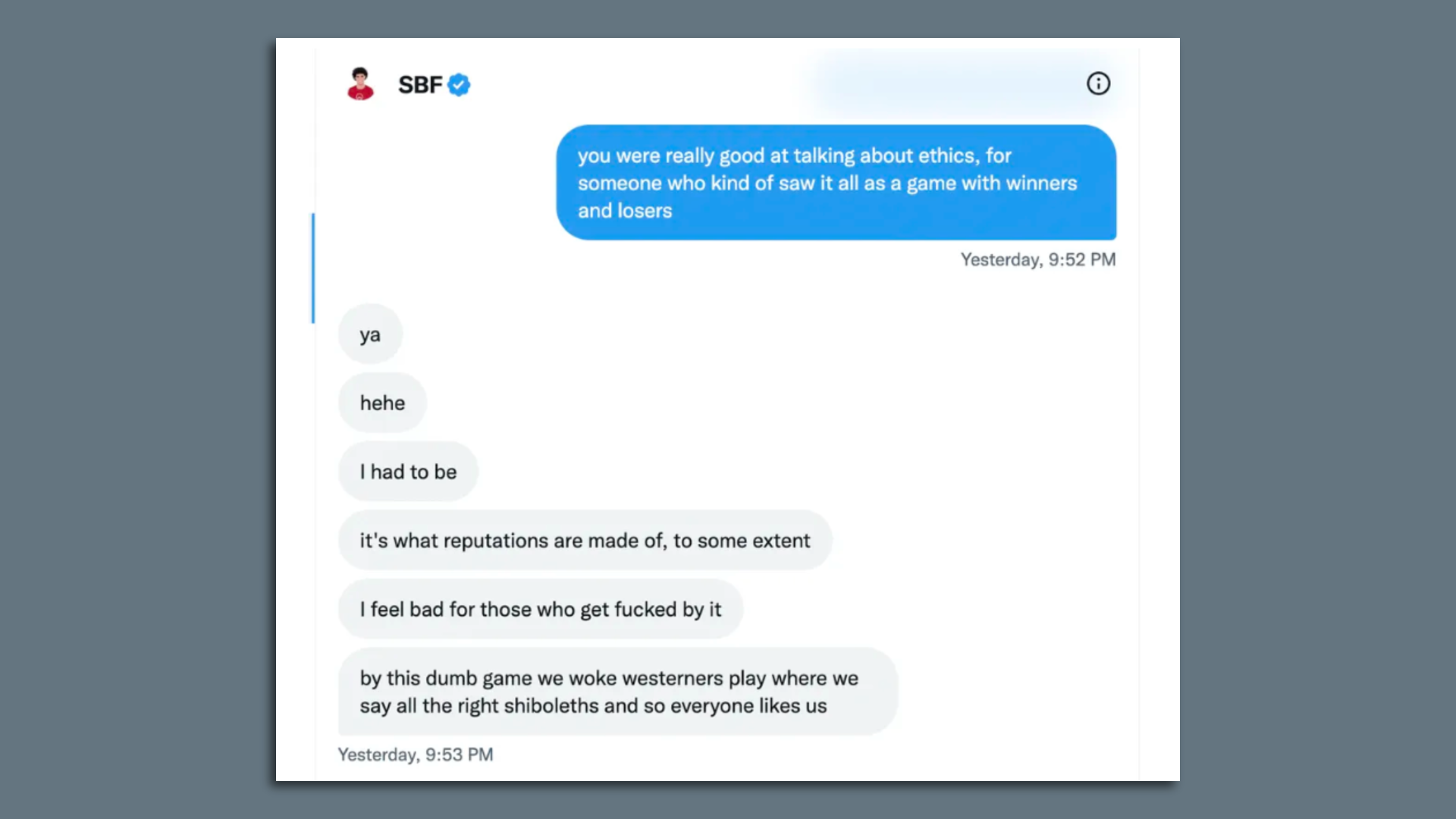
2. 💬 Quoted: "What reputations are made of"
Source: Vox; Illustration: Axios Visuals
These remarkable comments are part of an extensive direct message exchange between Vox reporter Kelsey Piper and former FTX CEO Sam Bankman-Fried, which the site published Wednesday.
- Why it matters: The interview is striking for the way Bankman-Fried seems to acknowledge that his interest in ethics and philanthropy — which featured prominently in coverage of the one-time crypto billionaire — was "mostly a front."
3. Catch up quick
🛳 UN says Black Sea grain deal has been extended for 120 days. (Reuters)
🤐 Congress passes a groundbreaking bill limiting the use of NDAs in sexual harassment cases. (Axios)
☕️ Over 100 unionized Starbucks locations plan to strike on Red Cup Day. (CNBC)
☀️ Italian energy giant Enel plans to build the largest solar power manufacturing facilities ever in the U.S. (WSJ)
4. Union support among the professional set
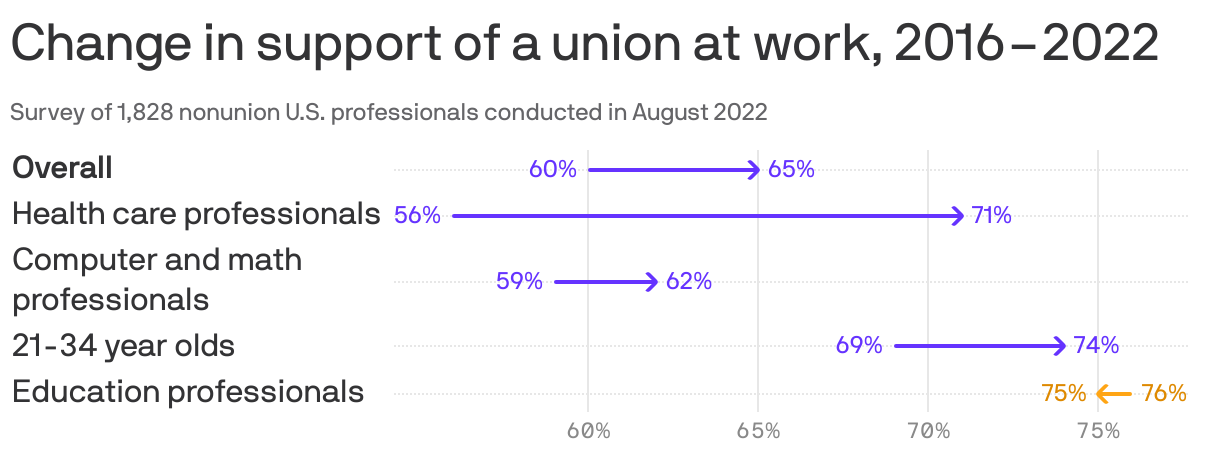
In a survey six years ago, 56% of health care workers said they would support a union at work. Then came COVID, Emily writes.
The latest: Now, 71% of these workers said they'd support such efforts, according to a survey of more than 1,800 nonunionized professional workers conducted in August and released this week from the AFL-CIO, the U.S. labor federation.
Why it matters: Union popularity is at a 57-year-high in the U.S. — but here's a sign that organizing is increasingly viewed positively among a set of workers that's historically been less likely to organize. Less than half of union members in the U.S. are professionals.
By the numbers: Support for unionizing rose to 65% from 60% among all professionals, defined as those with at least an associate's degree who hold a job where a degree is required.
- Among tech workers, support for unions has been gaining ground for more than a decade, from just 33% in 2005 to 62% in 2022, according to the AFL-CIO's survey data.
5. The one that matters
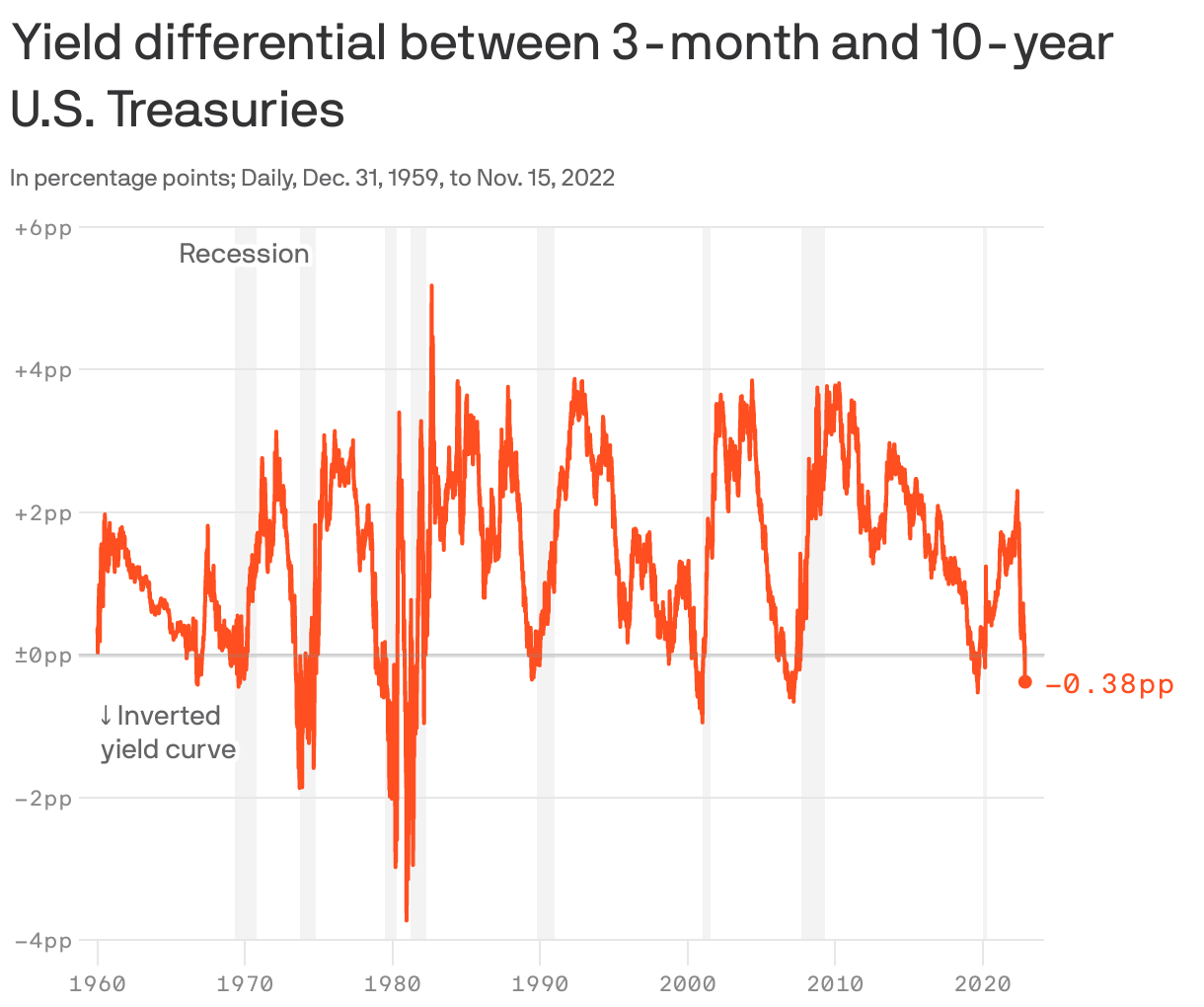
It happened. The section of the U.S. Treasury yield curve that most accurately predicts economic downturns has "inverted," or gone negative, Matt writes.
- And not for an intra-day blip — it's stayed that way for a couple of days now.
Why it matters: This part of the yield curve — the difference between yields on 10-year Treasuries and 3-month bills — has accurately predicted every U.S. recession since 1955.
- When it has gone below zero, a recession followed over the next two years.
Yes, but: Some thought its predictive streak would end when it last went negative in late 2019.
- The economy was basically fine, until the COVID crisis hit, sending it into a sharp — but brief — collapse that preserved the curve's perfect recession-calling record.
The bottom line: It's just an indicator, not an infallible omen that dooms us. But still, it's worth watching.
Was this email forwarded to you? Sign up here to get Axios Markets in your inbox.
Today's newsletter was edited by Kate Marino and copy edited by Mickey Meece.
Sign up for Axios Markets

Stay on top of the latest market trends and economic insights