Axios Markets

January 17, 2024

😎 Axios BFD is headed to Miami on Feb. 13. Guests will include Formula 1 Miami Grand Prix president Tyler Epp, former super-agent Jeff Moorad, and founder of Affinity Partners Jared Kushner. Request your invite.
Today's newsletter is 967 words, 4 minutes.
1 big thing: The 2023 bank bailout bill arrives
Illustration: Aïda Amer/Axios
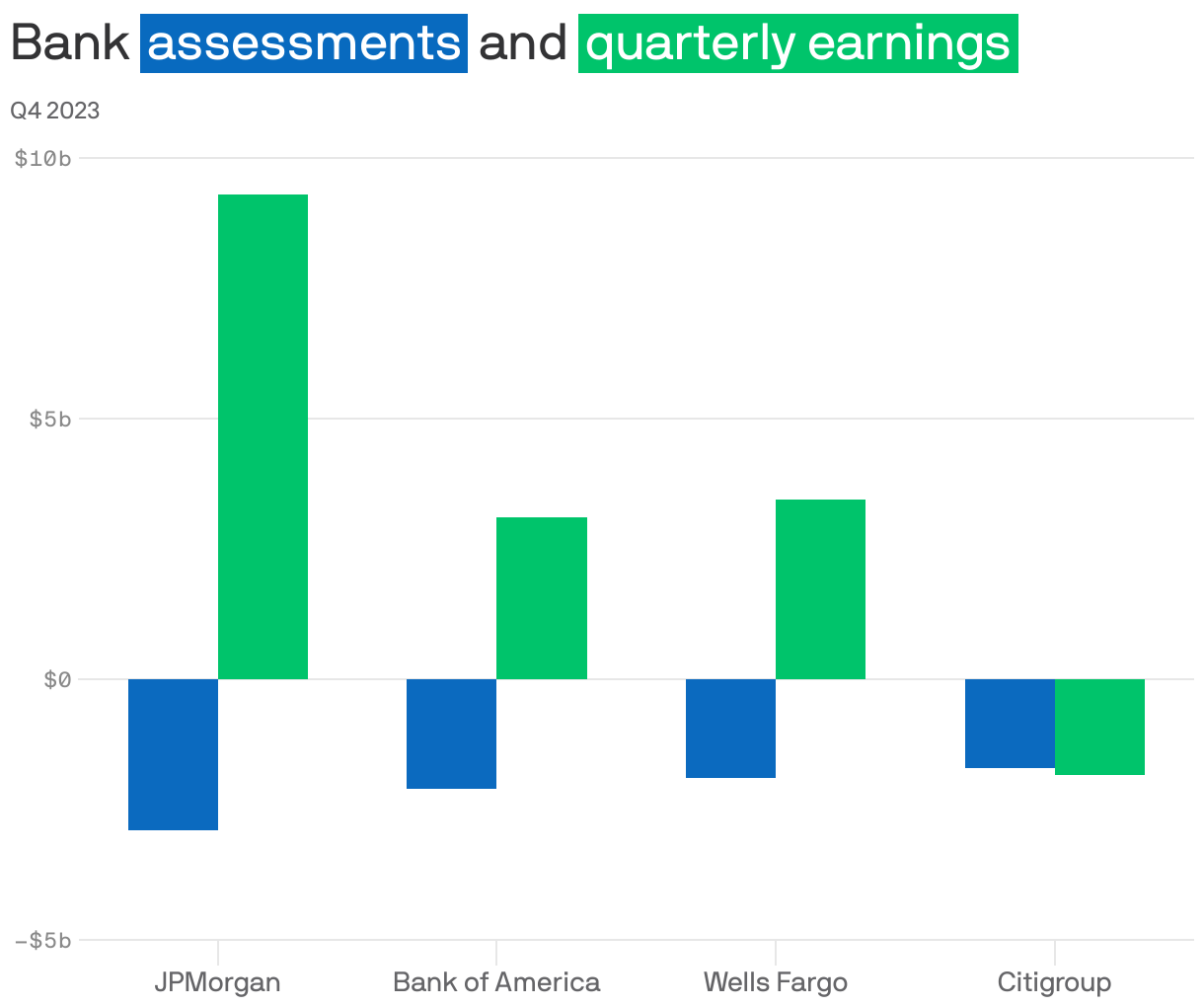
America's biggest banks each took a 10-figure hit to their earnings last quarter to cover the cost of bailing out uninsured depositors at Silicon Valley Bank and Signature Bank, Axios' Felix Salmon writes.
Why it matters: Most of the banks took the FDIC's special assessment in stride — their earnings are strong enough to be able to afford it. Citigroup is the exception.
How it works: The Federal Deposit Insurance Corporation is designed to reassure banks' customers that their deposits are safe.
- Its insurance fund held $119.3 billion at the end of the third quarter, including $3.2 billion that banks paid into the fund as their regular quarterly insurance premiums.
- That means the fund stands at 1.13% of America's insured deposits, below its target of 1.35%.
Where it stands: The fund is currently undercapitalized for three main reasons.
- First is the failure of First Republic, which is expected to cost the fund more than $15 billion.
- Second is an increase in insured deposits, which has taken place even though overall deposits have declined. The bank failures of 2023 encouraged many depositors to embrace brokered deposits and other ways of ensuring their money was insured.
- Third is that the FDIC was asked to pick up the $15.8 billion tab for protecting the uninsured depositors at Silicon Valley Bank and Signature Bank — a bill far larger than the relatively modest $2.4 billion cost of protecting insured depositors at those institutions.
Between the lines: Because the FDIC was never designed to bail out uninsured depositors, by law it has to levy a "special assessment" to get back that $15.8 billion.
- The assessment is based on the amount of uninsured deposits at U.S. banks, over and above $5 billion per bank.
- That money will be paid to the FDIC in eight installments starting this quarter — but because the final rule has been published and the amounts to be paid are pretty certain, the banks accounted for all of it in the fourth quarter.
By the numbers: The four giant national banks owe $8.6 billion in total, ranging from $1.7 billion at Citigroup to $2.9 billion at JPMorgan.
- Even after accounting for two years' worth of special assessments in a single quarter, the three biggest banks — JPMorgan, Bank of America, and Wells Fargo — each made multibillion-dollar profits last quarter.
- Citigroup, by contrast, ended the quarter with a loss of $1.8 billion.
The bottom line: That probably helps explain why Citigroup is trading on a price-to-book ratio of 0.5, while JPMorgan's ratio is more than three times higher at 1.6.
2. Charted: Stability's cost
4. Expanded child tax credit is back (maybe)

Illustration: Shoshana Gordon/Axios
Congressional committee chairs reached a deal yesterday that would expand the federal child tax credit, after three years of pushing by Democrats and progressives, Emily writes.
Why it matters: It's a meaningful expansion that could lift as many as a half-million kids out of poverty and make about 5 million more less poor, according to an estimate from the Center on Budget and Policy Priorities.
- The proposal, which faces an uphill battle in the House, won't bring back the monthly checks that parents got in 2021 but would make it so millions more lower-income parents get a meaningful tax refund.
The details: Called the Tax Relief for American Families and Workers Act of 2024, the deal was reached by the top lawmakers on tax-writing committees: Senate Finance Committee chair Ron Wyden (D-Ore.) and House Ways and Means chair Jason Smith (R-Mo.).
The details: Under the current law, parents can claim the child tax credit on their taxes — up to $2,000 per child.
- Lower-income parents, who don't owe taxes, can't get that maximum amount as a cash refund— but can with the Earned Income Tax Credit.
- For example, a mom with two kids who earns $40,000 a year gets a $4,000 tax break, while a parent earning $14,000 with two kids gets $1,725.
Stunning stat: There are 19 million children who, under the current law, are getting less than the $2,000 because their families' incomes are too low, according to a CBPP estimate.
How it works: The tax deal reached yesterday targets those lower-income families, increasing the amount of the credit that's refundable to the full $2,000 per child over three years.
- It also eliminates a provision that effectively penalized lower-income families with more than one child.
Yes, but: Under the proposed expansion, 93% of children in the lowest-earning families would still not receive the full credit, according to an analysis from the Institute on Taxation and Economic Policy.
- The proposal "leaves out too many children," the National Women's Law Center said in a statement.
Zoom out: The expansion would cost an additional $33 billion; that's the same amount the deal allocates to reinstating business tax breaks that were part of the Trump tax cuts.
- Even progressives who oppose corporate tax breaks applauded the deal — because they were able to secure a break for low-income families, too.
5. Get ready for more boardroom battles

Illustration: Tiffany Herring/Axios
Shareholder activism across the globe surged in the fourth quarter, Axios' Michael Flaherty writes.
Why it matters: The spike sets the stage for boardroom battles in the spring and early summer when most annual meetings and director votes take place.
By the numbers: Shareholders launched 229 activist campaigns in 2023, bringing the two-year total to 464 — the busiest such stretch on record, according to Barclays.
- The fourth quarter saw 71 campaigns, tripling the previous quarter and marking the largest Q4 surge on record.
- Campaigns of note include RC Ventures going after Alibaba, Trian's attack on Disney, and Elliott's push for changes at Salesforce.
Of note: Activists secured 134 board seats in 2023, a 30% increase and a five-year high.
Was this email forwarded to you? Subscribe here.
Axios Markets is edited by Kate Marino and copy edited by Mickey Meece.
Sign up for Axios Markets

Stay on top of the latest market trends and economic insights