Axios Macro

May 03, 2023

It's Fed day: A policy statement, alongside the expected quarter-point interest rate increase, comes at 2pm ET. A news conference with Federal Reserve chair Jerome Powell will begin a half hour later. Courtenay will be there — hit reply with any questions you think should be on our list.
- Before the big decision, we have a special edition of the newsletter that features a sneak peek of Felix's forthcoming book, "The Phoenix Economy."
💰 Situational awareness: The Treasury Department will launch a program next year to buy back government bonds for the first time since 2000 — a move intended, at least in part, to improve liquidity in the benchmark fixed-income market.
Today's newsletter, edited by Javier E. David, is 692 words, a 2½-minute read.
1 big thing: How the U.S. eroded the dollar
Illustration: Sarah Grillo/Axios
Americans hate inflation, in large part because it erodes the bedrock of capitalism — money. Concentrating on inflation, however, risks missing the profound other ways in which money has lost its power over the past three years.
Why it matters: U.S. government actions over the course of the pandemic have radically reshaped the dollar, which is now much more politicized and mutable than it was before 2020.
The big picture: Felix's new book, "The Phoenix Economy," out on Tuesday, covers the ways in which the world has changed since early 2020. Among them: a quiet revolution in how people think about what money even is.
Flashback: In mid-April 2020, millions of Americans woke up to find out that $1,400 had magically appeared in their bank accounts, placed there by the Trump administration as part of the first COVID stimulus plan.
- The U.S. dollar was effectively obeying orders being handed down by the government, the only entity capable of pulling such a move.
Where it stands: The Biden administration has been unusually aggressive in using the dollar as an instrument of foreign policy.
- It effectively confiscated $7 billion belonging to the central bank of Afghanistan, which it was able to do because those funds were on deposit at the New York Fed.
- It then did the same thing with Russia's foreign reserves, and followed that up by cutting Russia off from the dollar-based payments system.
Between the lines: The pandemic changed the world's (or at least America's) conception of money itself. In what Felix calls the New Not Normal, money has become contingent, more of a social construct than objective reality.
- In a society that for decades was centered on the almighty dollar, that was disconcerting, to say the least.
- "Fiat currency" has become a pejorative term used by crypto advocates to undermine trust in the dollar. The Federal Reserve is constantly attacked by Republicans from former President Donald Trump to Sen. Rand Paul.
Zoom out: The dollar still retains its hegemony as the world's reserve currency, along with its utility as a measure of relative wealth. But trust in the currency is eroding, in a world where the Fed's main policy tool is always its own credibility.
The bottom line: The good news is that we've found an important new tool of foreign policy, and even of domestic fiscal policy.
- The bad news is that it makes capitalism that much more difficult.
2. Democrats ramp up Powell pressure
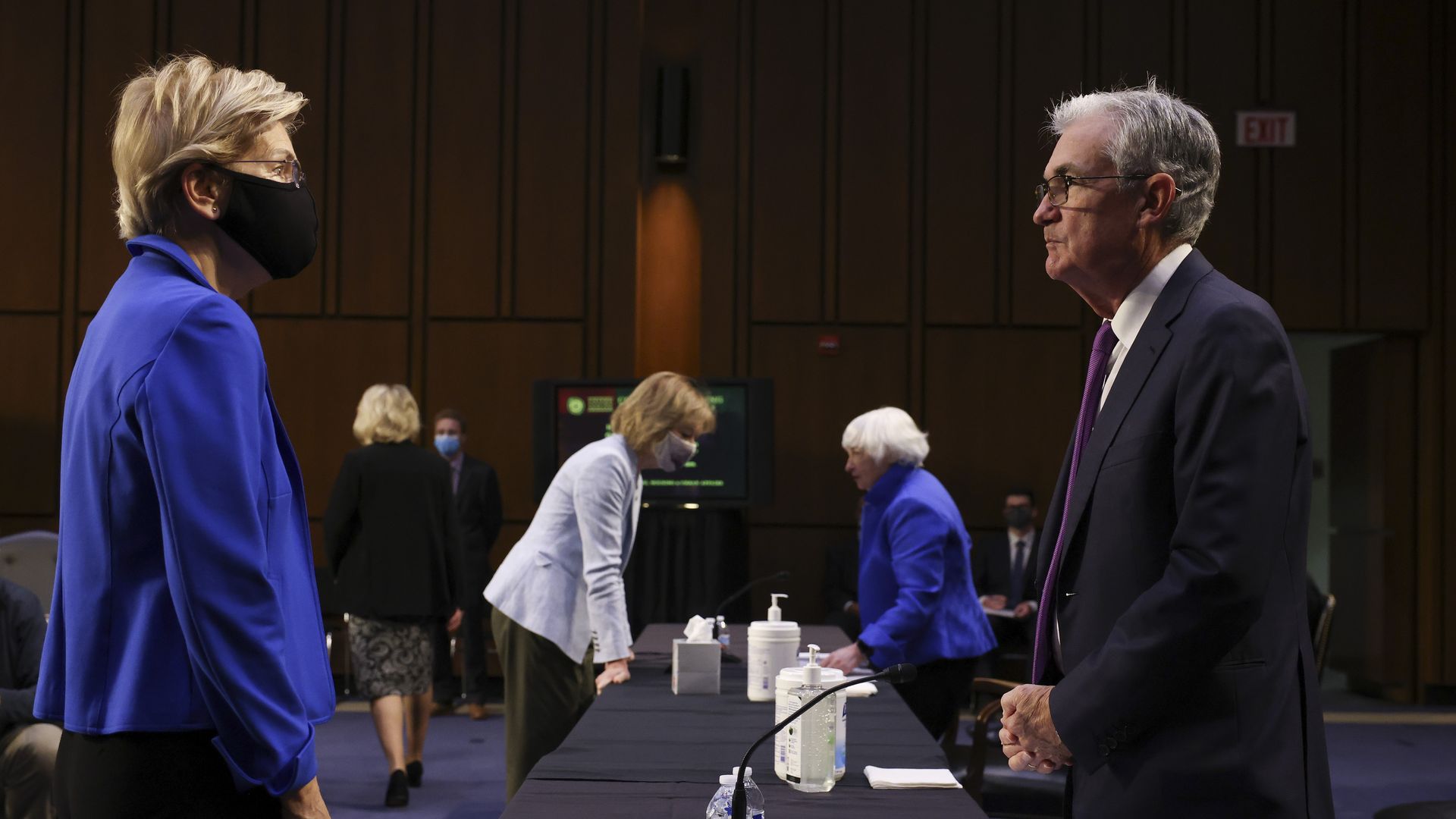
Sen. Elizabeth Warren (D-Mass.) speaks with Fed chair Jerome Powell during a congressional hearing in 2021. Photo: Kevin Dietsch/Getty Images/Bloomberg via Getty Images
As we mentioned yesterday, the Fed is all but certain to raise interest rates by a quarter-point this afternoon — and may signal a pause in its hiking cycle.
Yes, but: There's one powerful group demanding the central bank pause more imminently: Democratic lawmakers.
Driving the news: A group of 10 members of Congress, led by Sen. Elizabeth Warren (D-Mass.), wrote a letter calling for the Fed to hold rates steady at this week's meeting, citing the damage its moves may inflict on the labor market.
- "[R]ecent turmoil in the banking system ... and the lagging impacts of the Fed's earlier rate hikes leave our economy even more vulnerable to an overreaction by the Fed," the group writes.
Why it matters: It's the latest sign of unease among Democrats, who have recently bashed the Fed's campaign against price pressures.
- In the letter, the group acknowledges that the labor market has so far been resilient to the rapid tightening. They argue that the Fed's rate hikes are putting the solid job market at risk.
Between the lines: The lawmakers say inflation is well below last year's peak, and "the evidence to date suggests that progress can continue to be made without slamming the brakes on the economy and costing millions of Americans their jobs."
- They also wrote that mounting bank troubles are another reason to hold off, pointing to Powell's suggestion that those strains may restrain growth as banks ease up on lending.
The bottom line: As the Fed hiked last year, the Biden administration effectively backed the central bank's fight for price stability.
- Still, it is subject to oversight by Congress. Expect political pressure and blame games to ramp up — especially if the economy and labor market slow substantially.
Sign up for Axios Macro

Stay ahead of the curve on the most important economic developments with reporting and analysis on how business, policy, and markets collide.