Axios Macro

February 24, 2023
It's quite a Friday in Macro-land, as some spicy-hot new data on inflation and consumption came in. 🌶 🌶
- Meanwhile, many top monetary policy thinkers are gathered in New York to hear a dour new prognosis on the prospect of inflation coming down. We cover both in today's edition.
Today's newsletter, edited by Javier E. David, is 706 words, a 2½-minute read.
1 big thing: Painless disinflation is looking less likely
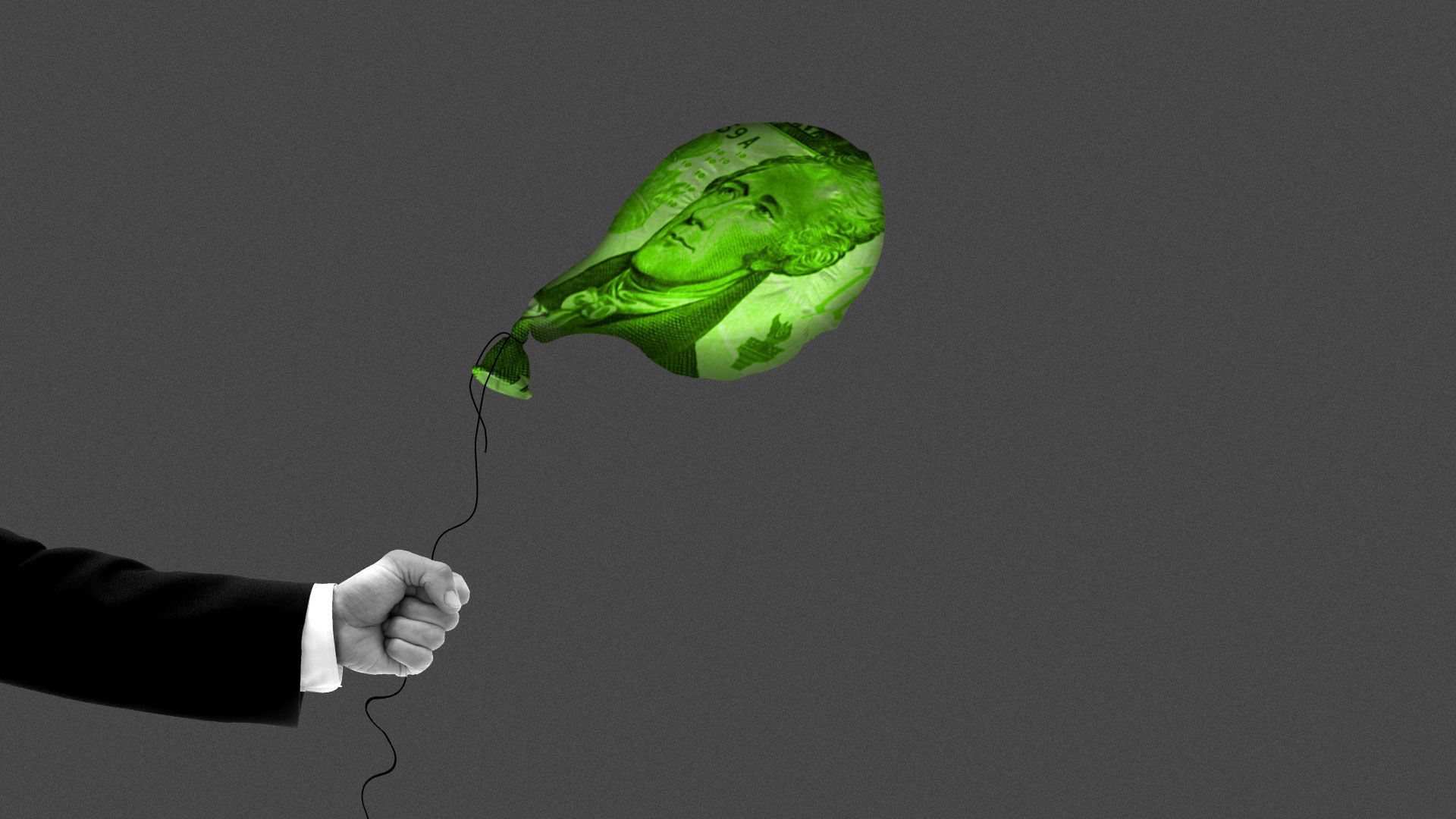
Illustration: Eniola Odetunde/Axios
For a while there, it was looking like a dream scenario for the U.S. economy just might be coming true: inflation falling while the job market remained robust, and the pain caused by Federal Reserve tightening confined to a few industries.
- Alas, it hasn't quite worked out that way in the recent run of data, with prices staying stubbornly high.
Why it matters: There is little doubt at this point that the Fed has the resolve to keep raising interest rates if inflation pressures don't dissipate. But it is looking more likely that it will take a more serious economic downturn than seen so far to make that happen.
Driving the news: New data out this morning showed consumer spending and inflation heated up in January (more on that below).
- Meanwhile, a paper presented this morning at a high-profile University of Chicago conference argues that, based on a study of past periods, "an immaculate disinflation would be unprecedented."
- The paper was presented at the Booth School of Business Monetary Policy Forum, with (by our count) seven out of 19 members of the Fed's policy-setting committee participating.
The details: The paper's five authors, including former Fed governor Frederic Mishkin, examined periods of disinflation in the post-World War II era in four countries. They calculated a "sacrifice ratio," i.e., how much economic pain, in the form of unemployment and other measures, it took to bring down inflation.
- The results suggest that a mild recession will be necessary for inflation to come down to the Fed's 2% target.
- "Our historical analysis and modeling exercise lead us to conclude that the Federal Reserve and other key central banks will find it hard to achieve their disinflation goals without a significant sacrifice in economic activity," wrote Mishkin, along with Stephen G. Cecchetti, Michael Feroli, Peter Hooper and Kermit Schoenholtz.
Yes, but: The open question is whether post-pandemic dynamics are so unique that relying on historical parallels doesn't really make sense. That is exactly what Fed governor Philip Jefferson, a discussant of the paper, emphasized this morning.
- "History is replete with confounding factors that make parsing difficult," Jefferson said.
- "The idiosyncratic nature of the pandemic implies that economic models, while still useful in many respects, are going to have limited applicability," he added. "Taken at face value, the model assumes, as all models do, that the past tells policymakers what they need to know."
- "But current inflation dynamics are being driven by some pandemic-specific factors not seen in the historical data," he said, and as such, policymakers need to look at a broader range of factors.
2. 🥵 More hot data


January's major indicators have pointed to the same conclusion: The economy is still hot. Any signs of cooling growth at the end of last year proved to be fleeting.
- That's also the major takeaway from this morning's numbers showing the Fed's preferred inflation index reaccelerated, alongside the strongest burst of consumer spending (+1.8%) since March 2021.
By the numbers: The core personal consumption expenditures price index, which excludes food and energy costs, rose 0.6% last month — the fastest since last June.
The intrigue: Since Fed officials last gathered for a policy meeting earlier this month, the inflation narrative has shifted some. Data they had in hand showed the core PCE index rose at a 2.9% three-month annualized rate. But since then, there's been an additional month of revisions; now, that figure is 4.8%.
Notably, the core services PCE index — a measure that strips out shelter costs and is watched closely by the Fed — rose at a 7.4% annualized pace in January. That's compared to a 5.2% pace in December, points out Diane Swonk, chief economist at KPMG US.
- "The move up we are seeing is the Federal Reserve's worst nightmare, as it suggests underlying inflation may be rebounding," Swonk wrote.
- "Those prices are more dependent on labor market shifts and are why the Fed is so focused on raising unemployment and cooling wage growth. The fear is a more persistent and corrosive bout of inflation taking root."
What's next: There is a lot more data to come between now and the Fed's next meeting. It may shed more light on whether January's boom-like data continued this month.
Sign up for Axios Macro

Stay ahead of the curve on the most important economic developments with reporting and analysis on how business, policy, and markets collide.