Axios Macro

April 04, 2025

📉 Jobs day is usually Wall Street's main event — except when there is another massive trade war escalation and the markets are plunging for reasons that have nothing to do with nonfarm payrolls.
- We parse the numbers below. But first, huge news is breaking this morning about the outlook for the Fed policy and new tension between the central bank and President Trump.
Today's newsletter, edited by Ben Berkowitz and copy edited by Katie Lewis, is 887 words, a 3½-minute read.
1 big thing: The Fed's not coming to the rescue
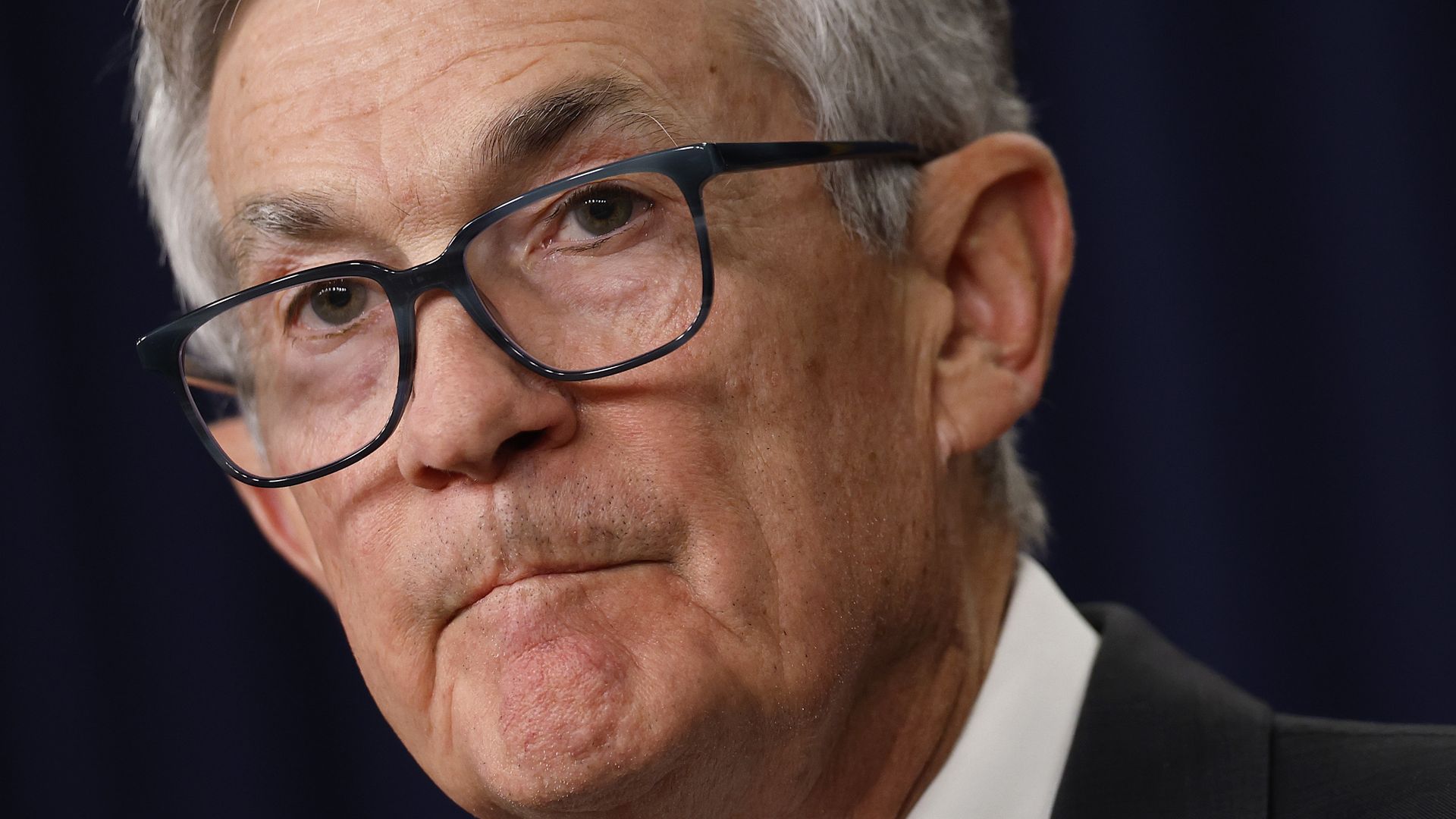
Fed chair Jerome Powell's big message in this morning's speech is simple: The cavalry isn't coming.
- That isn't remotely what Trump wants to hear.
Why it matters: Powell raised the prospect that the inflation surge generated by the trade war could prove "persistent," which implies the Fed has less flexibility to cut interest rates in response to faltering economic growth.
- In other words: no imminent relief from plunging markets and scrambled supply chains.
- Moments before the speech, Trump went on Truth Social to demand rate cuts. "This would be a PERFECT time for Fed Chairman Jerome Powell to cut Interest Rates," Trump wrote.
- "He is always 'late,' but he could now change his image, and quickly. ... CUT INTEREST RATES, JEROME, AND STOP PLAYING POLITICS!," he added.
- These developments point to a return to the tension between the president and the Fed that prevailed in Trump's first term.
What they're saying: "While uncertainty remains elevated, it is now becoming clear that the tariff increases will be significantly larger than expected," Powell said at a conference of business journalists, according to a prepared text.
- "The same is likely to be true of the economic effects, which will include higher inflation and slower growth," Powell said.
- "While tariffs are highly likely to generate at least a temporary rise in inflation, it is also possible that the effects could be more persistent."
State of play: That mix of slower growth, inflation, and high uncertainty has put the Fed's interest rate policy on indefinite hold, as Powell affirmed.
- "We are well positioned to wait for greater clarity before considering any adjustments to our policy stance," he said. "It is too soon to say what will be the appropriate path for monetary policy."
Between the lines: Financial markets are pricing in significant rate cuts over the course of the year, as the Fed reacts to a trade-induced economic slump. But Powell's comments throw some cold water on that possibility.
- If tariffs cause a one-off rise in prices, the Fed could be inclined to look through the adjustment and be more attentive to what is happening to the labor market.
- But with inflation already elevated and new tariffs an order of magnitude higher than those seen in decades, Fed officials fear Americans will lose confidence in longer-term inflation remaining low. That could unleash a cycle of rising prices.
- The Fed's obligation, Powell said, is "to make certain that a one-time increase in the price level does not become an ongoing inflation problem."
By the numbers: The stock market puked as headlines from Powell's speech blasted around Wall Street, with what had been a roughly 3% drop in the S&P 500 extending its losses.
- As of 11:40am, the index was down 4.2%.
The bottom line: Amid falling stock prices and an uncertain economic future, don't expect the Fed to come to the rescue anytime soon.
2. Jobs snapshot: Solid hiring, low layoffs


If Trump's trade policy weighed on the economy last month, it was not evident in the March jobs report.
Why it matters: In normal times, the gain of 228,000 payrolls last month and a still historically low unemployment rate might be sufficient proof to quiet recession fears.
- These are not normal times. The strong jobs report shows the economy is in a better position than feared, but that might be fleeting.
- A new suite of tariffs takes effect next week, while huge trade partners — including China this morning — plan to hit back at U.S. exporters.
What they're saying: "If tariffs were not in the picture, this report would point to continued economic expansion," Brean Capital economists wrote in a note.
- "However, this momentum in the economy is far from sufficient to ride through the tariff shock unscathed," they added.
- "[W]e will need to monitor the data closely going forward to see if the fears expressed in the equity markets translate to a cutback in hiring and investing plans by companies."
By the numbers: As of March, hiring was strong and joblessness remains low.
- The economy added a monthly average of roughly 152,000 jobs in the first quarter, slightly cooler than the average 168,000 monthly gains in the same period last year.
- Average hourly earnings rose 0.3%, matching February's pace. Over the past 12 months, wages by this measure rose 3.8% among private sector workers, slowing a bit from the 4% in February.
- That means workers still likely notched real wage gains last month, and there is little for Fed officials to worry about with respect to labor market inflationary pressure.
Officially, the jobless rate rose by 0.1 percentage point to 4.2%. But unrounded, it barely budged: it was 4.15% last month, up from 4.14% in February.
- That nudge higher looks largely to be a result of more workers coming off the sidelines: About 232,000 workers entered the workforce last month.
What to watch: Many of the DOGE-affected workers are on paid leave and receiving severance pay, so the Bureau of Labor Statistics still counts them as employed.
- Federal employment declined by 4,000, after a drop of 11,000 payrolls the prior month. With state and local employment, the government sector actually added 19,000 jobs in March.
The bottom line: In surveys, businesses warn of gloomy conditions as trade wars ramp up. At least so far, that is not apparent in the labor market indicators closely watched by policymakers.
Sign up for Axios Macro