
Axios Macro

April 01, 2025

President Trump will unveil reciprocal tariffs tomorrow afternoon, with a "Liberation Day" event in the Rose Garden. Today, we travel back in history for hints about the likely economic effects of his trade war.
- Plus, the first Job Openings and Labor Turnover Survey of the Trump era.
👀 Situational awareness: The Institute for Supply Management said the manufacturing sector fell into contraction in March, as its index of activity dropped to 49 from 50.3 (50 is the line between expansion and contraction).
- The new orders index fell particularly sharply, down 3.4 points to 45.2. 😬
Today's newsletter, edited by Ben Berkowitz and copy edited by Katie Lewis, is 781 words, a 3-minute read.
1 big thing: The ghosts of trade wars past
History, they say, may not repeat but it rhymes. America's periods of high tariffs dating back to the 1800s carry eerie similarities to today's trade war escalation.
Why it matters: The history of post-tariff higher prices and weaker economic conditions offers some perspective for what might happen in the months and years ahead.
- Tariffs have historically resulted in retaliation, pain for agricultural interests, higher consumer costs, political backlash and currency chaos, according to a new briefing by a trade group that represents companies responsible for nearly all of U.S. footwear sales.
What they're saying: "Regardless of the era, the consequences of high tariffs and retaliations remain largely the same," Andy Polk, senior vice president of the Footwear Distributors and Retailers of America, tells Axios.
- "You could swap the names of the main actors and their quotes, justifications, and politics would remain basically the same."
- "Almost like a blind taste test, if you lay out the quotes, it would be hard to guess which person said what and when," adds Polk, who says he's a descendant of President Polk — who lowered tariffs in the mid-1800s.
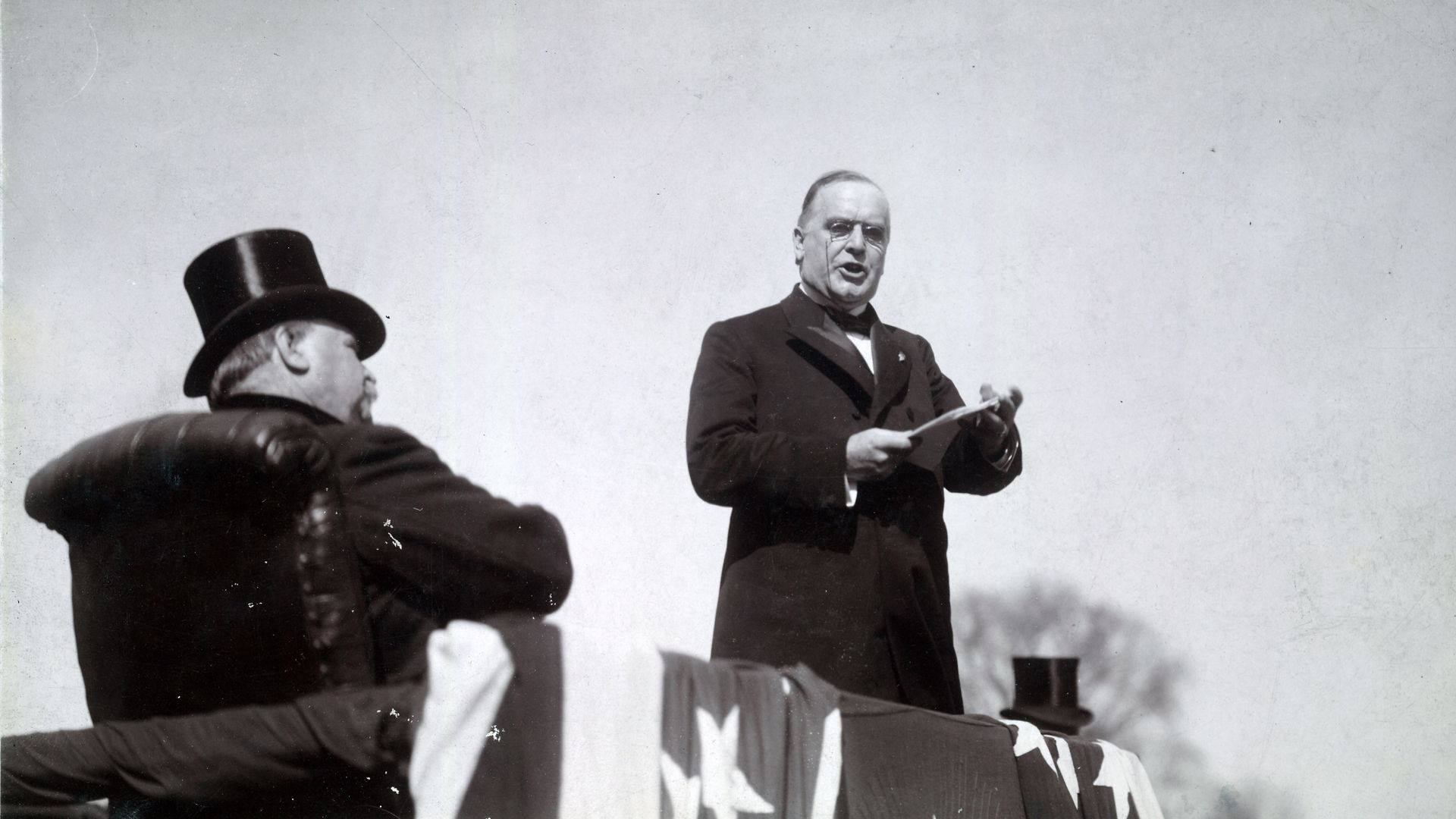
Flashback: The 1890 McKinley Tariff imposed levies of roughly 50% on almost all imports, a policy aimed at protecting domestic industry from foreign industry.
- Several nations, including Canada, retaliated with tariffs on agricultural goods. The briefing cites a go-to expert on trade history, Douglas Irwin, whose book notes that Canada created stronger trade ties with Britain.
- Many economists had expected Canada would be so economically damaged that it would join the United States — a parallel to Trump's "51st state" rhetoric.
The Smoot-Hawley Tariff, which raised the average tariff to almost 60%, resulted in higher sugar prices for the American public, to the tune of hundreds of millions of dollars, while tariffs on imported eggs soared, the briefing notes.
- The Trump 1.0 trade war in 2018 resulted in higher prices from a slew of consumer goods, including washing machines, clothing and furniture.
The intrigue: Rather than shy away from the history, Trump has openly admired former President McKinley for his trade policy. The 1890s were indeed a time of rapid industrialization.
- "President McKinley made our country very rich through tariffs and through talent," Trump, who recently restored McKinley's name to the nation's highest mountain peak, said last year.
- McKinley ultimately regretted imposing such high tariffs.
"We had no real income tax so tariffs were the main source of revenue, but it was a rather small federal government at the time," UC Davis economics professor Christopher Meissner, who wrote a recent paper on tariffs and manufacturing in the Gilded Age, tells Axios.
- But now "it's not necessarily the most efficient way of raising revenue to meet a modern economy's objectives," Meissner adds, noting that tariffs "would never" cover America's revenue needs.
What to watch: The embrace of trade protectionism might be too strong to completely reverse — one difference from years past.
- Trump's tariffs from 2018 held over into the Biden administration, though it's unclear what happens in a post-Trump era: The White House has already imposed more tariffs than in the entirety of Trump's first term.
2. Solid job market present, future warning


Hiring held up in the first full month of the Trump administration and layoffs remained low. But employers pulled back on the number of posted job openings, which could be an early sign of cracks in the labor market.
Driving the news: That is the takeaway from the Job Openings and Labor Turnover Survey (JOLTS) for February, offering a more granular understanding of what was happening with employment trends than the much-watched monthly jobs report.
- It showed that the largely stable labor market of the last six months remained stable in the early weeks of the new administration, despite some softening in business and consumer confidence surveys.
By the numbers: Hiring was essentially flat in February, rising by 25,000, and the rate remaining stable at 3.4%. The rates at which people voluntarily quit their jobs or were fired were also unchanged.
- However, employers cut back the number of posted job openings by 194,000, sending the rate of job openings to 4.5% from 4.7% in January.
- The drop in openings was particularly pronounced in wholesale and retail trade, and in arts, entertainment, and recreation.
Between the lines: The new data lines up nicely with other economic and survey data lately, which shows economic conditions holding up fine for the moment. But forward-looking indicators point to a newfound sense of caution among employers.
- After all, the hires made in February were presumably set in motion by job openings from several months ago.
- While the number of job openings can be volatile, it is an early warning of softer hiring later this year.
Sign up for Axios Macro