Axios Macro

August 25, 2023

There was a live hawk on display in the Jackson Hole Airport when Neil arrived yesterday, hosted by the Teton Raptor Center (photo below!). There was another speaking to a ballroom full of economists and central bankers this morning.
- We report on Federal Reserve chair Jerome Powell's speech below, plus a paper at the Jackson Hole symposium that suggests tight monetary policy can dampen innovation.
Today's newsletter, edited by Javier E. David and copy edited by Katie Lewis, is 739 words, a 3-minute read.
1 big thing: No victory lap from a hawkish Powell

Federal Reserve chair Jerome Powell at the 2023 Jackson Hole economic symposium in Moran, Wyoming. Photo: David Paul Morris/Bloomberg via Getty Images
Powell's much-anticipated speech this morning in Jackson Hole ran nearly 3,000 words but can be summed up in four: This isn't over yet.
Why it matters: While Powell sent no signals about the Fed's immediate next interest rate move, his comments set the stage for the central bank to hold rates steady or tighten further in the months ahead — while not entertaining the possibility of rate cuts anytime soon.
- "Although inflation has moved down from its peak—a welcome development—it remains too high," Powell said.
- "We are prepared to raise rates further if appropriate, and intend to hold policy at a restrictive level until we are confident that inflation is moving sustainably down toward our objective."
Where it stands: The remarks come after a string of favorable data that showed inflation cooling alongside a solid jobs market — a combination few economists expected, especially after an aggressive rate-hiking campaign that began nearly 18 months ago.
Yes, but: Powell acknowledged progress but warned of potential risks that may force the Fed to hike rates further down the line. The Fed set out to slow the economy, but recent data has pointed to far more resilience.
- "We are attentive to signs that the economy may not be cooling as expected," Powell said, noting that economic growth has been stronger than expected and "recent readings on consumer spending have been especially robust."
- "Additional evidence of persistently above-trend growth could put further progress on inflation at risk and could warrant further tightening of monetary policy," Powell said.
Of note: Contrary to some market speculation, Powell elected not to share any views about where the longer-term, so-called neutral rate of interest might be in the post-pandemic economy.
- "We cannot identify with certainty the neutral rate of interest, and thus there is always uncertainty about the precise level of monetary policy restraint," Powell said. "We will proceed carefully as we decide whether to tighten further or, instead, to hold the policy rate constant and await further data."
What they're saying: "This is straight down the middle," said Julia Coronado, president of MacroPolicy Perspectives, who was in the room. "The Fed is encouraged by progress but a long way from calling victory."
Flashback: The speech included throwback lines to Powell's past Jackson Hole speeches. "As is often the case, we are navigating by the stars under cloudy skies," Powell said, invoking a framework he used in his 2018 speech.
- He concluded by saying "we will keep at it until the job is done," repeating language from last year's speech that subtly invoked former Fed chief Paul Volcker, whose memoir is titled "Keeping At It."
2. How tight money can dampen innovation
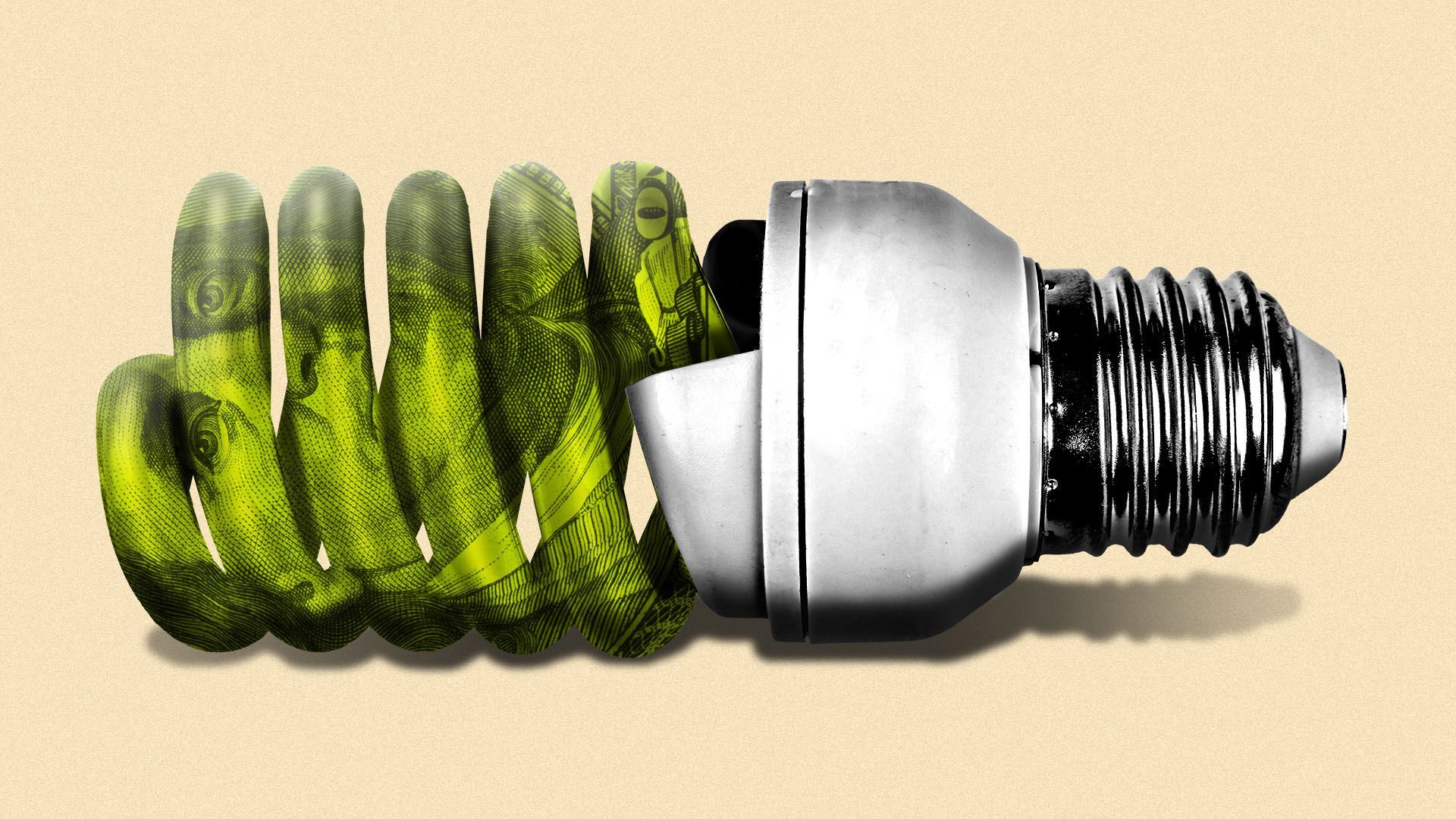
Illustration: Sarah Grillo/Axios
A buzzy paper presented at Jackson Hole warns about a potential side effect of the Fed's tightening: an innovation slump that could persist for years.
Details: Economists Yueran Ma and Kaspar Zimmermann find that rate changes in the past decade "have had noticeable effects on innovation funding such as [venture capital] investment."
Why it matters: In the era of rock-bottom rates, there was a flood of venture funding and startups were booming. The opposite has been the case since interest rates started to rise rapidly in 2022.
- Funding has slumped, with less-than-ideal consequences for cash-hungry startups.
What they're saying: "A slower pace of innovation may then have lasting effects," the economists write.
- "[R]ecent breakthroughs in AI raise the hope that another technological revolution could be on the horizon, and maximizing the benefit of the technological breakthroughs is important," the authors add.
By the numbers: The authors find that after monetary policy tightens by 1 percentage point, spending on research and development declines by as much as 3 percent, while VC investment slumps by about 25% one to three years following the tightening.
How it works: When central banks raise interest rates, they're aiming to slow economic demand. That demand slowdown "can reduce the profitability of developing new products and the incentives to innovate," the authors note.
- Additionally, tighter financial conditions — lower stock prices, higher bond yields, etc. — that traditionally come with central bank hikes can slow innovation funding as investors become more cautious.
The intrigue: "We do not think our findings necessarily imply that monetary policy should be more dovish" if innovation is slumping, the authors say.
- They acknowledged that policy affects a range of economic outcomes and cannot be expected "to balance all these dimensions."

Sign up for Axios Macro
Stay ahead of the curve on the most important economic developments with reporting and analysis on how business, policy, and markets collide.