Axios Login

April 19, 2022

Hello and welcome to Login on this Tuesday morning.
Today's newsletter is 1,179 words, a 4-minute read.
1 big thing: Labor starts to find a path into Big Tech

Illustration: Lazaro Gamio/Axios
Labor organizers see Apple and Amazon offering them an opening in the tech industry's longstanding barriers against unions, thanks to the nature of their workforces.
How it works: Unlike their competitors, these firms each have massive payrolls in retail or warehouse jobs, and those roles are seen as friendlier to unionizing efforts than the engineers and salespeople at corporate HQ.
Why it matters: Amid a broad decline in the number of unionized American workers over the last 40 years, the tech industry has long painted unions as a danger to Silicon Valley's reputation for innovation and flexibility.
- Union supporters see signs of change emerging just as wider disenchantment grows with the industry's power, wealth and practices.
Driving the news:
- Workers at Apple's Grand Central Terminal store in New York have taken the first steps toward unionization, gauging worker support. On Monday, organizers said their initial goals for the effort include salaries to at least $30 per hour, as well as improved retirement plans and other benefits.
- Workers at one Amazon facility in Staten Island facility voted to unionize earlier this month, while another is set to vote this month. A re-vote in a Bessemer, Alabama, warehouse faces continuing disputes over contested ballots and charges over Amazon's tactics.
Between the lines: Amazon and Apple don't officially reveal the breakdown of their workforce composition.
Amazon: In 2021, Amazon said it employed nearly a million workers in the U.S. The number ballooned during the pandemic as demand for deliveries soared.
- The employment tally does not include contractors, such as many of the firm's delivery drivers.
Apple: The spread of Apple Stores over the past decade has brought tens of thousands of retail workers onto the company's payroll.
- A 2018 analyst's estimate of 65,000 Apple Store workers is now widely cited, but the number has likely grown significantly since then.
- Apple's total global workforce is 165,000 today.
The big picture: While the tech industry overall remains solidly nonunionized, recent efforts to organize some online media and video game workplaces have begun seeing some success.
Zoom out: From Big Tech to retail big and small, various industries are seeing their workers organize in unprecedented ways.
- Before the pandemic, successful teachers' union strikes and Bernie Sanders’ presidential campaign laid some of the groundwork for the recent wave in organizing, Ken Jacobs, UC Berkeley Labor Center chair, tells Axios' Hope King.
- During the pandemic, "workers saw themselves deemed as essential but treated as disposable ... [which] created a lot of anger [and] willingness to take action."
- The National Labor Relations Board is seeing the highest level of union organizing in 10 years, CNN reports.
Meanwhile: Employees at Alphabet have taken a novel approach to unionization, forming a "minority union" that can't collectively bargain with the Google parent company. Organizers aim to become a voice for workers and contractors on a range of issues beyond those traditionally covered by labor laws.
- Workers at a Google Fiber subcontractor in Missouri have voted to unionize, giving the nascent union its first chance to negotiate a contract.
2. Calif. eyes new privacy rules for kids

Illustration: Aïda Amer/Axios
California lawmakers will debate a law Tuesday meant to require internet companies to design programs and apps for kids in ways that protect their privacy, Axios' Ashley Gold reports.
Why it matters: If the bill passes in California, many other states are likely to adopt similar measures, as happened with the state's last online privacy law.
Details: The California proposal resembles new rules passed last year in the U.K. that govern how tech firms can target kids with push notifications, messaging controls and other features.
- The California Assembly's privacy committee will vote Tuesday on the California Age Appropriate Design Code, where it is expected to pass. It will then go to the assembly's appropriations committee and eventually the assembly floor. The state senate will also need to approve it.
What they're saying: "Like so many parents, I grapple with how challenging it is to shield our kids from the harmful content and experiences they’ll encounter online," Democratic Assemblymember Buffy Wicks, a co-sponsor of the bill, said in a statement to Axios.
Be smart: In recent years, the U.K. and Europe have led the world in tightening privacy rules with measures like the General Data Protection Regulation.
- The U.K. design code has 15 standards that online services must follow for products that children use.
- The California bill closely mirrors the U.K. code and would apply to companies headquartered in California.
The big picture: In the absence of a uniform national online privacy code, the California Consumer Privacy Act set the de facto standard in the U.S., and many states followed suit with their own versions.
The bottom line: Congress' failure to pass a national privacy law means something similar is likely to happen with the new children's rules.
3. 2022's weirdest game system
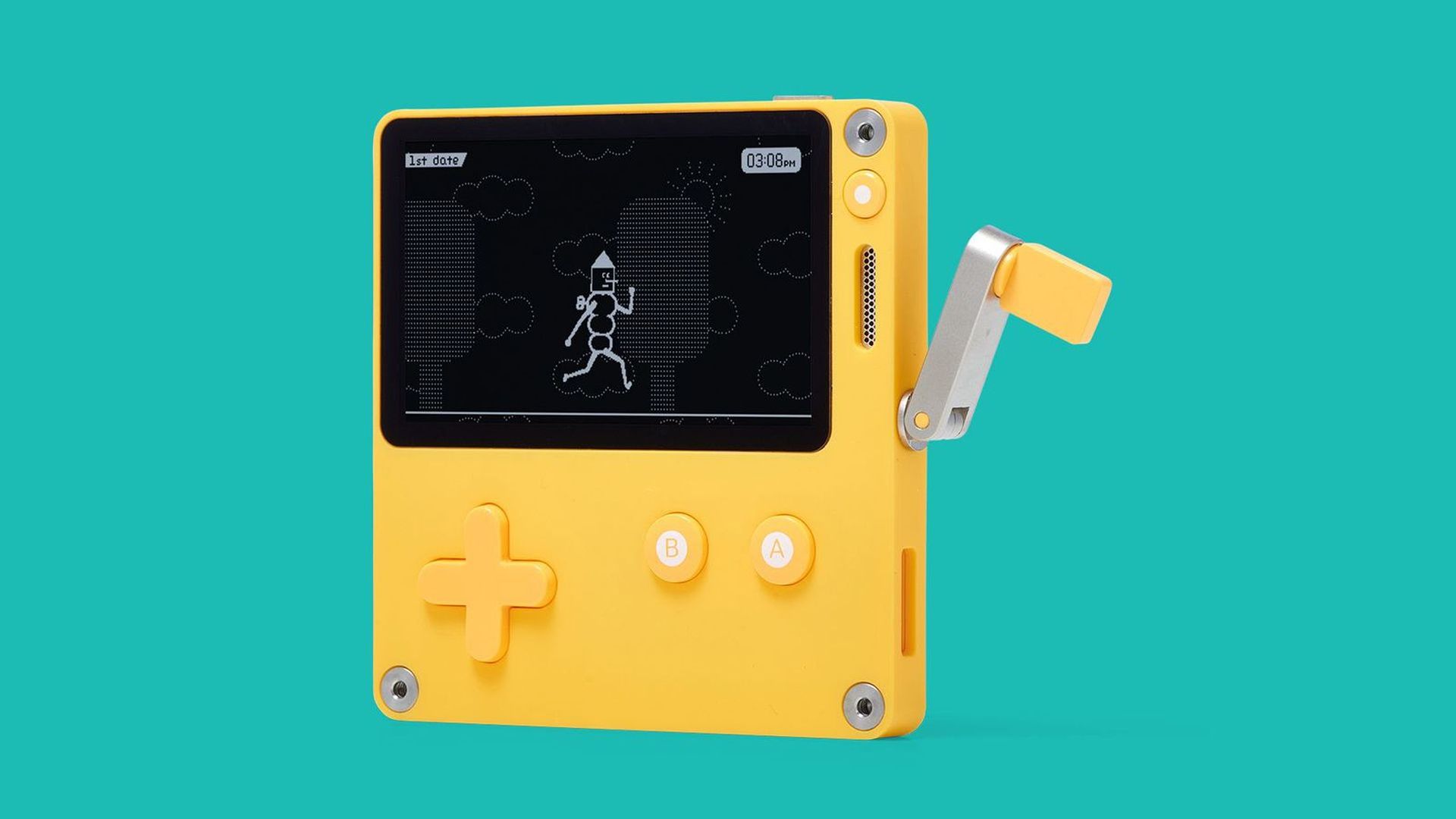
Photo: Panic
The brand-new Playdate portable gaming device has more going for it than a striking yellow color scheme and a crank you can use to control some of its games, Axios Gaming's Stephen Totilo writes in his review.
Driving the news: Launched on Monday, the Playdate is a mix of retro and modern with a clutch of unexpectedly pleasing games.
- It's also in short supply. The first wave of devices are shipping this week, according to its designers at Panic.
- But anyone who preorders one of the $179 machines today won't get theirs until next year.
The details: The Playdate is a tiny block of plastic about 3 inches square, with a monochromatic screen that harkens back to Nintendo's original Game Boy.
- It has buttons and a crank, the latter used in some of Playdate's first wave of games for stirring potions, swinging a sword, rotating a surfboard and, in at least two games, turning back time.
- But the system's most novel idea is its initial seasonal approach to game releases, doling out two new games a week — and at least one surprise — for 12 weeks, starting the moment an owner first connects the system online.
- The season feels of the moment. On a Playdate, the update awaiting you as you check the device isn’t a bunch of emails, Instagram photos or depressing tweets — it's small, often quirky new games that come digitally gift-wrapped.
4. Take note
On Tap
- Netflix discusses its earnings report after the markets close, while Miami Tech Week continues.
Trading Places
- Former Cars.com CFO Sonia Jain has been hired by trucking startup Convoy to be its its new chief financial officer, GeekWire reported.
ICYMI
- Following Meta, Amazon says it will undergo a racial equity audit to be led by former U.S. Attorney General Loretta Lynch. (Time)
- Glowforge CEO Dan Shapiro said his company will pay the expenses for employees or their family members who need to travel to access gender-affirming or abortion-related healthcare in the wake of a number of state-level restrictions. (GeekWire)
- Engineers give a peek into how Twitter's in-development edit feature could work. (TechCrunch)
5. After you Login
Named part of the ownership group of the NHL's Seattle Kraken, NFL veteran Marshawn Lynch did doughnuts in a Zamboni. (Which, it turns out, is what I would like to do when I buy an NHL team.)
Sign up for Axios Login

Taking you inside the AI revolution, and delivering scoops and insights on the technologies reshaping our lives.