Axios Login

June 06, 2023

Hi, it's Ryan, and I'd love for tech companies to launch products the same year they're actually ready to sell them.
Situational awareness: The SEC sued Coinbase, the largest U.S. crypto exchange, for evading securities regulations, a day after it sued Binance, the biggest global exchange.
Today's Login is 1,119 words, a 4-minute read.
1 big thing: Mixed reality's iPhone moment
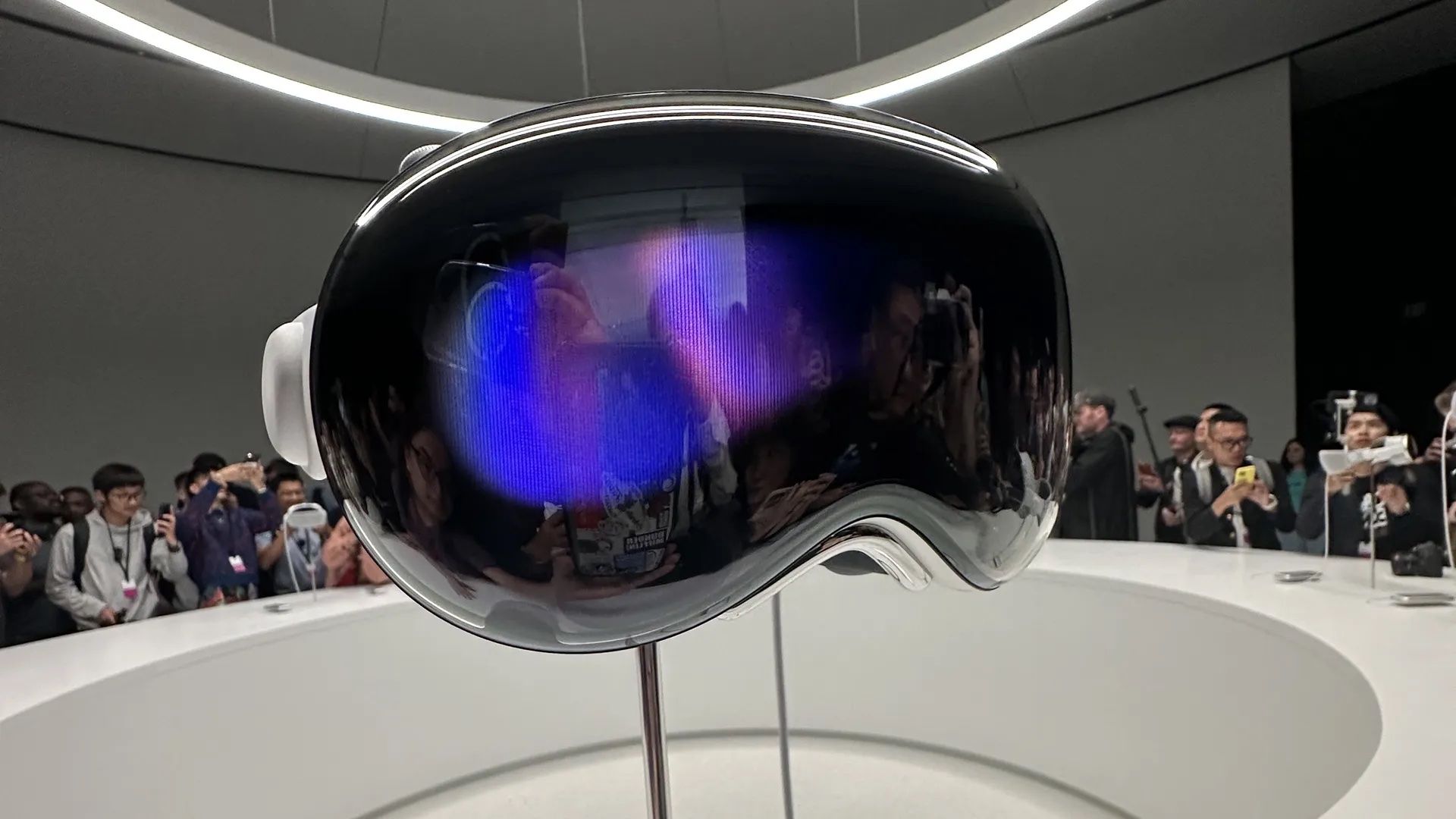
Photo: Ina Fried/Axios
Apple showed enough of its Vision Pro headset on Monday to spark excitement — but it will probably take another year or so to know if we have truly entered a new era of "spatial computing," as the company calls it, Axios' Ina Fried reports.
The big picture: The vision Apple painted is tantalizing and expansive — but also incomplete and expensive.
Be smart: The device won't ship till "early next year." That means more time will pass between now and the Vision Pro's arrival than has already passed since the launch of ChatGPT till now.
Driving the news: Apple CEO Tim Cook unveiled the $3,499 Vision Pro at the company's worldwide developer conference Monday, painting a picture of a device that can seamlessly overlay the digital and real worlds.
- Apple showed the headset fulfilling a range of tasks from playing movies and games to handling work tasks via multiple virtual monitors.
- Demo videos showed headsetted users working and playing in physical living rooms and offices festooned with 2D app icons and browser windows and even the occasional 3D virtual object.
Yes, but: We've seen this vision before. Meta made a very similar case for its $1,499 Quest Pro as Apple is making for its headset.
- But both reviewers and the marketplace concluded the technology wasn't ready for the kinds of office work and communications tasks the company envisioned.
The big picture: The real question is whether Apple has managed to succeed where others have so far failed.
- Leave aside the hefty price tag for a moment — the tech industry has a long history of being able to drive down costs over time.
- The more important issue is whether or not the device — along with the technology that underlies it — is truly ready for mainstream adoption.
Between the lines: Apple is known for picking the right moment when an emerging technology is just good enough to appeal to a wide group of customers.
- Cook and his company clearly believe that moment has arrived for headsets — and they've packed this one with 12 cameras, 5 sensors, 6 microphones and two different processors.
The other puzzle pieces that are tough to evaluate before Apple lets the device loose for public use is are the human aspects — everything from how it feels and looks to whether the interface is natural enough to appeal beyond the world of geeks and gamers.
- Vision Pro is a bet on the power of the headset to provide a sharp enough display for text and an immersive enough canvas for immersive movies.
- It's also a gamble on the ability of touch, eye-tracking and voice to be sufficient to use the device without need for any type of handheld controller.
Flashback: This sense of timing is what has defined Apple's most successful products.
- The iPhone wasn't the first smartphone, for sure. It wasn't even the first one with a capacitive touch screen. The iPod wasn't the first hard-drive-based music player, either.
- In both cases, Apple hit the market with just the right combination of a great interface wrapped around breakthroughs in hardware — the iPhone's responsive touch-screen, the iPod's thin disk drive.
Our thought bubble: I have no doubt the hardware will only get better. Some day the Vision Pro will look incredibly crude and bulky, the way early iPods and iPhones do now. The question is whether it is good enough to usher in a new era.
- I have yet to try the Vision Pro myself (stay tuned for Wednesday's Login) but early reviews suggest it might deliver on many of Apple's promises.
What to watch: One early tell will be how avidly developers embrace what Apple has created.
- If the Vision Pro really is the next big platform, it won't be just Safari and FaceTime that people are using, but all manner of apps — including new ones designed just for mixed reality.
2. Push for new House AI committee

Illustration: Brendan Lynch/Axios
Rep. Michael Waltz (R-Fla.) Monday called for the creation of a House committee dedicated to AI in an exclusive interview at an Atlantic Council event with Axios' Ryan Heath.
Why it matters: Waltz's call is the first time a member of Congress has publicly called for a new Congressional body dedicated to tackling AI issues.
- Pressure on Congress, and debate among members of Congress, has until now focused on the need for regulation and possibly a federal agency dedicated to AI.
Zoom out: Waltz, a China hawk who fills Ron DeSantis' old seat, is co-chair of a new, bipartisan think tank called the Global Tech Security Commission.
Be smart: Several Congressional committees already are already wading into AI-related issues.
- The Senate Judiciary Committee, which conducted hearings in May, will hold hearings on AI and intellectual property on Wednesday.
- The House Judiciary Committee and House Science, Space and Technology Committee are also active.
- A bipartisan Congressional AI Caucus has 52 members.
What they're saying: Waltz warned that Congress is not paying enough attention to AI and could "screw this up," and called AI the biggest unaddressed threat in the U.S.-China relationship.
- "We need a very small and select committee," Waltz said, made up of the representatives most knowledgeable on AI and able to do "deep dives."
- Waltz rejected the idea of pausing AI innovation as "incredibly dangerous" because it would hand economy and military advantages to China.
The other side: David Spirk, a senior counselor at Palantir Technologies and former chief data officer at the Pentagon, told Axios that centralizing Congress' AI activities "probably is a mistake" and instead urged every committee to improve its AI knowledge.
3. Tech on track to top 2001 layoffs

Illustration: Natalie Peeples/Axios
With 136,831 tech jobs announced to be cut by U.S.-based employers this year, the sector is on track to top the 168,395 layoffs announced in all of 2001 during the industry's last great downturn, the dotcom bust.
By the numbers: Of 80,000 job cuts announced by U.S.-based employers in May, 22,887 were in tech, per executive coaching firm Challenger, Gray & Christmas.
- Shifts to artificial intelligence accounted for 3,900 jobs lost in May — roughly 1 in 20 of those laid off.
4. Take note
On Tap
- Apple's Worldwide Developer Conference continues at Apple Park in Cupertino.
ICYMI
- Tech platforms are rolling back policies that blocked election- and COVID-related misinformation. (Axios)
- Microsoft will pay $20 million to settle Federal Trade Commission charges that it violated a privacy law by collecting and illegally retaining personal information from minors who signed up for its Xbox gaming system. (FTC)
- France passed a law to regulate paid influencers — and in some cases to ban them — to combat fraud. (Euronews)
5. After you Login
The U.S. has retrieved flight craft of non-human origin, a whistleblower with access to classified intelligence has alleged, as The Debrief reports.
Thanks to Scott Rosenberg for editing and Bryan McBournie for copy editing this newsletter.