Axios Login

August 30, 2022

Situational awareness: Elon Musk has sent a new termination letter to Twitter, adding the whistleblower accusations of Peiter "Mudge" Zatko as a new reason for ending his $44 billion purchase of the company.
- Meanwhile, Twitter this morning announced it will give all users access to Circle, a new feature that lets people share a post with a small circle of friends.
And now, on with our series on tech competition — today, with a focus on broadband access. Today's newsletter is 1,312 words, a 5-minute read.
1 big thing: Goalposts moving on broadband competition

Illustration: Shoshana Gordon/Axios
Most Americans can choose among several providers of home internet service, but that competition masks their much more limited options for the higher-speed connections most users today want, Axios' Margaret Harding McGill reports.
The big picture: Home internet connections became even more essential during the pandemic, but there's still wide disagreement among trade groups, consumer advocates and government agencies about the extent of competition in the broadband market.
State of play: According to the most recent data from the Federal Communications Commission, more than 97% of Americans currently have access to home internet service from three or more providers at speeds of 25/3 Mbps. (The first number represents download speed, and the second is for upload.)
- That speed is what the FCC now calls broadband. But there's growing consensus that it's not fast enough for today's demands.
- FCC chairwoman Jessica Rosenworcel wants to raise the standard to 100/20 Mbps.
- According to FCC data, nearly 30% of Americans now have access to three or more providers at 100/10 Mbps, and almost 40% can buy service at that speed from two companies.
Of note: The FCC's figures include satellite internet and fixed wireless service providers.
The FCC's data shows that only about 56% of Americans have access to a wired home internet connection — fiber, cable or ADSL (which uses copper telephone wires) — from two or more providers at speeds of 25/3 Mbps.
- Only 11% of Americans have three or more options for a wired connection at that speed.
What they're saying: "Even three is really not sufficient," Angie Kronenberg, general counsel for trade group INCOMPAS, told Axios. "You typically need four or more in order for there to be really robust competition."
- "You cannot say there is nationwide competition in every household for broadband," Jonathan Schwantes, senior policy counsel for Consumer Reports, told Axios. "It's just not true."
- A Consumer Reports survey in 2021 found that 26% of Americans said they had one choice for a wired home internet connection, 32% said they had two, and 16% said they had three.
- The survey also found the cost of home internet decreases based on the number of providers.
The other side: Trade associations for telecom and cable companies say competition has increased in the broadband industry as companies have invested billions in their networks.
- Cable trade group NCTA pointed to FCC data that shows that the percentage of Americans who can buy service from multiple providers at speeds of 100/10 Mbps nearly tripled between 2016 and 2020.
- USTelecom, another trade association, says prices have declined, speeds have increased and companies are continuing to invest — all hallmarks of a competitive industry.
Between the lines: Technical improvements are making fixed wireless, which delivers high-speed connections to homes using wireless networks, more of a competitive threat.
Meanwhile, SpaceX satellite internet service Starlink promises internet service in rural parts of the country at far greater speeds than in previous generations of satellite internet.
- But the FCC questioned whether the service can deliver those speeds and denied the company nearly $900 million in funding to build out rural service.
What's next: The Infrastructure Investment and Jobs Act provides $42.5 billion in funding to build internet networks at speeds of 100/20 Mbps.
2. New Corning factory will sate broadband thirst
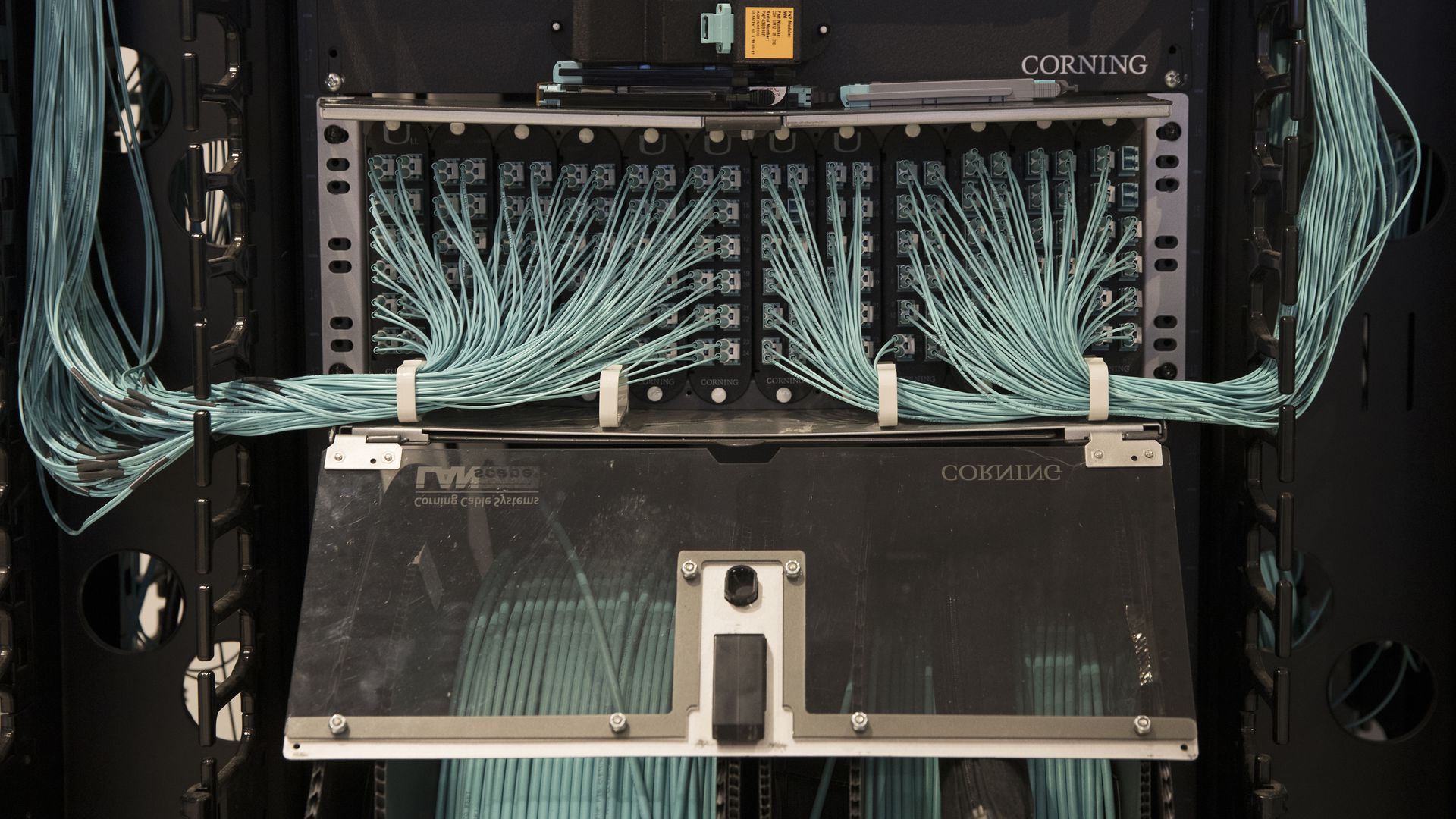
A Corning fiber optic access point in 2017. Photo: Victor J. Blue/Bloomberg via Getty Images
Corning today announced it will build a new manufacturing facility outside Phoenix in response to a spike in demand for fiber-optic cable as the U.S. government ramps up a $42.5 billion internet funding program, Margaret reports.
Why it matters: Building high-speed internet service to connect all Americans won't happen without the right equipment — and, thanks to the infrastructure funding law's "Buy America" provisions, it will need to be largely U.S.-made.
Driving the news: The fiber-optic cable factory will be built in Gilbert, Arizona. It's expected to open in 2024 and will add about 250 jobs.
- Corning said the investment is supported by customer commitments, including from "anchor customer" AT&T, which is also working with Corning on a fiber optic technician training program.
Between the lines: Corning, the 170-year-old company best known for glass, is poised to get a big boost in broadband business. It's the largest U.S. manufacturer of fiber optic cable at a time when U.S. law requires providers to use domestic-made products to receive federal funding.
State of play: AT&T is focusing on a fiber-first strategy for its expansion plans, with a goal of reaching 30 million locations with fiber by 2025.
- The company's wireless competitors, Verizon and T-Mobile, are building out home services based on 5G wireless connections.
- "Our belief is that while in the near term, fixed wireless might be able to play and meet some needs today, over the long haul we believe the only scale technology for most established businesses and homes is going to be fiber optics," AT&T CEO John Stankey told Axios.
3. The space race for our cell phones
Illustration: Aïda Amer/Axios
Already an option for fixed broadband, satellite-based internet access on standard smartphones is starting to become reality, Axios' Hope King, Miriam Kramer and the hardworking Margaret Harding McGill report.
Why it matters: Young satellite companies say they're on the precipice of blanketing the planet with cell phone service. If they succeed, their technology could eliminate dead zones and provide more reliable coverage to millions of people.
Driving the news: Elon Musk and T-Mobile CEO Mike Sievert late last week announced plans to start delivering service through SpaceX's Starlink by the end of next year in the U.S.
- Only text and certain messaging capabilities will be available in the beginning, with the goal of adding voice and data down the line.
- "We've all read about someone who was hiking, got lost or died of thirst or exposure," SpaceX co-founder Elon Musk said during the announcement event, adding that this service will help in those types of situations.
How it works: New satellites equipped with larger and more powerful antennas will pick up signals from cell phones directly, rather than relying on cell towers.
- Sievert described the vision as putting cell towers in the sky, but "a lot harder."
- The partnership would effectively enable cell phones to do what satellite phones can do, former FCC chief technologist Jon Peha tells Axios.
State of play: AST SpaceMobile and Lynk are other major competitors working to make cell coverage direct from space a reality.
- Project Kuiper, from Amazon, is working with Verizon on an effort to provide rural communities with wireless coverage via thousands of satellites.
- Rumors are also swirling that Apple might be set to announce its own direct-to-satellite iPhone partnership with Globalstar next week.
The ultimate goal is to offer high-speed mobile internet access via satellite.
What they're saying: "The human race is becoming less and less tolerant of being disconnected," AT&T CEO John Stankey told Axios in an interview.
What's next: SpaceX and T-Mobile will need regulatory approval from the Federal Communications Commission for their plans.
4. Take note
On Tap
- Today's earnings reports include Crowdstrike and both printer/computer maker HP Inc. and Hewlett Packard Enterprise.
Trading Places
- Longtime Google and YouTube executive Robert Kyncl is leaving the company after a dozen years, with Google executive Mary Ellen Coe taking over his chief business officer role in October, CNBC reports.
- Y Combinator CEO Geoff Ralston is stepping down at year's end, to be replaced by Garry Tan, who left Y Combinator in 2015 to help start Initialized Capital.
ICYMI
- Google says it's blocking former President Trump's Truth Social Android app from its store because of content moderation failures. (Axios)
- Microsoft is changing its licensing policies in Europe after complaints from rivals. (Bloomberg)
- Lawyers for Elon Musk have filed a subpoena for Peiter Zatko, Twitter's former security chief who recently came forward as a whistleblower. (Axios)
- The FTC is suing data broker Kochava for selling geolocation information from mobile devices that can be used to track people. (Axios)
5. After you Login

My friend Vicki shares this tip: Slicing off the bottom of a bok choy produces what looks like a beautiful green rose.