Axios Login

July 13, 2023

Hi, it's Ryan. I'm giving a shout out the all the scientists and philosophers and humanitarians who have spent thousands of years trying to "understand reality." (See second item below.) Today's Login is 1,191 words, a 4-minute read.
Situational awareness: Right before FTC chair Lina Khan testifies before the House Judiciary Committee at 10 am ET this morning, a source familiar confirmed to Axios that the agency has opened an investigation of ChatGPT maker OpenAI, exploring how the company manages risks.
- Yesterday the FTC said it was appealing a court's ruling against its effort to block Microsoft's acquisition of Activision.
1 big thing: 5G goes members-only

Illustration: Shoshana Gordon/Axios
After years of public 5G networks rolling out nationwide, the biggest mobile network action is now in private 5G networks.
The big picture: The private networks are popping up not just in places where they were long expected, such as schools and hospitals, but also at sports events, festivals, construction sites and mines — anywhere businesses are trying to wow their customers or speed up operations.
Why it matters: America's huge appetite for connected experiences and organizations is exceeding what sometimes patchy and insecure public 5G networks have delivered.
- That’s led to a surge of private 5G innovation, including the arrival of pop-up 5G networks at sporting events and festivals and special units designed to help with disaster relief.
- The shift also has an element of global competition: more than 5,000 private 5G networks are running in China, leaving the U.S. in catch-up mode.
Driving the news: The Cleveland Clinic on Tuesday opened a new hospital in Mentor, Ohio, one of the first in the nation to be built with private 5G in mind: a "fully digital hospital infrastructure," per Matthew Kull, chief information officer at Cleveland Clinic.
- The facility uses Verizon 5G for robot check-in kiosks, high resolution cameras in every patient room, assisted surgery and imaging and patient infotainment.
What's happening: Mobile networks are no longer the exclusive domain of big telecom companies.
- Tech companies including Amazon, Cisco and HP have become significant players in 5G, spurring new partnerships and surprising results.
Customers who only need temporary or small networks can opt for virtual 5G networks that rely heavily on software.
- That can means huge companies like Amazon end up serving the smallest companies, while telcos seeking to pay for massive investments in spectrum license chase the biggest customers.
Construction projects have proved a lucrative market, even in dense urban areas with plenty of broadband. Private 5G can be cheaper and quicker than digging up roads for new cables, or dealing with historic building preservation rules.
Sports use cases range from massive events like the Formula 1 Grand Prix in Miami in May, where private 5G helped keep 250,000 fans moving and purchasing, to the Phoenix Suns' new practice facility, which uses 150 wall and ceiling cameras and sensors to capture each player's every movement. In past NBA seasons, the team had to get by with just four cameras.
Verizon executive vice president Craig Silliman told Axios that private 5G use cases range from mining companies in isolated areas to heavily regulated banks to military facilities like Joint Base Pearl Harbor Hickam, where Ericsson and Verizon are partnering to improve the base's aircraft maintenance.
- An AWS product called Snowcone has combined use of drones with a mobile 5G network in a van to help with typhoons in the Philippines and landslides in Brazil.
What they're saying: Jan Hofmeyr, an AWS vice president, told Axios "there's a lot of room for everybody" in the private 5G market.
- Hofmeyr said Amazon's development and use of private 5G was spurred by needing a more effective network for operating autonomous robots than WiFi.
- By developing their own 5G systems, Amazon gained more productive (and constantly monitored) workers and robots — and a 5G business line for AWS which pairs with other AWS Cloud services.
The Lightning in a Bottle music festival, held at a remote location outside of Bakersfield, California, in late May, couldn't have been delivered without private 5G, Jordan Reed, a network architect at entertainment company DDR.Live, told Axios.
- Relying on WiFi and multiple vendors created ongoing hassles at past festivals, Reed said — from problems with wristband scanners to a network outage when radio installations failed at the 2022 festival.
Yes, but: One reason private 5G has been slow to ramp up until recently is that the previous network generation, LTE, can get the job done in most cases.
- "You can serve 95% or so of use cases with private LTE and there is no real need for 5G," per Pablo Tomasi, an analyst at Omdia.
- Around half of all new private networks announced globally in 2022 incorporated 5G, per Analysys Mason, but in the U.S it's only 26%.
- The U.S. lag is partly due to the popularity of LTE networks that operate on spectrum the FCC released in 2015, known as Citizens Broadband Radio Service.
2. Elon Musk unveils new AI startup, xAI
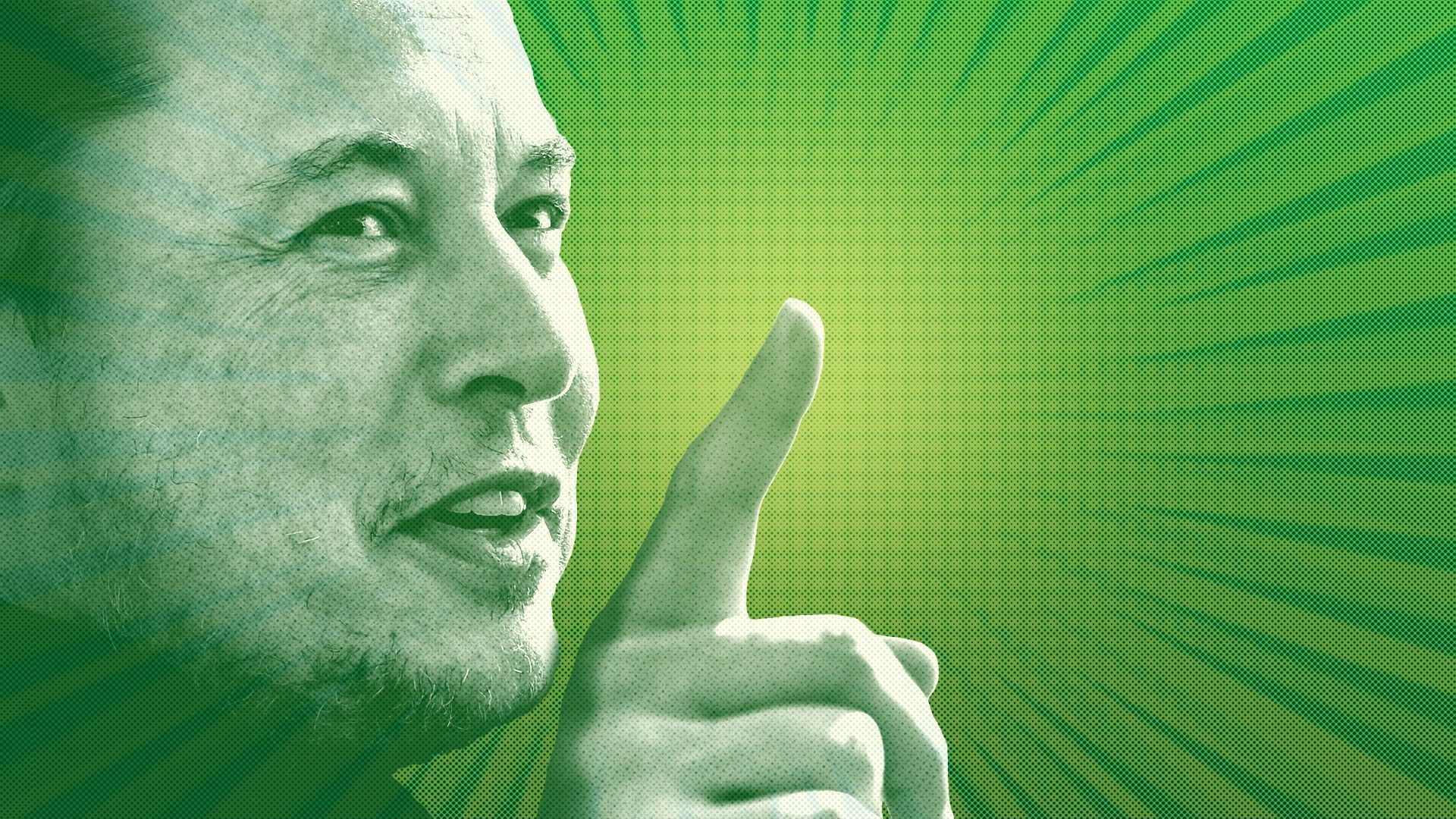
Photo illustration: Sarah Grillo/Axios. Photo: Patrick Pleul/Pool via Getty Images
Elon Musk officially launched his AI startup, xAI Wednesday, reports Axios' Hope King.
Why it matters: The announcement, made on Twitter, comes amid a heated race to develop generative AI products — and a conflict over what sort of rules AI should follow.
Driving the news: "Announcing formation of @xAI to understand reality," Musk tweeted.
- The company, according to its website, is led by Musk and aided by a team of research engineers who have previously worked for Google Research, DeepMind, OpenAI, Microsoft Research and Tesla.
- The all-male team, according to their own websites and profiles, have been focused on large language models, deep learning, and neural networks.
- While other firms have set out to create guardrails in AI to avoid hate speech and bias, Musk has denounced such efforts as "woke" AI and "censorship."
Our thought bubble: Homogeneous perspectives lead to distorted AI results. "Understanding reality" is likely to demand a broader range of views than x.AI's single-gender leadership team seems to offer.
What to watch: Musk and his team plan to host a Twitter Spaces conversation on Friday.
3. Adobe proposes anti-impersonation law
Adobe wants Congress to pass an anti-impersonation law that would protect artists and creators from people using AI to impersonate their work, general counsel Dana Rao, told Axios' Ashley Gold.
Why it matters: Adobe, which uses AI in its creative tools, has an interest in both protecting creators of visual and audio art and ensuring that any new legislation around AI doesn't go too far in restricting creativity and innovation.
- Concerns over how AI will impact copyright and IP are bubbling over in Congress, Axios previously reported.
What they're saying: A federal "anti-impersonation right" will address a core concern of creators, who may be asking "is somebody using an AI model, training it off of my work, creating something that [impersonates] me, and I don't get paid for that?" said Rao, ahead of Senate testimony on AI and IP Wednesday.
- If you're "intentionally impersonating someone's style or likeness" creators should be able to use a statutory damages concept to prove economic harm, he said.
Details: Adobe came up with the concept after talking to creators, and says it has received positive feedback from lawmakers.
- "There's months ahead of gathering data and getting feedback on how exactly this would work," said Rao.
What's next: Rao said Adobe has met with Senate Majority Leader Chuck Schumer's office to discuss his plans for an AI legislative framework.
4. Take note
Trading Places:
- Lauren Garry is the new legal adviser to FCC commissioner Brendan Carr.
ICYMI:
- China's major tech companies have shed $1 trillion in value during two years of regulatory crackdown. (Reuters)
- Elon Musk's Twitter faces a $500 million lawsuit over ex-employee severance. (Variety)
5. After you Login
So cool! Scientists have created a white paint that can make building surfaces 8°F cooler than midday air temperatures, and up to 19°F cooler at night.
Thanks to Scott Rosenberg for editing and Bryan McBournie for copy editing this newsletter.
Sign up for Axios Login

Taking you inside the AI revolution, and delivering scoops and insights on the technologies reshaping our lives.