Axios Login

February 24, 2023

Hi there. I'm back after a quick trip to Tahoe with the family. (See After you Login for pics.) Today's Login is 1,237 words, a 5-minute read.
1 big thing: Generative AI is a legal minefield
Illustration: Allie Carl/Axios
New generative AI systems like ChatGPT and Dall-E 2 raise a host of novel questions for a legal system that always imagined people, rather than machines, as the creators of content.
Why it matters: The courts will have to sort out knotty problems like whether AI companies had rights to use the data that trained their systems, whether the output of generative engines can be copyrighted, and who is responsible if an AI engine spits out defamatory or dangerous information.
Between the lines: New laws specific to AI don't yet exist in most of the world (although Europe is in the process of drafting a wide-ranging AI Act). That means that most of these issues — at least for now — will have to be addressed through existing law.
- Meanwhile, critics say that as the field has accelerated, companies are taking more risks.
- "The more money that flows in, the faster people are moving the goal posts and removing the guardrails," says Matthew Butterick, an attorney whose firm is involved in lawsuits against several companies over how their generative AI systems operate, including Microsoft's GitHub.
Here are four broad areas of legal uncertainty around AI:
Should AI developers pay for rights to training data?
One big question is whether the latest AI systems are on safe legal ground in having trained their engines on all manner of information found on the internet, including copyrighted works.
- At issue is whether or not such training falls under a principle known as "fair use," the scope of which is currently under consideration by the Supreme Court.
- Much of the early legal battles have been about this issue. Getty, for example, is suing Stable Diffusion, saying the open source AI image generator trained its engine on 12 million images from Getty's database without getting permission or providing compensation.
- CNN and the Wall Street Journal have raised similar legal issues about articles they say were used to train Open AI's ChatGPT text generator.
It's not just about copyright. In a lawsuit against GitHub, for example, the question is also whether the CoPilot system — which offers coders AI-generated help — violates the open source licenses that cover much of the code it was trained on.
- Nor are the potential IP infringement issues limited to the data that trains such systems. Many of today's generative AI engines are prone to spitting out code, writing and images that appear to directly copy from one specific work or several discernible ones.
Can generative AI output be copyrighted?
Works entirely generated by a machine, in general, can't be copyrighted. It's less clear how the legal system will view human/AI collaborations.
- The U.S. Copyright Office this week said that images created by AI engine Midjouney and then used in a graphic novel were not able to be protected, Reuters reported.
Can AI slander or libel someone?
AI systems aren't people, and as such, may not be capable of committing libel or slander. But the creators of those systems could potentially be held liable if they were reckless or negligent in the creation of the systems, according to some legal experts.
- ChatGPT or Microsoft's new AI-powered Bing, for example, may face a new kind of lawsuit if the information they serve up is so defamatory as to constitute libel or slander.
The problem is trickier still because AI shows different results to different people.
- Unlike traditional apps and web sites, which generally return similar information given the same query, generative AI systems can serve up completely different results each time.
Who's responsible if AI systems offer private or dangerously false info?
Another question is whether the makers of AI systems could be found liable for the consequences of providing dangerously wrong information.
- Companies like Microsoft, Google and OpenAI have recently detailed their efforts to improve the accuracy of their generative AI programs, while also warning customers that the AI engines may offer information that's fabricated or wrong.
- Private information could also be exposed by generative engines, something that anecdotal reports suggest is already occurring.
What to watch: Both courts and lawmakers will likely play a role in determining how these and other legal issues play out. The courts will seek to apply existing law, while legislators may face pressure from several directions to write laws more directly addressing AI.
Go deeper: Read more in Axios' AI Revolution series — start here.
2. Raimondo: U.S. funds to build 2 chip "clusters"
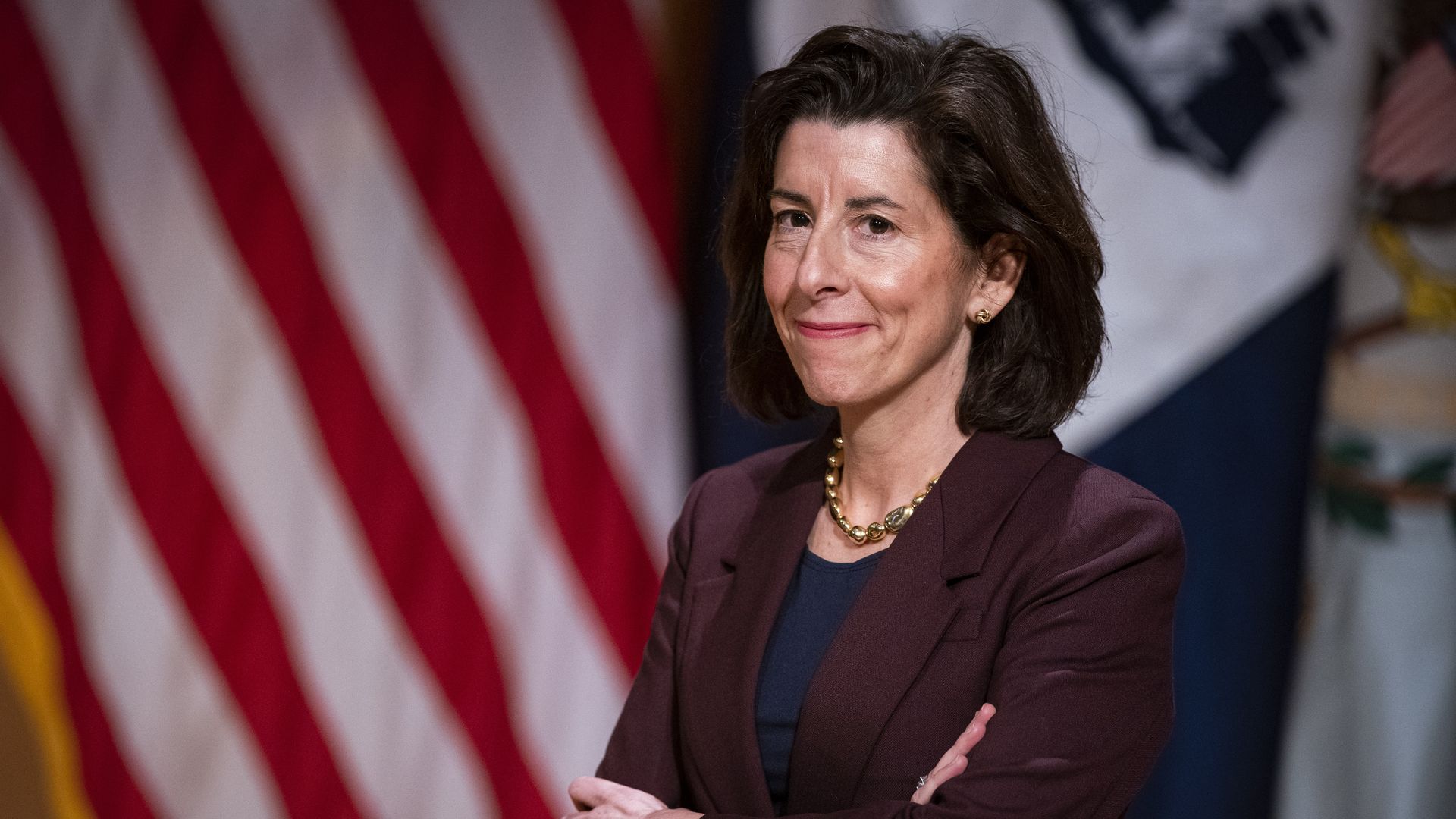
Commerce Secretary Gina Raimondo during an event at Georgetown University's School of Foreign Service in Washington, D.C., on Thursday. Photo: Al Drago/Bloomberg via Getty Images
Commerce Secretary Gina Raimondo said Thursday the Biden administration wants to use the $52 billion CHIPS Act to create two new "clusters" in the U.S. for manufacturing semiconductors.
What's happening: The Commerce Department plans to open applications next week for companies to seek funding under the law, passed last year.
What they're saying: In a speech at Georgetown University, Raimondo said the purpose of the spending was to bolster national security, not pick favorites in the chip business.
- "Each cluster will include a robust supplier ecosystem, R&D facilities to continuously innovate new process technologies, and specialized infrastructure," Raimondo said. "Each of those clusters will employ thousands of workers in well-paying jobs."
The big picture: The U.S. aims to boost domestic chip manufacturing to boost jobs and protect its supply chain from disruption during international conflict.
- The spending aims to promote both the most advanced chipmaking, which is dominated by Taiwan and South Korea today, and the production of the kind of older chips that faced a shortage during the COVID pandemic.
Raimondo compared the chip funding effort to the 1960s-era moon-landing program or the development of nuclear power, per the AP.
Go deeper: Chip billions won't be a quick fix
3. Amazon-One Medical closes, others face bumps
Amazon closed its $3.9 billion purchase of healthcare provider One Medical on Wednesday, a day after the FTC said it wouldn't stand in the way. However, tech deals remain in the antitrust spotlight, with the Justice Department said to be preparing a suit to block Adobe's planned $20 billion acquisition of Figma, per Bloomberg.
Why it matters: Regulators in the Biden administration have vowed to more vigorously enforce antitrust laws against Big Tech companies — but have also found they have to pick their battles amid limited resources.
The big picture: Scrutiny of deals has definitely increased under President Biden, but the track record of actually stopping acquisitions is mixed.
- Microsoft's purchase of Activision Blizzard remains in limbo amid regulatory concerns in both the U.S. and Europe.
- However, Meta closed its purchase of VR fitness firm Within after a court rejected an FTC effort to stop the deal.
Meanwhile, various state, federal and overseas entities continue to scrutinize the tech landscape.
- Google, which already faces a variety of antitrust inquiries in the U.S. and abroad, could face yet another DOJ inquiry, this time into its role in the mapping business.
- Apple (along with Google) continues to face pressure to change policies that limit third-party payment options on mobile devices, while Amazon faces questions over how it treats other sellers in its marketplace.
4. Take note
On Tap
- Mobile World Congress officially starts Monday in Barcelona, though announcements from the big mobile trade show will likely begin dribbling out this weekend.
Trading Places
- Michelle Clatterbuck is stepping down as Intuit chief financial officer at the end of July, to be replaced by longtime finance executive Singh Aujla.
ICYMI
- A Vice reporter says he was able to use an AI-generated voice to access his bank account.
5. After you Login

Photos: Ina Fried/Axios
Lots of fun in the snow for the whole family, including the Lego versions of us.
Thanks to Peter Allen Clark and Scott Rosenberg for editing (and Scott for filling in for me earlier this week) as well as to Bryan McBournie for copy editing today's Login.
Sign up for Axios Login

Taking you inside the AI revolution, and delivering scoops and insights on the technologies reshaping our lives.