Axios Login

September 21, 2022

Hi from a very crowded New York, where there are several conferences going on, as well as the UN General Assembly. I was fortunate to get a hotel room for last night.
Anyway, today's Login is 1,297 words, a 5-minute read.
1 big thing: Meta repositions as not-so-big tech

Illustration: Sarah Grillo/Axios
As Meta shapes its antitrust defense, it has begun pointing out its plummeting stock price as a sign that competition is alive and well in its market, Axios' Ashley Gold reports.
Driving the news: Meta's market value is down by more than 60% since the spring. It has lost ground to its surging rival TikTok, and its revenue has been curtailed by Apple's iOS privacy changes.
- During a hearing Monday on the future of a lawsuit brought against Meta by a group of states, Aaron Panner, the attorney representing Facebook, noted the exploding popularity of TikTok and other social media platforms and said, per Reuters: "Sometimes facts that are good for an antitrust defense are bad for business."
Meta's arguments imply that the company is simply no longer a colossus deserving so much government scrutiny and lawsuits over what regulators describe as its monopoly.
Why it matters: Most companies do everything they can to tell stories of growth and market dominance, but as Meta faces antitrust action by the Federal Trade Commission, the EU and U.S. states, it finds it useful to underscore its weakness.
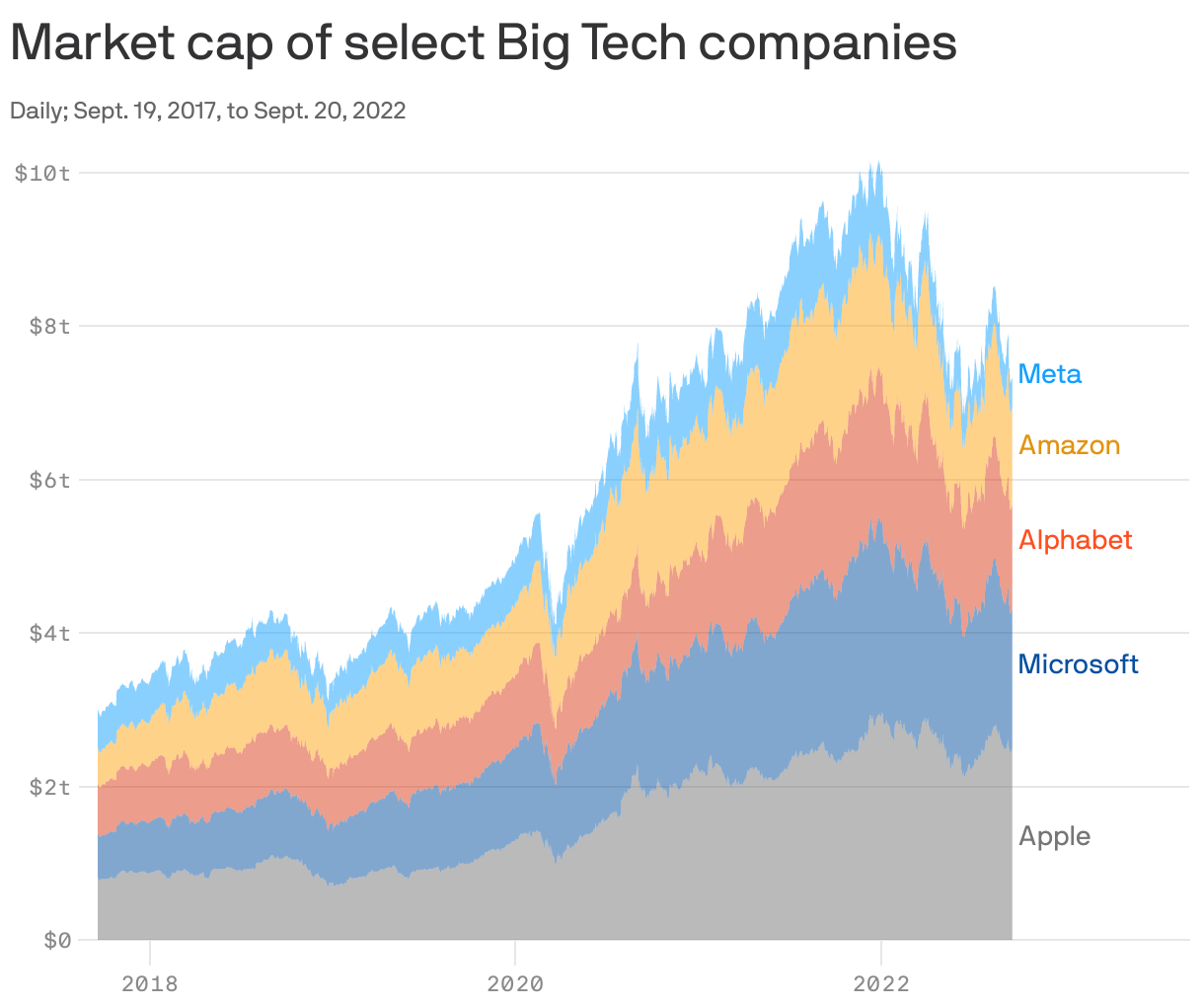
By the numbers: Apple, Microsoft, Amazon and Google are each worth more than $1 trillion. Meta is now worth less than half that.
- Apple, Microsoft, Amazon and Google are all currently in the top five companies globally by market cap. Meta sits around No. 10.
- TikTok was once again the most downloaded app globally last quarter, a position it's held for eight quarters in a row, per Sensor Tower, an apps analytics firm. Meta keeps introducing changes to Facebook and Instagram to make them more like TikTok.
What they're saying: "The fact we compete with companies that are many times our size and have vast resources beyond ours is not lost on us," a Meta spokesperson told Axios. "We're acutely aware that, despite the economic evidence of a hyper-competitive landscape, some regulators and politicians seem convinced that Meta has a monopoly."
- In addition to highlighting its struggles to compete with TikTok on Capitol Hill and in earnings reports, Meta has blamed Apple's App Tracking Transparency feature, which lets iPhone users opt out of tracking for targeted advertising, for billions of dollars of lost digital advertising revenue.
Yes, but: Despite taking some major hits, Meta has 2.9 billion monthly active users and had net income of $6.7 billion on $29 billion revenue last quarter. It's still buying other companies. Its global influence over information and advertising remains vast.
The big picture: The FTC has sued Meta over its past acquisitions of WhatsApp and Instagram and recently filed suit to stop the company from buying VR fitness company Within.
- Abroad, Meta is fighting antitrust authorities in Germany, the EU and the U.K., in cases that look at Facebook Marketplace, digital advertising and the role of data.
- Meta has argued that its purchase of Instagram and WhatsApp a decade ago benefitted users and that it helped grow the two companies in ways that would have been impossible without its resources. It says its acquisition of Within will significantly boost adoption and innovation in the fitness VR market.
The other side: "[The FTC and the Europeans] will say, 'We're not going after Meta because of market cap, we care about other exercising of monopoly power in social networking," Alden Abbott, former FTC general counsel, told Axios.
- "The scrutiny that Meta faces is of its own doing, resulting from the company's aggressive business practices and track record of misrepresenting how its products operate," Jared Holt, senior research manager at the Institute for Strategic Dialogue, told Axios.
- "Though Facebook is starting to recede in popularity among some demographics, it and other products in Meta's portfolio remain dominant and important platforms around the globe," Holt said.
2. Charted: Big Tech market values
3. Survey: Gen Z is embracing spatial audio

Illustration: Natalie Peeples/Axios
Although only half of Americans know what spatial audio is, the next-generation surround sound technology is more popular among younger people, a new survey finds.
The big picture: Roughly 80% of Gen Z consumers would be willing to pay more for their next pair of headphones if it supports the technology, according to a survey by Agora, which offers tools to include real-time audio and video within other applications.
Be smart: Spatial audio mimics the way sound is heard in the natural world, providing a sense of how far away a sound is and what direction it's coming from.
Why it matters: Spatial audio is key to making virtual reality convincing, but can also help with everything from watching movies to video conferencing.
- It's supported on a number of newer headphones, including models from Apple, Google and Samsung.
What they're saying: The technology is only in its infancy, says Agora CEO Tony Zhao, with large hardware and software makers only beginning to invest in support.
- "The Gen Z audience sees the value of spatial audio and is willing to invest in the hardware required to experience it," Zhao said in a statement. "These numbers should give technology companies greater confidence when considering whether or not to invest in spatial audio features and capabilities."
4. How hacker groups get their names
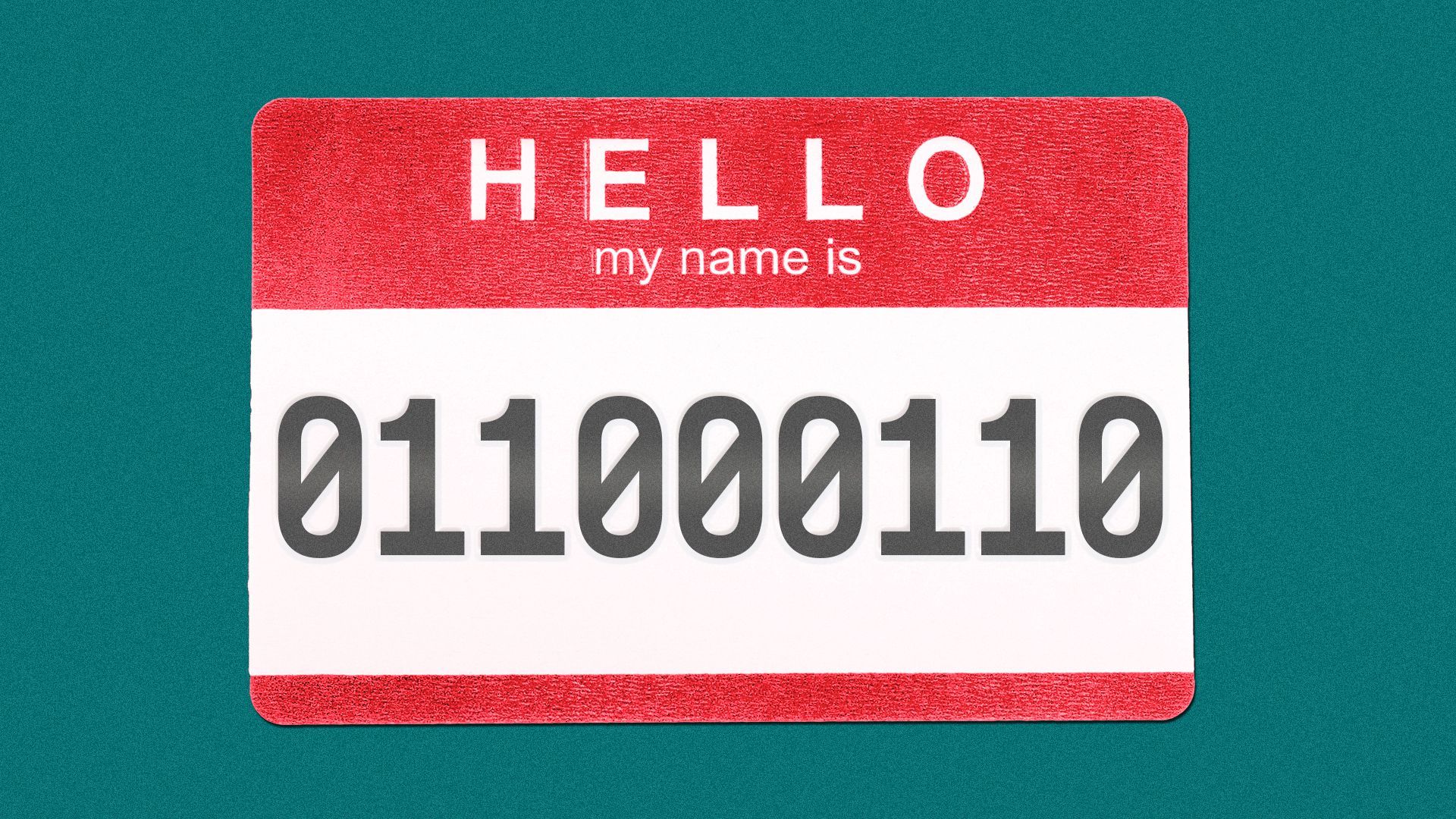
Illustration: Brendan Lynch/Axios
No matter how confusing it gets to refer to the same Russian hacker group by a handful of different names — Cozy Bear, Nobelium, APT29 and so on — don't expect the private companies behind those monikers to give them up anytime soon, Axios Codebook's Sam Sabin reports.
The big picture: Naming conventions for state-backed hacking groups vary from technical, advanced persistent threat (APT) group numbers to whimsical, animal-based names, making it difficult for people outside of cybersecurity research to understand which hackers do what.
- In the case of that well-known Russian cyber espionage group, Mandiant researchers refer to it as APT29, CrowdStrike researchers called it Cozy Bear, and Microsoft named it Nobelium.
Driving the news: Several cyber threat intelligence firms published research about Iranian group Charming Kitten earlier this month, but each company used a different name to identify the group — renewing questions about why researchers don't standardize naming conventions.
- Mandiant released a report referring to the group as APT42, while Microsoft referred to it as Phosphorous.
Between the lines: Part of this is due to marketing, cyber researchers tell Axios.
- It's a reputational win if a cyber threat intelligence firm is able to get its naming convention into the mainstream.
Yes, but: Five major threat intel firms tell Axios that even if their marketing teams weren't involved, they would still have these different names because they all have varying visibility into hackers' activities.
- "There's not always going to be a one-to-one match for how they see the threat and how I see the threat," says Jeremy Dallman, senior director at Microsoft Threat Intelligence Center.
At Mandiant, cyber espionage researcher Benjamin Read tells Axios, they stick with the technical APT numbers to allow for more precision in their naming conventions.
- Having super-precise identifications also helps Mandiant in its work with government investigators, Read says.
Other firms opt to create unique, memorable names for each group.
5. Take note
On Tap
- Salesforce's Dreamforce conference continues in San Francisco, Nvidia's GTC continues online and Unfinished Live begins in New York, where I will be moderating a session Friday on the ethics of the metaverse.
Trading Places
- Business and technology consulting firm Slalom has hired former Twilio chief information officer Michelle Grover as its first chief technology officer.
ICYMI
- The FTC is taking a deeper look at Amazon's planned acquisition of Roomba maker iRobot. (WSJ)
- Microsoft announced its first major update to Windows 11, adding a video editor and improved Start menu. (CNBC)
- Privacy-focused Facebook alternative MeWe will migrate its platform to the blockchain-based Project Liberty web infrastructure. (Axios)
6. After you Login

Photo: ina Fried/Axios
Not only did I get a hotel room, I also got some amazing views from the rooftop bar last night. And they served drinks in a koala-shaped mug. Don't worry. I only had one koala.
Thanks to Scott Rosenberg and Peter Allen Clark for editing and Bryan McBournie for copy editing this newsletter.