Axios Login

February 15, 2022

I thought I was addicted to watching the Winter Olympics. But check out this cat enjoying ice dancing.
Today's newsletter is 1,183 words, a 4-minute read.
1 big thing: Ukraine's TikTok war

Photo illustration: Sarah Grillo/Axios. Photo: Alexandra Stanescu/Anadolu Agency via Getty Images
Videos of Russian troops massing on Ukraine's borders are being widely disseminated on TikTok, giving the world an unprecedented view of what's happening on the ground ahead of a potential war, Axios' Sara Fischer and Zachary Basu report.
The big picture: The world has moved away from a top-down view in which the public learned about major military movements only through big media outlets and governments. The troop buildup around Ukraine is there for everyone to see.
Details: Videos of Russian equipment being transported to the border of Ukraine began surfacing on TikTok during an initial military buildup last spring, and then again late last year as Russia began to build toward its current force posture of about 130,000 troops.
- Russian military and open-source intelligence experts, including Michael Kofman of CNA and Rob Lee of King's College, have compiled Twitter threads with hundreds of crowdsourced videos of military equipment and units on the move toward the Ukrainian border.
- One apparently Russian TikTok user under the moniker @dmitrymartynov25 posted a video clip over the weekend that showed dozens of army tanks passing him on the road.
Why it matters: The open-source intelligence community has evolved from a niche corner of the internet to a major player in one of the biggest stories on the planet. It has often preempted government warnings about Russia's military movement by a wide margin.
- The investigative journalism group Bellingcat has won awards for open source intelligence-based reporting on the Russian military's covert activities, including the downing of a passenger airplane in eastern Ukraine in 2014.
Be smart: This isn't the first time social media has been used to shed light on a conflict from the ground. It was an enormous organizing force during the Arab Spring in 2012.
- Since then, however, smartphone adoption around the world has significantly increased, and new platforms like TikTok have made it much easier for users to upload video faster.
- And TikTok's algorithm amplifies user-generated content over professional content, which is helping these videos about geopolitical conflicts overseas go viral quickly.
Yes, but: While social media can be helpful for foreign policy and national security officials, it also brings new risks.
- Last year, misinformation about clashes between Palestinians and Israelis snowballed online, as images and videos were taken out of context.
- Ukrainian officials have warned that Russia's military movements — and all the attention they're receiving — may be feeding a narrative about a looming invasion in order to destabilize Ukraine and cause panic.
Between the lines: While the preparations for a possible land war are now playing out in a fuller public view than ever before, one of the most potent tools in modern geopolitical conflicts — cyber attacks — adds a new dimension that's more secretive than ever.
2. 5G hype boils over

Illustration: Annelise Capossela/Axios
Verizon tapped actor Jim Carrey while T-Mobile leaned on Dolly Parton and Miley Cyrus to sell 5G during the Super Bowl, as once again the major wireless companies are spending big to convince consumers to upgrade, Axios' Margaret Harding McGill reports.
Why it matters: The 5G marketing blitz has also led to a surge in company-on-company complaints over misleading advertising.
The big picture: The top three carriers are spending big on star power as they push new home 5G service meant to woo people away from cable.
- Carrey reprised his role from the movie "The Cable Guy" to promote Verizon's new in-home 5G service.
- Parton and Cyrus highlighted T-Mobile's 5G phone service while "Scrubs" actors Zach Braff and Donald Faison sang about the company's in-home offering.
Yes, but: 5G service has yet to really resonate with consumers, said Roger Entner, founder of Recon Analytics.
- Entner notes that out of monthly surveys of 3,000 consumers, 5G service ranks fifth out of nine categories for the most important reason to pick a new wireless provider, and ninth out of nine as a reason to leave a provider.
- "Just saying my G is bigger than your G — consumers don't give a hoot," Entner told Axios. "And that's because we really haven't seen these must-have applications that are reliant on 5G."
The intrigue: Current consumer apathy has not stopped wireless and cable companies from accusing each other of making misleading 5G claims before the BBB National Programs' National Advertising Division, a self-regulatory body for businesses.
- Disputes over 5G advertising jumped more than 40% since 2019, Laura Brett, the vice president of the National Advertising Division, told Axios.
- Most recently, NAD urged Comcast to stop its "Unlimited 5G" and "best price" claims after T-Mobile challenged the advertising.
Between the lines: This type of industry in-fighting over a new product is typical in telecom, where marketing often gets ahead of reality.
- Carriers have battled during past launches, including the past generation of wireless service, known as 4G LTE.
What they're saying: "When one of these telecom companies introduces a new claim into the marketplace, they know their competitors are watching," Brett told Axios. "If misleading claims are out there, this is a forum for competitors to challenge those claims and for us to issue modifications or changes that ultimately benefit consumers."
- The recommendations from NAD are voluntary, but the organization can forward cases to the Federal Trade Commission, which polices deceptive advertising.
3. U.S. internet aid program serves 10M homes
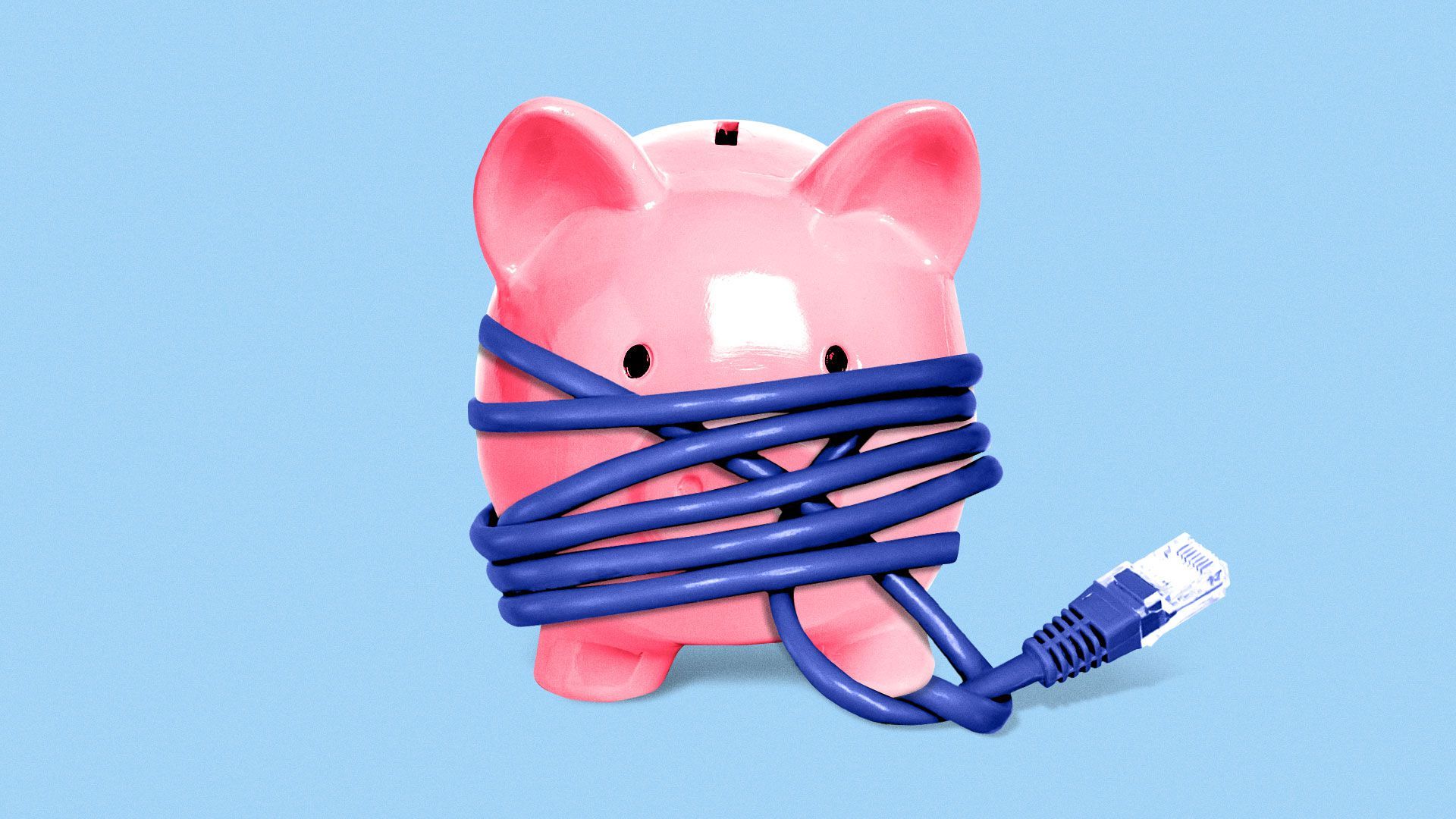
Illustration: Eniola Odetunde/Axios
The White House announced yesterday that a program meant to lower internet service cost for Americans has connected more than 10 million households, Margaret reports.
Why it matters: The Affordable Connectivity Program (ACP) is the largest federal effort to help low-income Americans afford service by offering a $30 monthly discount.
What's happening: The ACP is a $14.2 billion program created in the new infrastructure funding law as the successor to a previous broadband benefit that provided $50 a month to help families pay for internet service during the pandemic.
- The prior program began in May, and connected more than 9 million households by the end of the year.
- The ACP lowered the monthly benefit to $30 a month, which is available to people who are on some federal assistance programs or receive Pell Grants, among other criteria.
What they're saying: At an event at the White House, Vice President Kamala Harris spoke about the importance of the program.
- "Every person in our nation and every parent, no matter how much they earn, should be able to access high-speed broadband internet," Harris said.
Take note
On Tap
- Earnings reports today include Airbnb and Roblox.
Trading Places
- Stripe and Netflix veteran Lindsey Grossman tweeted on Monday that she has joined Square parent Block to lead the product, partnerships and marketing teams that are building a hardware cryptocurrency wallet.
ICYMI
- Texas sued Facebook parent company Meta on Monday for allegedly capturing and using biometric data without properly obtaining informed consent. (Axios)
- Intel is said to be close to a $6 billion deal to buy Tower Semiconductor, which would give its foundry business access to new people, plants and technologies. (Wall Street Journal)
5. After you Login

Image: Lego
Lego will announce today it has joined forces with PlayStation to create a set based on the gaming world of Horizon Forbidden West. A 1,200-piece buildable recreation of a Horizon Tallneck will go on sale in May for around $80.