Axios Login

October 11, 2022

I'm writing today's Login a bit gingerly, as I am sore from playing seven softball games in a tournament this weekend. (We won a couple games and had lots of fun.)
Today's Login is 1,243 words, a 5-minute read.
1 big thing: How the pandemic changed the PC business

Photo illustration: Allie Carl/Axios. Photo: Microsoft
Microsoft Windows chief Panos Panay tells Axios that the pandemic didn't just boost long-flagging computer sales, but also helped reinvigorate the PC as a critical tool for communication.
Why it matters: Sales of new computers have slowed significantly in recent months, but usage remains at record levels.
By the numbers: In making his case, Panay shared several statistics that he says outline the broader role Windows is playing for everyone from workers to families.
- More people are using Windows than ever before — a 20% monthly increase vs. pre-pandemic.
- More time spent on Windows PCs: On average, people are spending 10% more time on each PC vs pre-pandemic.
- Customer satisfaction for Windows 11 is higher than any other previous version of Windows.
Yes, but: The pandemic-fueled PC buying spree is increasingly looking like a blip rather than a sustainable boost to annual sales.
- Just last week, AMD issued an earnings warning, blaming a weaker-than-expected PC market.
- And a fresh IDC report says computer sales were down 15% year-over-year in the third quarter, though they remain above pre-pandemic levels.
- "I'm not saying there aren't headwinds," Panay acknowledged.
The big picture: Who makes the computer and what operating system it uses has become less critical for many workers, students and consumers, with most key apps running in the browser and from the cloud, or being available across Macs and PCs.
- Windows still dominates the market for PC operating systems, but Apple has gained significant ground. Beyond grabbing a larger slice of the consumer market, Macs are now either standard or an option at many startups and a growing number of large companies, too.
- Google's Chrome OS has also become a significant player — especially in education.
Gaming remains the key exception, with Windows dominating when it comes to computer-based game play.
- Microsoft faces more competition there from dedicated consoles than it does from the likes of Google or Apple.
- Although gaming activity overall has started to level off or drop from pandemic peaks, Panay said that time spent gaming on PCs remains at an all-time high, at a level set during the height of the pandemic.
Between the lines: While Apple and Google have a core group of customers who are all-in on their services, Panay says part of what makes Microsoft's PC operating system popular is it plays well with all of the major apps and services.
- "Does somebody else have a leg up?" Panay said in an interview. "I don’t think they do on choice, and I think choice matters to all of us."
Zoom in: Panay, whose official title is chief product officer, rose to prominence at Microsoft by spearheading Surface, the company's high-end hardware line, from its inception. Panay says Surface's role has evolved beyond the convertible tablet it debuted with more than a decade ago, but the product line still fills three big roles:
- Filling the "seam" between Windows hardware and software that arose historically because Microsoft controlled the software but a variety of manufacturers developed the machines.
- Expanding other computer makers' horizons on what's possible with Windows.
- Giving Windows a lineup of high-end devices to compete directly with Apple.
What's next: Microsoft is expected to introduce a crop of new Surface hardware at an event Wednesday. Panay said there won't be a new Surface Duo for the holidays, but said that the company isn't abandoning its Android-based phone effort.
2. Scoop: TikTok supply chain plans chase Amazon

Illustration: Annelise Capossela/Axios
TikTok is planning to build its own product fulfillment centers in the U.S., creating an e-commerce supply chain system that could directly challenge Amazon, more than a dozen new job openings posted in the past two weeks to LinkedIn indicate.
Why it matters: The move signifies TikTok's commitment to e-commerce as its next major revenue stream, following the explosive growth of its ads business, Axios' Sara Fischer reports.
- "By providing warehousing, delivery, and customer service returns, our mission is to help sellers improve their operational capability and efficiency, provide buyers a satisfying shopping experience and ensure fast and sustainable growth of TikTok Shop," the company wrote in one job listing.
Details: According to the job postings, TikTok is looking to build an "international e-commerce fulfillment system" that will include international warehousing, custom clearings and supply chain systems that support domestic e-commerce efforts in the U.S. and cross-border e-commerce efforts.
- One position, a logistics solutions manager for a global fulfillment center, details plans for a Seattle-based employee to design fulfillment centers and e-commerce logistics solutions involving the transportation of goods, order prediction and inventory management.
- Another Seattle-based role calls for the creation of a new fulfillment service center "from scratch." The center, the posting says, "is a global team responsible for developing and growing our logistics solution," and will include product fulfillment by TikTok Shop to its sellers by "providing warehousing, delivery, and customer service returns."
State of play: Building out its own e-commerce supply chain could give TikTok more control and boost profits in the U.S. and around the world.
- TikTok began piloting a shopping feature in the U.S., Canada and the U.K. last year via a deal with Shopify.
What they're saying: A TikTok spokesperson said the company's e-commerce "focus" remains on the U.K. and southeast Asia, its currently active regions.
The big picture: TikTok's meteoric growth, which has already taken its toll on Meta's Facebook and Instagram, has also begun to pose a threat to companies like Amazon and Google that rely on intent-based search advertising to drive business on their shopping platforms.
3. Exclusive: Google touts cloud deal with Ford
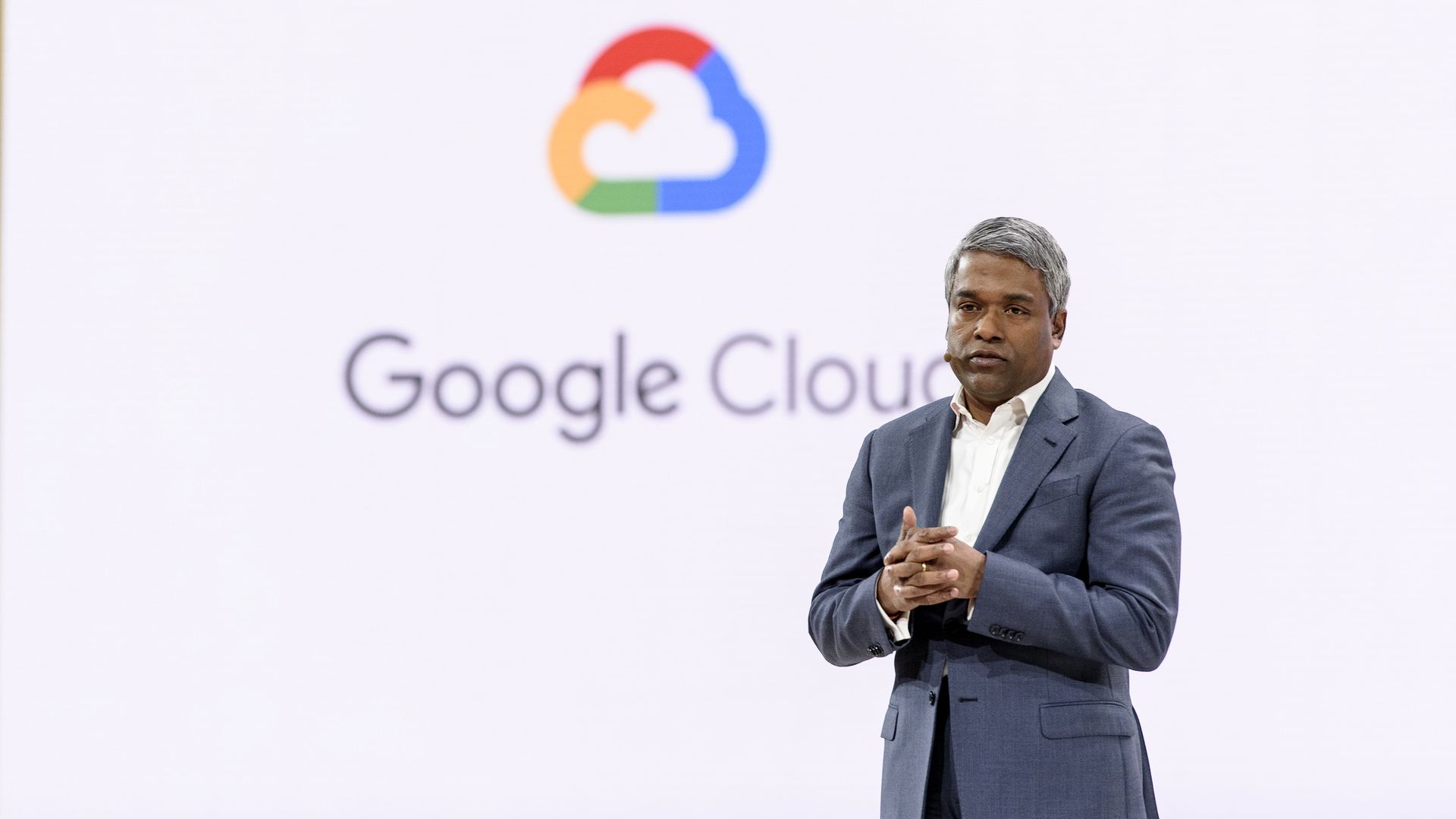
Google Cloud CEO Thomas Kurian, speaking at the Google Cloud Next '19 event in San Francisco. Photo: Michael Short/Bloomberg via Getty Images
Google is touting its role in helping transform Ford Motor Co. as an example of what other large businesses can gain by making use of its cloud services.
Driving the news: Ford CEO Jim Farley will join Google Cloud chief Thomas Kurian today during Google Cloud Next to offer an update on how the two companies' relationship is evolving 18 months into a six-year partnership.
- Google is helping Ford with a range of tasks from quality assurance in its factories to delivering over-the-air software updates to vehicles.
- The deal also includes a separate commitment by Ford to use Google's Android operating system to power the in-car entertainment systems of future vehicles.
Why it matters: Despite their size, both companies have their work cut out.
- Google's cloud business has been fast growing, but still significantly trails market leaders Amazon and Microsoft.
- Ford, like other traditional automakers, is trying to secure its spot in a significantly changing world in which electric engines are replacing gas power and technology plays a key role in everything from music to self-driving features.
4. Take note
On Tap
- It's a big week for tech company events. Microsoft is hosting its Ignite conference and has the Surface event on Wednesday. Meta has its VR-centered Connect event online today, which will also see the aforementioned Google Cloud Next taking place online and in San Francisco.
- Lesbians Who Tech takes place virtually and in San Francisco this week. I'm interviewing Rep. Ro Khanna (D-Calif.) later today over Zoom, with the event's in-person activities kicking off Wednesday.
Trading Places
- Brian Roberts is out as CFO of NFT marketplace OpenSea. The former Lyft CFO had been at OpenSea for less than a year.
- Oisin Hanrahan is stepping down as CEO of Angi, the home-improvement platform formerly knows as Angi's List. Company chair Joey Levin is replacing him.
ICYMI
- Russian-speaking hackers on Monday disrupted the websites of multiple U.S. airports through denial-of-service attacks. (Axios)
5. After you Login
Check out the process that went into transforming a set of colored pencils into an incredible vase. (Want!)
Thanks to Scott Rosenberg for editing and Bryan McBournie for copy editing today's Login.
Sign up for Axios Login

Taking you inside the AI revolution, and delivering scoops and insights on the technologies reshaping our lives.