Axios Login

December 06, 2021

Is your refrigerator running? Ours hasn't been, so we picked out a new one on Sunday. (And what they say about supply chain problems is real. At least half the models were unavailable until January or February at the Best Buy we visited.)
Today's newsletter is 1,151 words, a 4-minute read.
1 big thing: Congress' chip-funding pause raises alarms

Illustration: Aïda Amer/Axios
Despite bipartisan support in the Senate, a plea by the Commerce secretary and growing desperation from industry officials, Congress still can't get a key bill that funds the U.S. chip business over the finish line, Axios' Margaret Harding McGill reports.
Why it matters: With the global chip shortage continuing to crimp the economy, the semiconductor industry has ramped up pressure for funding of U.S.-based manufacturing facilities as one remedy.
- Intel and memory chip maker Micron have both said they will spend $150 billion in the next decade, but have pressed for government help to close the cost gap with some Asian markets.
The big picture: The U.S. share of global semiconductor manufacturing has dropped from 37% in 1990 to 12%. Executives from Intel and Micron told lawmakers it costs at least 30% more to manufacture chips in the U.S. than it does in many Asian countries for three main reasons:
- Labor costs more in the U.S. than in Asia both for operating fabrication facilities and for building them.
- For the last 20 years, many Asian countries have focused on policies to grow the semiconductor ecosystems.
- Some other countries provide greater incentives to the semiconductor industry than the U.S.
What's happening: The Senate, by a 68-32 majority, passed a China competition bill championed by Majority Leader Chuck Schumer (D-N.Y.) in June, but the House has not advanced it.
- The U.S. Innovation and Competition Act (USICA) includes $52 billion for domestic semiconductor manufacturing, and a host of other measures meant to improve U.S. competition against China.
Between the lines: The legislation did not move on the fast track through the House the way it sped through the Senate.
- Schumer made the bill a legislative priority and used the power of his office to negotiate a bipartisan agreement in the Senate.
- House leadership focused on other priorities, including the infrastructure and the social spending bills, that are key to the Biden administration's agenda.
What they're saying: Micron has said it wants the U.S. government to move forward on tax incentives while the company weighs where to build its next manufacturing plants.
- Intel CEO Pat Gelsinger told Axios' Ina Fried, "We can't be 30% or 40% more expensive than Asia. So help us close that gap so that we can build bigger and faster on U.S. soil."
What's next: House Speaker Nancy Pelosi (D-Calif.) told reporters last week she was convening relevant committee chairs to discuss the House version of USICA.
- Observers say they think it's unlikely USICA will pass this year, but they believe it will eventually become law.
- Commerce Secretary Gina Raimondo, who recently gave a speech on the issue in Detroit, told Axios in a statement: "Every day that we do not pass this legislation, we continue to fall behind and lose our competitive edge on the world stage."
2. A common language for self-driving cars
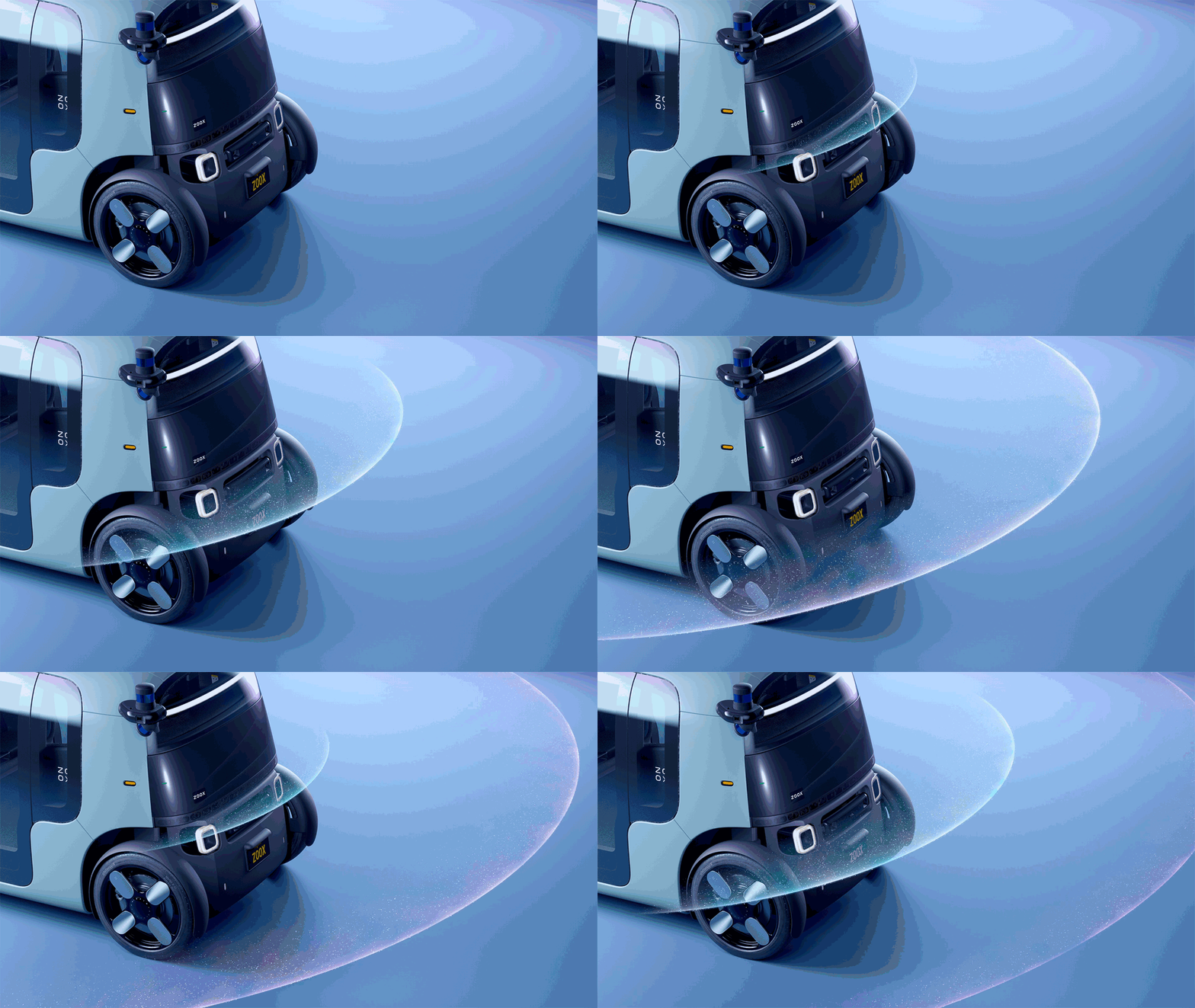
Zoox is developing sound patterns that can be pinpointed toward individuals to indicate the intentions of its robotaxi. Photo: Zoox
Autonomous vehicle companies are exploring the use of a common language — standardized light patterns or sounds — that would help driverless cars communicate their intentions to humans, Axios' Joann Muller reports.
Why it matters: Autonomous vehicles will share the road with human-driven vehicles, pedestrians and cyclists for a long time. The development of a standard communications method could build trust and reduce traffic accidents.
What's happening: Argo.ai, the developer of a self-driving system, is urging fellow developers to adopt its newly released technical guidelines for safe interactions between robocars and bicyclists.
- The guidelines, created in collaboration with the League of American Bicyclists, urge AV companies to incorporate bike lanes into their AI maps, for example, and to model typical cyclist behavior — like lane-splitting or swerving around an open car door — into their algorithms.
Meanwhile, companies are also trying to find a common language for self-driving vehicles.
- Some companies are promoting what they see as best practices through voluntary safety self-assessments of their self-driving technology that they've filed with the National Highway Traffic Safety Administration.
- Ford Motor's safety report, for example, describes a white light bar mounted near the top of the windshield where a pedestrian or cyclist may look for cues from a human driver.
Zoox, which makes a custom robotaxi, is testing its own communication patterns using a variety of lights incorporated into its design.
- The vehicle, which has no front or back, also features 32 speakers that can pinpoint sound in a specific direction to communicate with other road users.
The big picture: America's roads are getting deadlier, with U.S. traffic deaths up 18% in the first half of 2021, due mostly to risky behavior like speeding, texting or driving while intoxicated.
3. DoorDash debuts ultra-fast NYC grocery delivery

Illustration: Sarah Grillo/Axios Visuals
DoorDash is making a foray into the ultra-fast grocery delivery market with a small pilot in NYC's Chelsea neighborhood.
Why it matters: Delivering purchases within 10–15 minutes is the latest trend in grocery delivery, so it's no surprise that established companies like DoorDash are trying to keep up.
The big picture: Ultra-fast delivery — already popular in other parts of the world like Europe — started to catch on over the past year or two, as the pandemic limited in-person shopping.
- Grocery delivery company Instacart is also reportedly working on its own such service, per The Information.
Details: DoorDash customers within the new service's delivery radius can order items for a fee between 99 cents and $1.99 and get them delivered by a courier on an e-bike from the company's DashMart warehouse.
- Similarly to rival services like Gorillas and Jokr, the couriers (and warehouse workers) for this service are employed by DoorDash via a new subsidiary called DashCorp. They earn $15 an hour (plus tips), along with standard benefits.
- The company plans to expand to more parts of NYC in the coming weeks and months and eventually to other cities.
Between the lines: This is a notable — but not surprising — departure for DoorDash which, along with other gig economy companies, has strongly defended the independent contractor model.
4. Bumble revamps matchmaking algorithm
Bumble, the Austin-based dating app maker, unveiled a new profile design for users and revamped its matchmaking algorithm, Axios Austin's Nicole Cobler reports.
The big picture: The update prioritizes placing a person's pronouns and interests immediately after their first photo, which the company says will help users' determine whether they've found a potential match sooner.
- The update also recommends which picture should lead users' profiles, and Bumble touts the feature has already led to an increase in matches.
5. Take note
On Tap
- MongoDB reports earnings after the markets close.
Trading Places
- Twitter on Friday announced a reorganization that will see controversial design head Dantley Davis leave the company, while several product and tech executives were given more responsibility, including Kayvon Beykpour, Bruce Falck and Nick Caldwell. (Marketwatch)
ICYMI
- Apple is challenging a ruling from Russian regulators that it needs to allow developers more latitude to promote alternative payment options. (Engadget)
6. After you Login
I just rewatched the original "Jurassic Park," but now I really want to check out this rework that replaces that movie's creatures with those from the '90s sitcom "Dinosaurs."
Sign up for Axios Login

Taking you inside the AI revolution, and delivering scoops and insights on the technologies reshaping our lives.