Axios Login

June 07, 2023

Ina here, fresh from a demo of Apple's Vision Pro mixed reality headset. Keep reading for my take. Today's Login is 1,274 words, a 5-minute read.
1 big thing: Apple's VR headset blew my mind
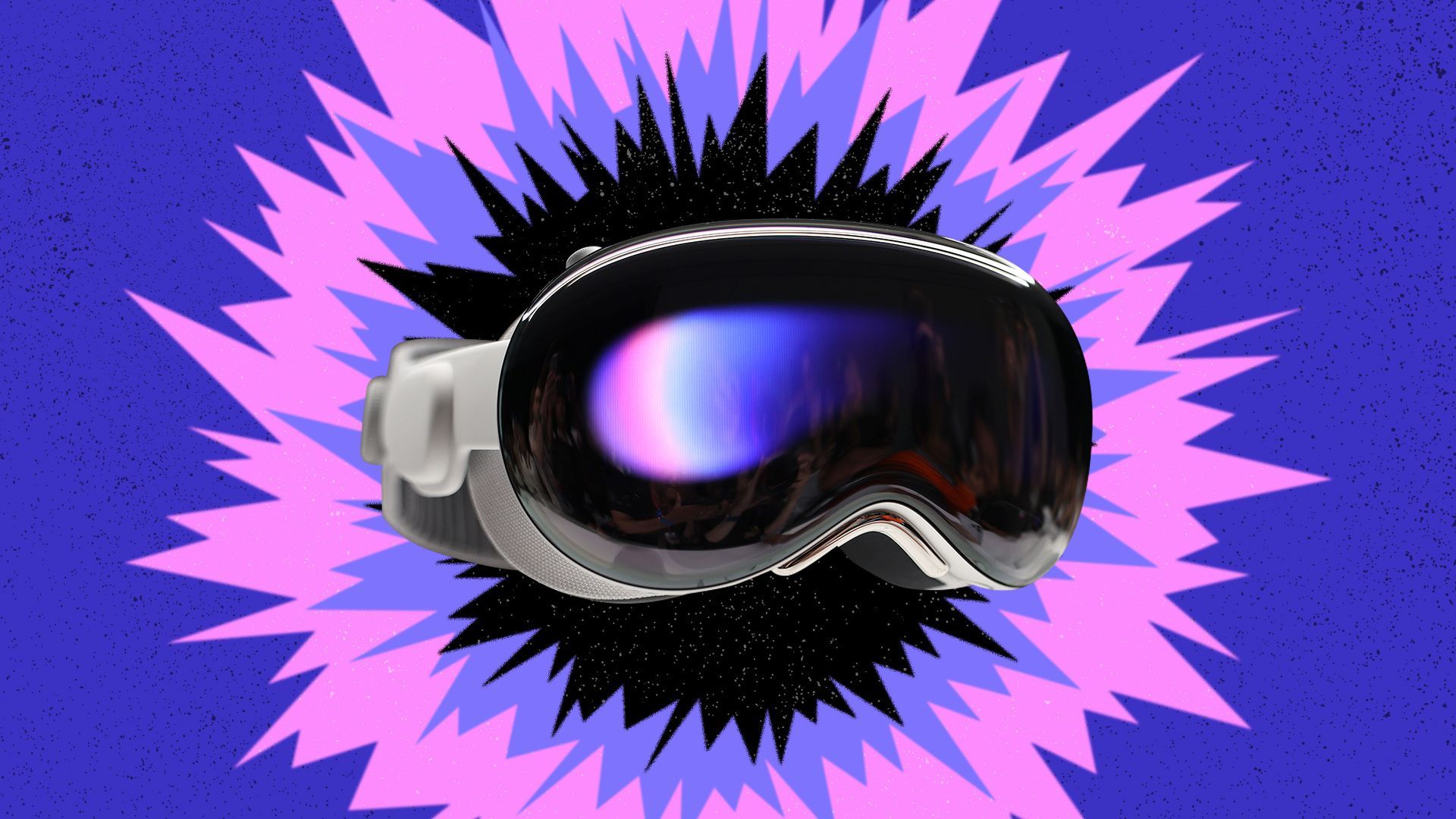
Photo illustration: Aïda Amer/Axios. Photo: Justin Sullivan/Getty Images
From the first moment I pinched my two fingers together to "click" on the Safari icon that floated in front of a mock-living room wall, I realized that Apple's Vision Pro isn't just the latest in headsets: It's the first headset that I can imagine capturing the public's heart.
Why it matters: The world of virtual and augmented reality is littered with devices that never delivered on their promise. Apple's entry could be the first where the main objection is "it costs too much" rather than "why would I want it?"
I spent about half an hour in a demo at Apple Park on Tuesday and left wanting more time with the device, which goes on sale "early next year" and starts at $3,499.
- What's impressive about the Vision Pro isn't the set of tasks it can do: web browsing, messaging, playing standard and immersive movies. It's how elegantly and intuitively it does them.
How it works: The first thing I had to do was get outfitted for a set of magnetic prescription lens inserts. Because I am severely nearsighted in my left eye, the lenses Apple had on hand didn't fully correct. However, I was still able to read text on a web page.
- Putting on the headset and doing some initial calibrations was quick and smooth. The headset itself feels lighter than many others, but it's not so light that you don't know you are wearing it.
- A simple press of the "digital crown" brings up a menu of apps and options. Simply looking at an item highlights it. To click, you pinch your fingers — wherever they may be, including resting comfortably on your leg.
The mix of virtual windows and the real-world environment felt seamless in a way I've never experienced before, in either a lab demo or on a shipping product.
Other devices support eye-tracking, voice commands and hand tracking. But Apple has put them together so deftly that it's eliminated the need for any other controls.
My short time with the Safari browser and other apps felt similar to using them on a computer, in the sense that they were both easy and natural.
- VR makers have long touted the potential for users to enjoy multiple large virtual monitors, but Apple has created what felt like the first device I'd want to use that way.
Be smart: Wearing the headset and interacting with people was easy and natural for me. That doesn't mean it will be easy and natural for the headset-less to interact with a Vision Pro user.
- Apple's novel design offers a digital representation of the headset wearer's eyes on the front of the goggles, but it remains to be seen how well that limits potential awkwardness.
A highlight reel of video content showed off the Vision Pro's chops as a media device with immersive clips from the worlds of sports, music and nature.
- In one clip it felt like Alicia Keys was singing right to me, while in another, I felt like I was on the field as a major league ballplayer let a throw drift just past his glove.
- As a sports fan, I love the prospect of getting views I couldn't have even with the best seat — but in the past, low image quality has proven too great a tradeoff.
- Movies filmed in 3D — like a clip from the latest "Avatar" that Apple showed during the demo — are especially well-suited to the device.
Of note: The demos didn't include any gaming — which has been the main thing most people have actually used VR devices to do.
My thought bubble: I've been fortunate to witness a few breakthrough moments in tech — from the launch of the iPod and iPhone to Microsoft's original multitouch Surface tabletop PC. As with the first time I used those devices, experiencing the Vision Pro made me feel, "Yes, that's an experience I want to have."
Yes, but: While I got to control the interactions, the experiences were handpicked by Apple, so there could well be rough edges that Apple elegantly steered around.
The bottom line: The real test of the Vision Pro will come once it's in the hands of thousands of people who discover its flaws and limits — and also put it to uses Apple hasn't yet imagined.
2. Scoop: Sen. Hawley enters the AI chat

Sen. Josh Hawley. Photo: Bill Clark/CQ-Roll Call, Inc via Getty Images
Sen. Josh Hawley (R-Mo.) is looking to use his perch atop a panel that oversees technology to shape the emerging discussion in Congress around regulating artificial intelligence, Axios' Andrew Solender and Maria Curi report.
Why it matters: The issue represents a rare opportunity for Congress to try to tackle a major issue in a bipartisan way as lawmakers display growing interest in legislation to govern AI.
- Hawley, a right-wing populist who is ranking member of the Judiciary Subcommittee on Privacy, Technology and the Law, has enjoyed unusual alignment with liberal Sen. Richard Blumenthal (D-Conn.), the subcommittee chair.
The details: Hawley is unveiling, and circulating to colleagues, a framework for AI legislation focused on corporate guardrails. The five principles in the outline, according to a document viewed by Axios, are:
- Creating a legal avenue for individuals to sue companies over harm caused by AI models.
- Imposing stiff fines for AI models collecting sensitive personal data without consent.
- Restricting companies from making AI technology available to children or advertising it to them.
- Banning the import of AI-related technology from China and prohibiting American companies from assisting China's development of AI.
- Requiring licenses to create generative AI models.
What he's saying: Hawley argued Congress should "move with all deliberate speed" before development of the powerful technology — along with potential industry efforts to oppose new rules — puts effective government action out of reach.
3. Exclusive: Twilio to tap Google Cloud's AI
Twilio is integrating Google Cloud's generative AI into Twilio Flex, the company's contact center, sales, and in-app concierge service, Axios' Ryan Heath reports.
Why it matters: Twilio aims to offer a cookie-less personalized service — a holy grail for those who want the benefits of digital services without compromising privacy.
How it works: When customer service representatives are chatting with a customer, the generative AI will prompt them with a next best action based on the customers' specific history and needs.
- After a customers hangs up or closes their chat, the AI will build out the customer's profile with after-call summaries and sentiment analysis.
State of play: Toyota is already using Twilio's new features to power its Toyota Connected Destination Assist navigation feature.
- Toyota Connected is now live for all Toyota and Lexus drivers in North America.
Zoom out: Customer service is one of the first fields being transformed by generative AI — allowing service agents to focus more tightly on a customer's specific needs.
- Alex Singla, McKinsey senior partner, told Axios that generative AI will "dramatically change how companies interact with their customers."
4. Take note
On Tap
- Amazon is hosting its AWS Summit in Washington, D.C., featuring a panel on generative AI, today and tomorrow.
Trading Places
- Timothy Gallagher, a former special agent in charge of the FBI's Washington Cyber Division, has joined global investigations firm Nardello & Co. as its chief security officer.
ICYMI
- Instagram hosts networks of accounts "openly devoted to the commission and purchase of underage-sex content," and the service provides users who visit one with recommendations for more, a Wall Street Journal investigation finds.
- Apple has purchased augmented reality headset maker Mira. (The Verge)
- Legendary Silicon Valley venture firm Sequoia is spinning out its China and India affiliates. (Axios)
- Defense-tech startup Shift5, which aims to protect military equipment and critical infrastructure from cyberattack, closed an $83 million funding round. (Axios)
5. After you Login
I thought you might enjoy this bit of AI humor.
Thanks to Scott Rosenberg for editing and Bryan McBournie for copy editing this newsletter.