Axios Login

November 08, 2022
I'm sure nobody has mentioned it, but it's Election Day in the U.S., so please vote. As y'all know, I love sports and democracy is a participation sport. Today's Login is 1,256 words, a 5-minute read.
1 big thing: What to expect when your tech firm is downsizing

Illustration: Allie Carl/Axios
As Silicon Valley and the broader tech industry face a season of layoffs, workers are unprepared for the ordeal and management has little experience with the wrenching process, Axios' Scott Rosenberg reports.
Driving the news: Meta is expected to announce large-scale job cuts as soon as Wednesday, the first ever in its history. That comes on the heels of major layoffs at Twitter and many other flagship tech firms.
Why it matters: At most companies, layoffs are a business decision for top execs but a deeply personal experience for everyone else.
The big picture: The industry's phenomenal 20-year run of largely unimpeded growth means that most of its workforce doesn't have much idea of what to expect from widespread layoffs. Here's a brief guide.
1. For those laid off, the pain is personal.
- Even in the best cases, where a company has carefully selected who gets the axe and applied sensitivity to the process, people who are let go can feel a sense of failure — even though, typically, the actual failure belonged to the company and its management.
- The worst cases — as with Twitter's reportedly 50% cuts last week, made by a new ownership team with little preparation or apparent care — create a broader kind of sorrow among a workforce as well.
2. While no one should shed tears for the managers, they're having a hard time too.
- Middle managers often find themselves having to select winners and losers from groups of people they handpicked to join their teams not that long ago.
- Then, they have to face the people who are left and help them through what can be extended bouts of anger, depression and survivor's guilt.
- Workers and managers both face bigger workloads under post-layoff do-more-with-less mandates.
3. For companies, layoffs leave slow-healing psychic wounds.
- Tech companies often aim to inspire workers with mission statements and caring rhetoric. But once a firm has gone through a round of layoffs, it becomes effectively impossible to persuade employees that anything matters beyond the bottom line.
- After big rounds of layoffs, tech leaders can't just move on as if nothing happened. They also have to try to rekindle workers' belief that the organization can do big things.
Between the lines: Layoffs that are tied to the shutdown of a specific product line or division can be written off as strategic in nature. Broader layoffs are a sign that a company grew too fast, took too many risky bets, or just never hit overly ambitious goals.
- Many tech companies overhired during the pandemic and now face tougher times.
- The people responsible for such choices are rarely the people who lose their jobs — though sometimes, as in Twitter's case, layoffs are made by a new management with a belt-tightening agenda.
To be sure, many tech workers have been generously paid and are relatively well-off compared with other industries. But losing your job is still losing your job.
Scott's thought bubble: I'm a veteran of a dotcom era startup that went public and then laid off half its staff more than two decades ago, and I still get flashbacks.
- You never forget these experiences, and this year's cuts could reshape how a generation in tech thinks about their careers.
Yes, but: When laid-off developers filled the coffeeshops of San Francisco and other tech hubs after the bust in 2000-2001, they used their newfound don't-give-a-damn state to hatch passion-project ideas.
- Some of them took off and sparked the next boom. That could happen again.
2. Musk's Twitter chaos opens door to challengers
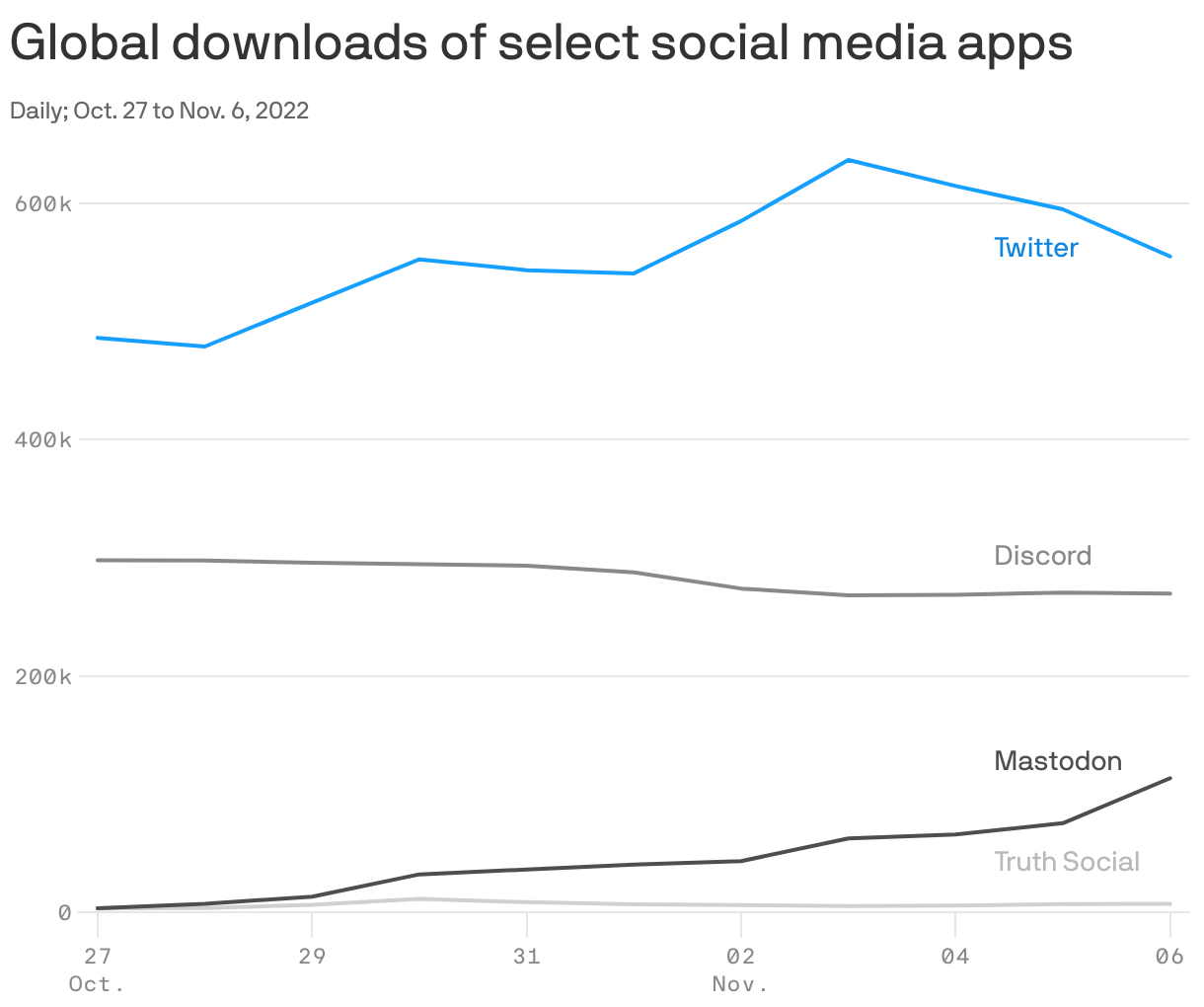
Downloads of Twitter's app have grown steadily in the first week since Elon Musk became the company's owner, but other apps — particularly Mastodon, a distributed open-source service — are starting to gain traction as some users begin to experiment with alternatives, Axios' Sara Fischer reports.
Why it matters: That competitive pressure is clearly irking Musk, who tweeted, and then deleted, a series of lewd tweets about Mastodon on Monday.
- Unlike competition in electric cars or spacecraft, software companies can very quickly seize market share from rivals. Users can download a new social app instantly, and usually for free.
Details: Downloads of Mastodon, a social media app that works something like Twitter but with a chronological feed and no central server, have exploded since Musk took over Twitter, according to new data from Apptopia.
- Between Oct. 27 and Nov. 6, daily downloads of the app increased from 3,400 to 113,400.
- Mastodon's founder Eugen Rochko said in a Mastodon post Monday that it now has more than 1 million monthly active users, having added a whopping 489,003 new users since Oct. 27, when Musk bought Twitter.
The big picture: Meanwhile, Apptopia data suggests Twitter's global downloads have increased slightly since Musk took over, averaging roughly 571,000 downloads daily.
- For the full year preceding the purchase, Twitter was averaging around 350,000 to 450,000 downloads per day.
- According to internal documents obtained by The Verge, Twitter is telling sales staff that it has added more than 15 million monetizable daily active users since the end of the second quarter.
Yes, but: Advertisers are slowing or pausing their Twitter buys as companies grow frustrated with Elon Musk's moves.
3. How tech can make work harder
Illustration: Aïda Amer/Axios
Tech enables many people to do their jobs however and wherever they like, but the number of applications jobs now require can make it feel like we're working multiple jobs at the same time, Axios Closer's Hope King reports.
By the numbers: Workers are using an average of six to eight apps to perform a single business process, Tori Paulman, senior director analyst at Gartner, told Axios.
- A salesperson, for example, switches among email, calendar, enterprise chat software such as Slack, a customer relationship management (CRM) platform such as Salesforce, a notetaking application, a presentation maker, a video conference system, and maybe a conference room system in order to meet with a client.
- One study published in the Harvard Business Review suggests workers are switching from app to app and website to website nearly 1,200 times a day — and paying a so-called "toggling tax" that amounts to a total of 9% of their annual time at work.
Context: The number of ways workers stayed in touch with one another digitally shot up during the pandemic, said Paulman.
- Friction (and frustration) increased as a result — whether it's learning a completely different set of apps for a new job, clashing with colleagues who have varying levels of tech proficiency, or being forced to use one program when you prefer another.
What they're saying: "You might not be commuting into the office, but you're commuting from email to CRM and from CRM to [browsing the web] and from the internet to [using your phone]," Paulman said.
Some repeatable solutions: Employers should enable workers with a lot of "digital dexterity" to help their peers, Paulman said.
- For example, Gartner's research has shown that peer learning (a colleague showing another colleague a tip or trick) is more effective than an IT department forcing new programs onto workers.
4. Take note
On Tap
- The NBA has scheduled no games today, while Stanford has canceled classes and sports, so that everyone can focus on voting.
Trading Places
- Andrew Lee is joining Andreessen Horowitz as an entrepreneur-in-residence.
- Jeremy Hodara and Sacha Poignonnec, co-founders of African e-commerce startup Jumia, are stepping down, per TechCrunch.
ICYMI
- Federal authorities seized more than $3.36 billion worth of bitcoin earlier this year as part of an investigation into fraud involving the Silk Road dark web marketplace, the Department of Justice announced Monday. (Axios)
After you Login
Check out this artist, who makes portraits using Rubik's Cubes.
Thanks to Scott Rosenberg and Peter Allen Clark for editing and Nick Aspinwall for copy editing this newsletter.
Sign up for Axios Login

Taking you inside the AI revolution, and delivering scoops and insights on the technologies reshaping our lives.

