Axios Login

May 08, 2023

Happy National Write Your Own Intro Day. _________________ Today's Login is 1,238 words, a 5-minute read.
1 big thing: China's rules for AI race ahead of those in U.S.
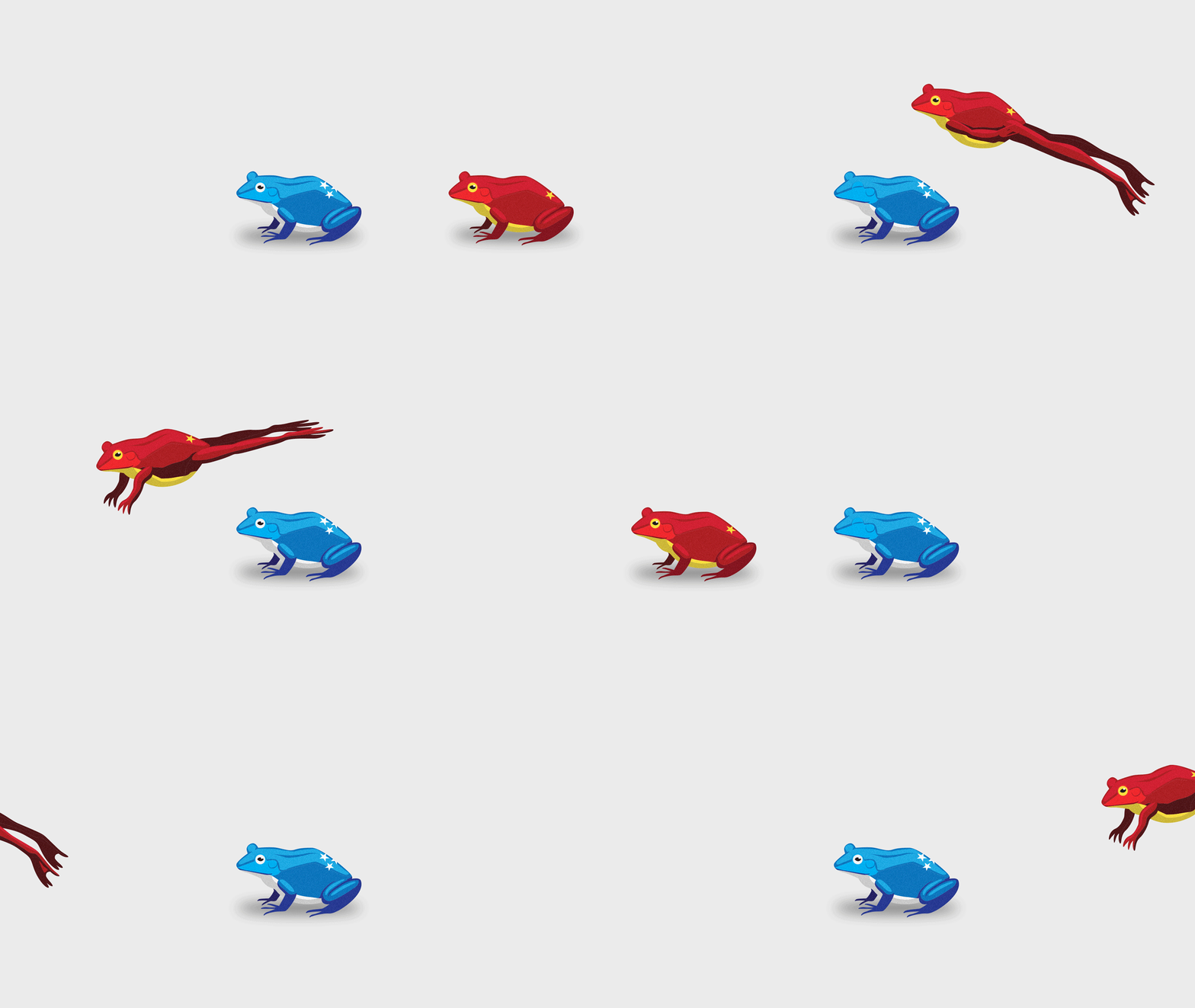
Illustration: Aïda Amer/Axios
While American leaders fret that China might eventually overtake the U.S. in developing artificial intelligence, Beijing is already way ahead of Washington in one area — enacting rules for the new technology, Axios' Ryan Heath reports.
Driving the news: Chinese officials will close consultation Wednesday on a second round of generative AI regulation, building on a set of rules governing deepfakes agreed in 2022.
Why it matters: The Biden administration is behind both allies and adversaries on AI guardrails. While officials in Washington talk about delivering user rights and urge CEOs to mitigate risks, Beijing and Brussels are actually delivering rights and mitigating risks.
The big picture: If China can be first on AI governance, it can project those standards and regulations globally, shaping lucrative and pliable markets.
At the same time, Beijing's speedy regulation achieves three goals at home:
- Delivers tighter central government control of debate.
- Builds up hybrid corporate entities that are meshed with the Chinese Communist Party.
- Boosts trust in AI — already among the highest levels globally — which drives consumer uptake and spurs growth.
Between the lines: After lagging behind the West through consecutive industrial revolutions, leaders in Beijing are driven by a determination not to be humiliated again in the AI era.
- Chinese authorities now have six years of experience building up AI regulatory know-how since they launched a Next Generation Artificial Intelligence Development Plan in 2017. They're using regulation as a form of industrial policy, in addition to traditional subsidies.
Beijing thinks clear AI rules will help the public trust AI.
- Generative AI's breakthroughs have happened in the U.S., but adoption of consumer-facing AI is widespread in China. Xiaoice, Microsoft's China-focused chatbot, has 660 million users.
- To minimize social disruption, party leaders accept that the public must support AI and enjoy its benefits.
- "You can't have a vibrant AI ecosystem if consumers don't trust AI products enough to use them," Helen Toner, a director of grants for Georgetown's Center for Security and Emerging Technology, told Axios.
Yes, but: Tech industry insiders see regulation as a drag on speedy AI development, so many view China's lead in this realm as a U.S. advantage.
What they're saying: Matt Sheehan, a Chinese AI governance expert at Carnegie Endowment for International Peace, told Axios Beijing's first regulatory efforts were stoked by a fear of AI's downsides.
Details: Authorities have been rolling out rules every few months since 2021, including a national privacy law, the Personal Information Protection Law, and a Code of Ethics for New-generation Artificial Intelligence, which outlines requirements that new AI products deliver everything from "improving human well-being" to "controllability and credibility."
- Since 2022 Chinese AI users have had transparency rights — such as the right to turn off an algorithmic recommendation service, or the right to know when they are being supplied with AI-generated content.
- Beijing rolled out "deep synthesis" rules to protect against deepfakes in 2022. While it didn't anticipate the text-based breakthrough of ChatGPT, those rules provided a head start in drafting new rules addressing the risks of text-based generative AI.
The catch: While Beijing has granted rights for Chinese AI users to, for example, challenge an interview turn-down from a hiring algorithm, there's little chance those rights could be exercised at scale, said Russell Wald, policy director at Stanford's center for Human-Centered Artificial Intelligence.
Be smart: China's AI regulations govern what businesses in China do with AI, but very few in the West believe they will restrain the Chinese government's absolute power in any real way. U.S. efforts to regulate AI take aim at both business and government.
2. OpenAI's Altman on that White House meeting
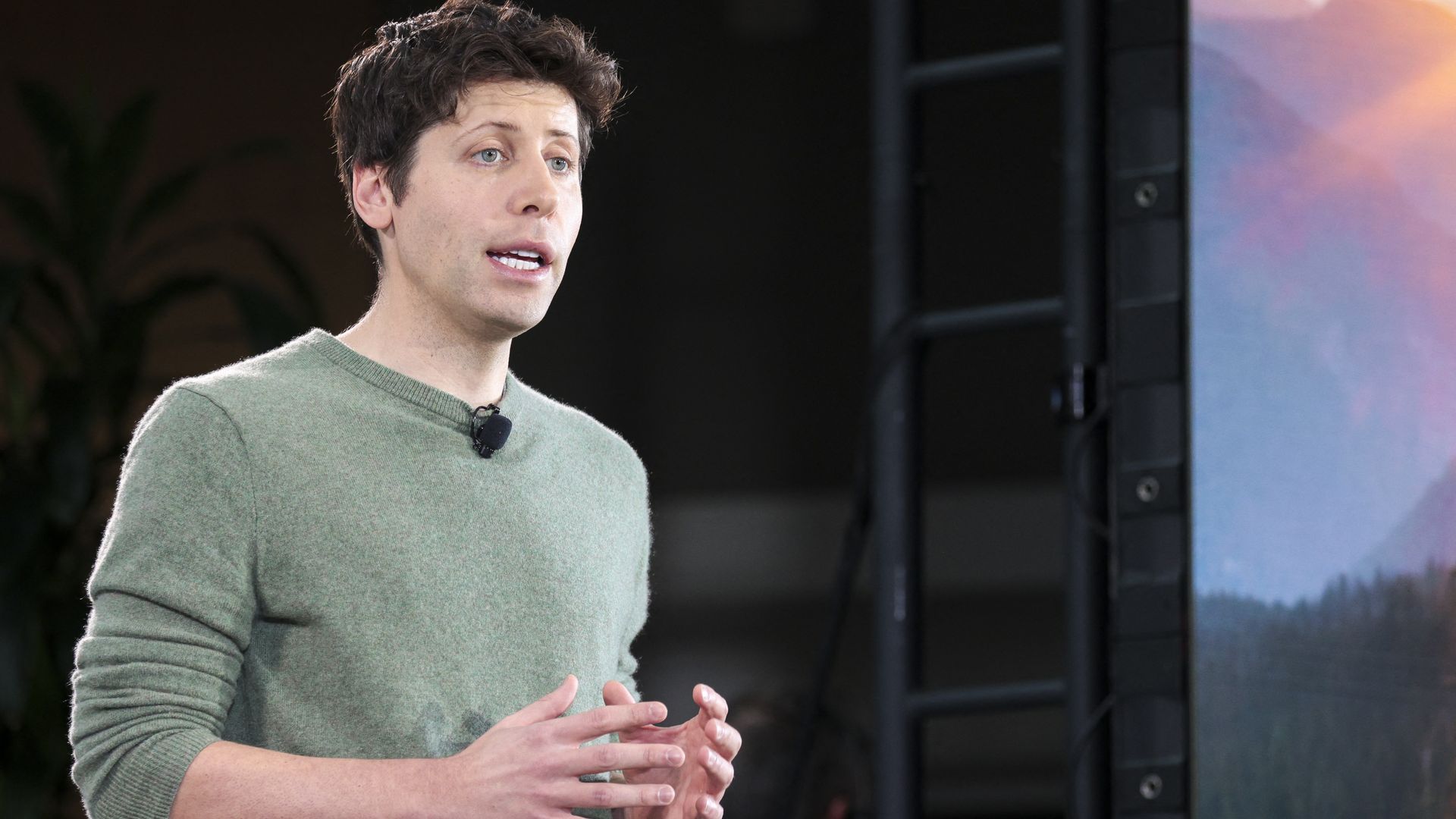
OpenAI CEO Sam Altman speaks in February at Microsoft. Photo: Jason Redmond / AFP via Getty Images
OpenAI CEO Sam Altman said Friday that last week's White House AI summit discussed laws mandating AIs reveal themselves, and added that his firm is working on new ChatGPT models that respect copyright, Ryan and Axios Atlanta's Thomas Wheatley report.
Driving the news: Altman spoke Friday to students at Clark Atlanta University, one of Georgia's leading HBCUs, for the kick-off event of a "Future of Artificial Intelligence" world tour.
Of note: Altman said that one of the most important conversations in Thursday's AI CEO mini-summit at the White House was around "laws so that people know if they're talking to an AI," which he supports.
On copyright, Altman positioned himself on the side of copyright systems that ensure creators are paid for the value they create: "We're trying to work on new models where if an AI system is using your content, or if it's using your style, you get paid for that," he said.
Reality check: Today's generative AI systems are trained on vast troves of internet data that contain significant quantities of copyrighted material. Given the size of the large language models used by OpenAI and its competitors, some see generative AI as a copyright infringement racket.
What he's saying: On the debate around the likelihood and potential timelines for a "god-like" advanced AI with its own will, Altman remained firm: "We are building a tool, not a creature," he said.
- While AI "can make us better at everything we do," Altman said he doesn't "personally think it's gonna wake up and become conscious."
Altman said he was committed to "really figure out what it means" for AI to "reduce bias in the world."
- He also claimed that "AI does not have the psychological problems and the built-up crap that humans do, and so is a neutral force that can call out bias."
Yes, but: For all his optimism, Altman is a realist on jobs. "Customer service is one category where I expect a lot of those jobs, honestly, to just go away," he said.
3. Quick takes: Musk invents new Twitter metric
1. Elon Musk is touting a vague new metric on which he believes Twitter should be valued: "unregretted user minutes." A novel and rather vague measure, the new statistic seems to refer to the amount of time people spend on the site that they don't later come to regret.
My thought bubble: While Twitter has undoubtedly declined on other metrics with Musk at the helm, for me it has plummeted the most on the very metric Musk is touting. Due to higher toxicity and less useful content, I spend far less time on Twitter these days — and regret those minutes more.
2. Hollywood's use of AI in screenwriting has become one of the major sticking point in the current writers' strike, reflecting both the threat posed by the technology and the specific timing of the contract negotiations.
Between the lines: A year ago, the AI issue probably wouldn't have been on the writers' radar. A few years from now, the discussion may have already been too late with the technology more widely in use. Instead, the strike comes as the threat is in clear view, but before AI is really in a position to replace striking writers.
4. Take note
On Tap
- Tech developer conference season kicks into gear this week, with Intel Vision running today through Wednesday in Orlando, IBM's Think running Tuesday through Thursday also in Orlando and Google's I/O taking place Wednesday in Mountain View.
- PayPal and Palantir both report earnings today after the markets close.
ICYMI
- Apple's long-term bets on emerging markets such as India may be starting to pay off. (Bloomberg)
5. After you Login
Razer CEO Min-Liang Tan asked AI to design a toaster in the company's edgy gamer style. I thought the results looked pretty good, but Tan said, "Looks like it'll take a while before AI catches up with our design team."
Thanks to Scott Rosenberg and Peter Allen Clark for editing and Bryan McBournie for copy editing this newsletter.