Axios Login

July 22, 2021

10011011101011001111001010001 — Oh sorry, let me switch this thing out of binary! There, that's better.
Today's newsletter is 1,380 words, a 5-minute read.
1 big thing: Swiss privacy app wades into U.S. antitrust war
Illustration: Sarah Grillo/Axios
Privacy-focused email app ProtonMail is stepping into the U.S. antitrust debate as it and other smaller players take on Apple and Google in a fight over app store fees and practices, Axios' Margaret Harding McGill reports.
Why it matters: App makers have long feared antagonizing Big Tech firms that control their access to customers, but now some are seizing the antitrust moment as a chance to change the rules.
Driving the news: Proton Technologies, a Swiss company that provides fully encrypted email services, argues that privacy is an antitrust issue in a new blog post Thursday. The post throws the company's support behind the House Judiciary Committee's tech antitrust bills.
- Proton argues that if it could compete on a level playing field with Google for email services, consumers would be more likely to choose its privacy-focused app over Google's ad-supported offerings.
- "Essentially, they control the whole ecosystem," Proton policy counsel Jurgita Miseviciute told Axios. "For startups, especially privacy-focused companies, it's very, very difficult to compete when there are conditions like that."
At the top of Proton's list of grievances is the 30% commission Apple collects on subscriptions sold through its App Store, with Google planning to enforce the same fee (although Google recently announced a temporary extension to 2022).
- Proton's "freemium" model means it relies on paid subscriptions for revenue.
- The company raised prices for consumers to cover the Apple fee, and is facing the prospect of doing the same when Google enforces its fee.
The big picture: "Fortnite" maker Epic Games has pursued a private antitrust lawsuit against Apple over its app store restrictions, and a ruling could come any week.
The other side: A study on commission rates last year commissioned by Apple found that the 30% cut is "similar in magnitude to the commission rates charged by many other app stores and digital content marketplaces."
- Apple notes that 85% of apps don't pay a commission, and it has exempted books, video and music apps from paying the fee.
- Google, which is facing an antitrust lawsuit from state attorneys general over its Play Store practices, says only 3% of developers are subject to its fee, and notes "our current business model benefits the overwhelming majority of developers."
- Apple and Google both recently announced fee reductions to 15% for small businesses that earn less than $1 million.
What's happening: Proton, a member of the Coalition for App Fairness, sees the tech antitrust bills, and particularly the American Choice and Innovation Online Act, as a path toward more competitive fees.
- Proton believes the bill would make it illegal for Apple and Google to require the use of their payment processing services in order to distribute apps, allowing for more competition and perhaps lower fees.
What to watch: Proton thinks the bills could be improved if they prevented Apple and Google from pre-installing default apps on devices. (The legislation currently says users should be allowed to remove pre-installed apps.)
Yes, but: The bills were narrowly approved out of the House Judiciary Committee in June, but it is unclear when they could move to the House floor.
2. Exclusive: Where Amazon wants to take Alexa
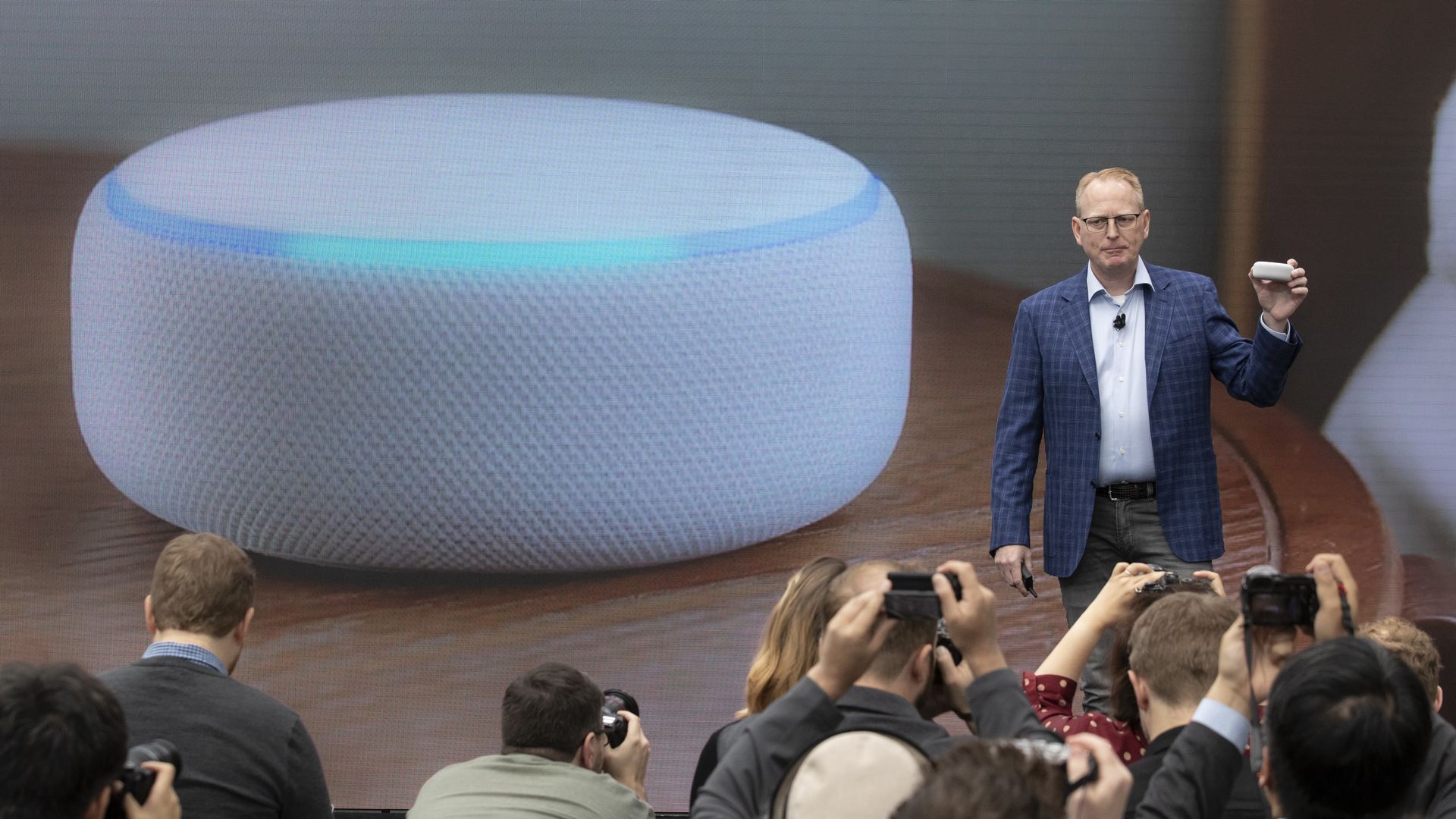
Amazon exec Dave Limp at a 2018 event. Photo: Stephen Brashear/Getty Images
While many people think of Alexa as just the voice behind Amazon's smart speaker, Amazon sees it as the first step towards something more akin to "Star Trek's" remarkably versatile talking computer, Axios' Ina Fried reports.
Why it matters: So-called "ambient computing" is seen as the next big wave of computing, where information is personal and delivered in the best way possible given the combination of devices one has nearby.
"You look at those 'Star Trek' episodes and it's very conversational," Amazon executive Dave Limp told Axios in an interview ahead of the company's Alexa Live conference, which took place on Wednesday.
- Limp, a longtime Amazon executive, is in charge of Alexa, as well as the company's devices, including the Echo family as well as Ring and other products.
Today's voice assistant, be it Alexa or rival ones from Google and Apple, remains far too transactional, Limp said.
- A truly smart assistant also needs to be able to predict what you might want, rather than just respond to commands.
- "When we started, Alexa was 100% reactive," Limp said.
Early on, Amazon also required people to install the "skill" they might want Alexa to know as well as to summon that skill by name.
- That, according to Limp, put way too much onus on a person to know what Alexa was capable of — which is particularly difficult in a voice-only environment without menus to show the possibilities.
The big picture: In recent years, Amazon, along with Google and Apple, has become more adept at using cues — such as your location, history and the time of day — to predict what you might want out of their assistants.
What's new: Amazon took some incremental steps Wednesday at its online Alexa Live conference, adding new types of widgets as well as taking advantage of devices like Echo Show that have screens to help customers know more of what Alexa can do.
Longer term, the company's goal is for customers to ask for what they want and Alexa to figure out whose skill is needed — whether it is one from Amazon or from one of the thousands of developers who build on top of Alexa.
- "For customers it just means we find the expert in the room and automatically route that question," Limp said.
3. New GOP plan to tax Big Tech for broadband
A trio of Senate Republicans introduced legislation Wednesday that would lay the groundwork to force Big Tech companies to pay fees to support broadband subsidy programs, Margaret reports.
Why it matters: Republicans are increasingly looking to Big Tech to support a struggling subsidy fund that pays for internet access and deployment programs.
Driving the news: The bill, from Sen. Roger Wicker (R-Miss.), ranking member of the Senate Commerce Committee, and Sens. Shelley Moore Capito (R-W.Va.), and Todd Young (R-Ind.), would direct the Federal Communications Commission to study the feasibility of collecting fees from companies like Google and Netflix to shore up the agency's Universal Service Fund.
- The Funding Affordable Internet with Reliable Contributions Act would require the FCC to consider possible sources of Big Tech revenue, like digital advertising and user fees.
- The agency would also have to assess whether or not it could collect fees on companies that historically have not been regulated by the FCC.
Catch up quick: Republican FCC commissioner Brendan Carr in May outlined a plan to force Big Tech companies to pay into the subsidy fund.
- Currently, a fee on phone bills goes into the Universal Service Fund, but that revenue base has been decreasing.
4. How TikTok sees inside your brain
A new video investigation by the Wall Street Journal finds the key to TikTok's success in how the short-video sharing app monitors viewing times.
Why it matters: TikTok is known for the fiendishly effective way that it selects streams of videos tailored to each user's taste. The algorithm behind this personalization is the company's prize asset — and, like those that power Google and Facebook, it's a secret.
How they did it: WSJ created a batch of individualized dummy accounts to throw at TikTok and test how it homed in on each fake persona's traits.
What they found: TikTok responds most sensitively to a single signal — how long a user lingers over a video. It starts by showing new users very popular items, and sees which catch their eyes.
- The TikTok algorithm works so well that some people think it's reading their minds.
Yes, but: The investigation also found that TikTok — like YouTube — can lure users deep into rabbit holes of increasingly extreme content.
Go deeper: Watch the video.
5. Take note
On Tap
- Intel, Twitter and Snap report their earnings today.
ICYMI
- The FTC, by unanimous vote, formally pledged to go after restrictions on consumers' "right to repair" products and devices. (The Verge, Axios)
- Flooding in central China has reached Apple's biggest iPhone plant. (WSJ)
- In a survey of tech workers, 50% said they were very or somewhat interested in being represented by a union. (Protocol)
- Clubhouse, the live-audio app, is no longer invite-only. (TechCrunch)
- California is suing Activision Blizzard over a "frat boy culture." (The Verge)
6. After you Login
The cardboard beds are about sustainability, not celibacy, folks. (And they were planned pre-COVID.) Also, they look pretty darn sturdy, as this athlete demonstrates.
Sign up for Axios Login

Taking you inside the AI revolution, and delivering scoops and insights on the technologies reshaping our lives.