Axios Login

February 22, 2022
No football. No Olympics. Please send some emergency sports (as well as tech news tips) to [email protected].
Today's newsletter is 1,189 words, a 4-minute read.
1 big thing: AT&T's 3G shutdown sparks "alarmageddon" fears

Illustration: Sarah Grillo/Axios
AT&T's shutdown of its 3G network today has sparked fears that home security systems, medical alert monitors and a range of other devices will stop working, Axios' Margaret Harding McGill reports.
Why it matters: Carriers have previously retired networks, but this transition is proving more complicated because the pandemic hindered companies that rely on 3G services from making upgrades. Plus, there are just more devices to manage.
- AT&T, T-Mobile and Verizon are all planning to shut down their 3G networks this year to support new 5G services.
Driving the news: AT&T, which first announced plans to sunset its 3G network in 2019, says less than 1% of its mobile data traffic runs on that network.
- The company has offered customers free and discounted 4G LTE phones to help them upgrade, totaling about 2 million replacements.
What to watch: AT&T says phone coverage will not be affected, but it's not just phones that use the company's 3G network.
- 3G-connected cars — including some that are only a few years old — may require software or hardware upgrades, or could lose automatic crash notifications and other features entirely.
- As much as 10% of all public school buses across the country will lose GPS and communications services, according to a filing from AASA, The School Superintendents Association.
- San Francisco warned bus riders that more than 650 prediction display systems at bus shelters that rely on AT&T's 3G service will stop displaying real-time information.
Details: An alarm industry group says roughly 2 million devices powering burglar intrusion systems, fire alarms and personal emergency alerts will go offline.
- The Alarm Industry Communications Committee said the pandemic hindered technicians' ability to get into homes to upgrade devices and source materials, and has asked the Federal Communications Commission to force AT&T to delay its plans.
- The FCC has not acted on the group's request. Spokesperson John Brady told Axios the industry has taken its concerns to the White House, which intervened in a dispute between AT&T and Verizon and the airline industry over 5G signals last month.
- "I basically told the White House that you were worried about planes falling out of the sky. How about people dying in their homes? Because that's what's going to happen," said Brady, who is also COO of Connect America, which provides personal alert devices.
What they're saying: "We are heading to alarmaggedon," Harold Feld, senior vice president of tech policy group Public Knowledge, told Axios.
- "If you roll the dice, maybe nobody has a problem in the first day or the second day or the third day," Feld said. "But eventually someone’s going to have a problem where they will need that alarm."
- A senior Biden administration official told Axios the White House is "closely tracking carriers' 3G transition plans and shares concerns about the potential impact of these plans on the function of home security and medical alert devices."
The other side: AT&T says it has built a plug-in device to automatically connect 3G alarm service devices to its LTE network, and is using roaming options to help bridge the transition for many connected devices.
Meanwhile, FCC chairwoman Jessica Rosenworcel, a Democrat, said the agency worked with AT&T to ensure there are roaming agreements in place for devices that rely on its 3G network.
- "I think we are on course for this transition to take place with limited disruption," Rosenworcel told reporters at a press conference Friday.
What's next: T-Mobile will sunset its 3G service on July 1, and Verizon plans to end its service by the end of the year.
2. Trump's Truth Social has a rough launch
Screenshot: Apple App Store
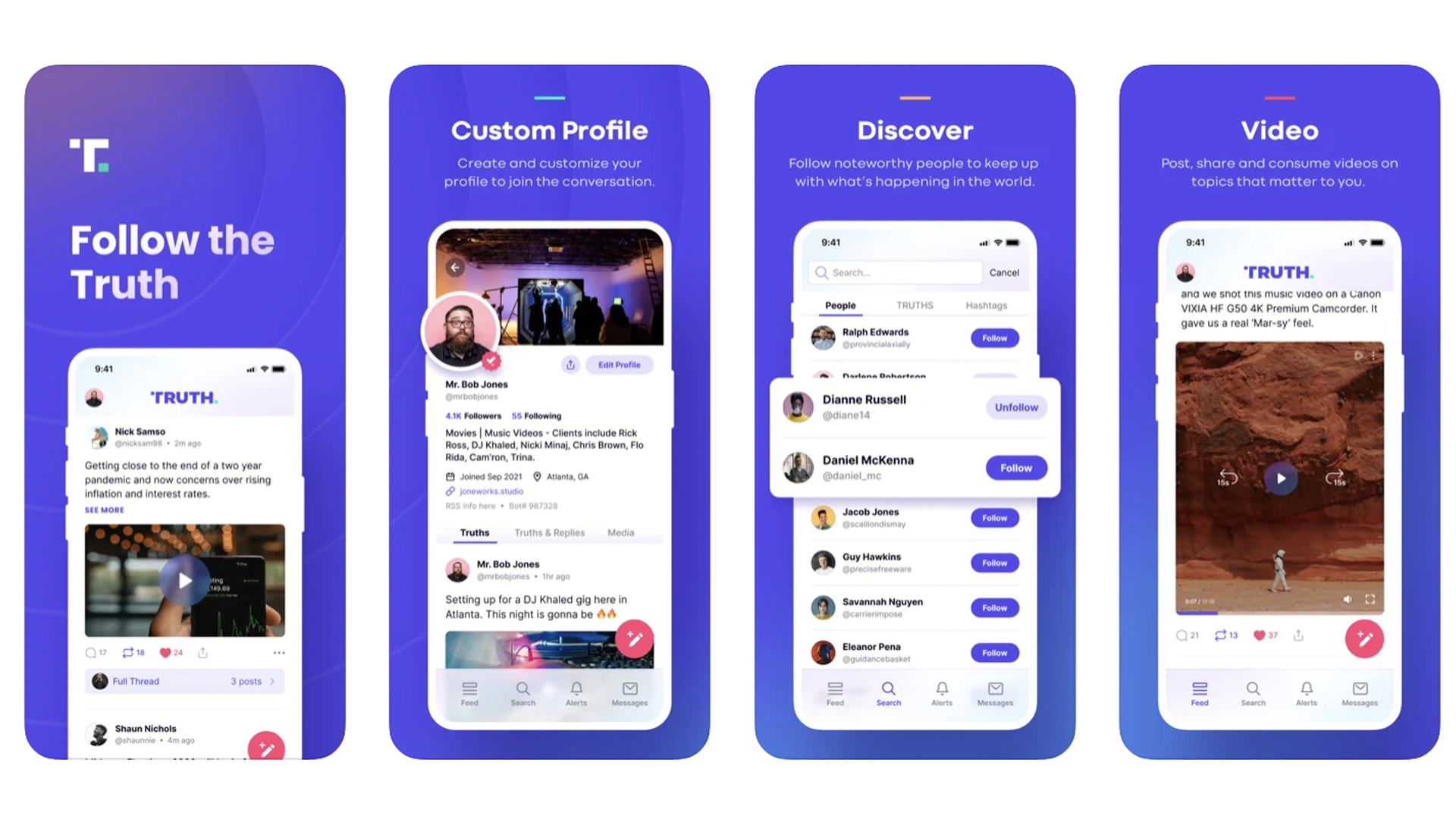
Former President Trump's social media app Truth Social launched in Apple's App Store Monday at midnight, but still wasn't fully available to all users, Axios' Sara Fischer reports.
State of play: While some users experienced error notifications, others were asked to join waitlists. At least two sources told Axios they were asked to submit their emails for user verification, but never received emails to sign up.
- Some users complained on Twitter about being placed on the waitlist again, after first signing up to be a part of the app last year, before it launched in Apple's app store.
The big picture: In addition to a chaotic sign-up process, the app experienced a number of security and business setbacks ahead of launch. On Sunday night, a reporter for The Daily Dot noted he was able to access an internal beta version of the app used internal by developers that was left publicly accessible online.
- On Monday, a small British company threatened Truth Social with legal action for copying its logo.
- The blank check company Truth Social is set to merge with is under investigation by securities regulators.
Yes, but: The technical glitches didn't stop users from wanting to get in on the action. The app was the top free app in Apple's App Store Monday.
3. Exclusive: LinkedIn nabs former Facebook exec
Photo illustration: Mateusz Slodkowski/SOPA Images/LightRocket via Getty Images
LinkedIn will announce today that it has hired Joaquin Quiñonero Candela as the company's first technical fellow.
Why it matters: Candela is a leader in the field of responsible AI and previously worked at Facebook for nearly a decade, most recently as its distinguished tech lead, and also ran its AI and Society lab. He is also on the board of the Partnership on AI.
What he's saying: In a blog post being published today, Candela said he was impressed not only by what LinkedIn does, but also by its people and values.
- "LinkedIn puts members — the people they serve — first," Candela said. "LinkedIn also embraces equity in how they build products: they strive to serve everybody and to provide equal access to economic opportunity."
4. The fight over Tim Cook's pay package


Apple wants to award CEO Tim Cook a $99 million pay package — but shareholder advisory firm ISS has recommended a "no" vote, Axios Markets' Emily Peck reports.
Why it matters: It's the latest flare-up in the long running debate of "How much is too much when it comes to CEO compensation?"
State of play: ISS says the package is too big — triple the peer median pay — and that it does little to help with retention, since much of it is stock that Cook will earn in retirement no matter what. Another advisory firm, Glass Lewis, approved the comp package.
- Reality check: Shareholders will likely ignore the recommendation, Daniel Ives, managing director at Wedbush Securities, tells Axios.
The big picture: Shareholders need Cook, says Ives. The last thing they want is to make him unhappy.
"Compare what Cook's done to the disaster of Zuckerberg and to other CEOs of similar stature," Ives added, referencing Mark Zuckerberg of Meta, whose shares recently plummeted. "The success of Apple is unparalleled."
5. Take note
On Tap
- There are a smattering of earnings reports this week, including eBay and Booking.com on Wednesday, with Square and VMware on Thursday.
ICYMI
- Facebook parent company Meta invested $40 million earlier this year in Japanese mobile gaming company Playco, Axios' Kia Kokalitcheva scooped. (Axios)
- The IRS on Monday said it would allow taxpayers to verify identities in virtual interviews after a plan to use facial recognition software drew significant backlash. (Axios)
6. After you Login
Check out this artist who has reimagined the clothesline as a canvas.
Sign up for Axios Login

Taking you inside the AI revolution, and delivering scoops and insights on the technologies reshaping our lives.


