Axios Latino

November 23, 2021
¡Muy buen día! Today we discuss banned books, colorism and songs in sign language.
- 🚨 Job alert: Axios Latino is looking for a senior editor to lead the newsletter to its next milestone. If you have journalism experience and ideas to make this newsletter even better, apply here.
- Send us any feedback (quejas, sugerencias, chismes) by replying to this email. Sign up if you aren’t yet subscribed, and remember you can read the Spanish version here.
- This newsletter — edited by Alison Snyder and Michele Salcedo — is 1,399 words, about a 5-minute read.
1 big thing: Latino young adult books face bans

Illustration: Sarah Grillo/Axios
Conservative school boards want to ban Latino young adult literature that tackles issues of race and sexuality.
Why it matters: The growing backlash against lessons on slavery, racism, and LGBTQ issues has engulfed young adult Latino authors whose work is often overlooked in discussions about race in education materials.
- Banning the works in libraries or schools makes reading about and contemplating those experiences less accessible than those of the majority-white non-Hispanic authors and publishers in the industry.
- The bans are especially centered on the young adult genre, which is increasingly promoted on new platforms like Instagram (known as Bookstagram) and TikTok (with the hashtag #BookTok), and has slowly diversified, particularly with sci-fi and fantasy offerings.
What's happening: Books by Ashley Hope Pérez, Elizabeth Acevedo, Benjamin Alire Sáenz and other authors have landed on banned book lists tracked by the American Library Association.
- Two of Acevedo's novels are on the 2020 list of books restricted or removed from shelves by librarians, school authorities, parents or local politicians.
- They are 2018's "The Poet X," a winner of the National Book Award for Young People's Literature, and 2020's "Clap When You Land," about half-sisters who find out about one another when their father's plane crashes. Both novels are written in verse and center on Afrolatina teens.
- Alire Sáenz's lyrical novel "Aristotle and Dante Discover the Secrets of the Universe," about two Mexican American gay teens in the 1980s, has also been on banned book lists. The work is being adapted to film.
- The novel, and its Spanish translation, were also attacked recently in Texas, where lawmaker and candidate for attorney general Matt Krause unveiled a list of 850 works he has said should be made unavailable at schools across the state.
Ashley Hope Pérez’s "Out of Darkness" has become one of the most high-profile targets of conservative parents.
- The novel is about an interracial romance between a Mexican girl and a Black boy, but parents have been focusing on a sex scene.
The big picture: The young adult genre isn't the only one in which Latino authors have written in recent years about topics that have been the target of book banning efforts.
2. Chile at the extremes
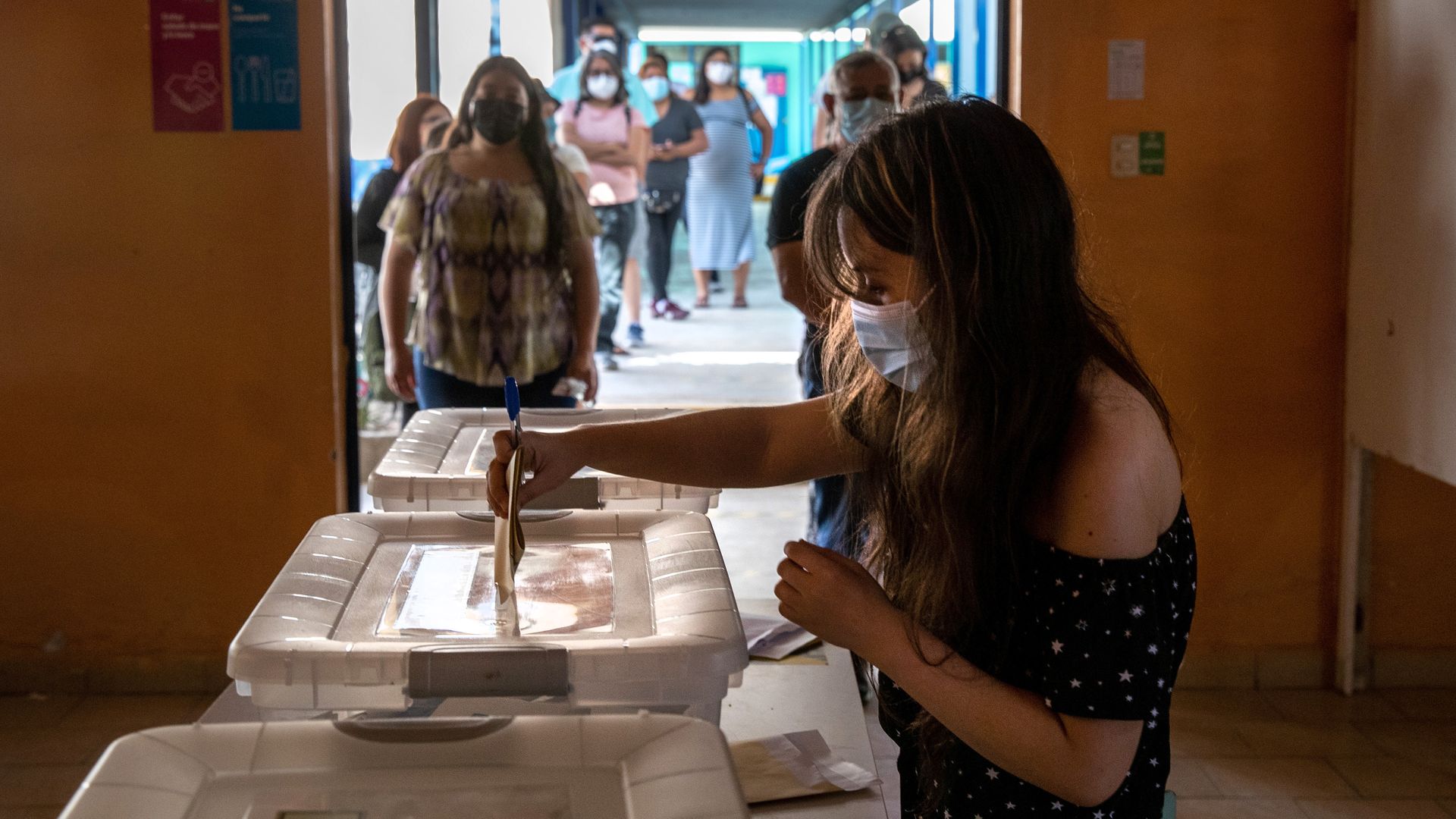
A voter casts her ballot during national elections on Nov. 21 in Arica, Chile. Photo: John Moore/Getty Images
Chile's centrist candidates were shut out in Sunday's first-round vote, which now heads to a run-off election between a far-right and a far-left candidate.
Why it matters: The outcome of the second round of voting on Dec. 19 will have repercussions for an increasingly polarized Chile and how the country's economy, which is supported by key global resources such as copper, is handled.
The details: Gabriel Boric, a 35-year-old leftist congress member and former student leader, will face off against José Antonio Kast, an ultraconservative 55-year-old lawyer who has defended Augusto Pinochet's dictatorship. Kast got 27% of the votes — the most of all candidates — in the first round on Sunday.
- Boric champions levying more taxes on companies, pension reform, and tightening regulations to try to reduce the environmental effects of the state-owned mining company, Codelco.
- Kast proposes privatizing that company and possibly raising export taxes or output royalties on copper, which could increase the metal’s price.
- Chile is the world's largest producer of copper and second-largest of lithium, both key for electronics and for manufacturing renewable energy technologies.
3. Younger Latinos call out discrimination and colorism
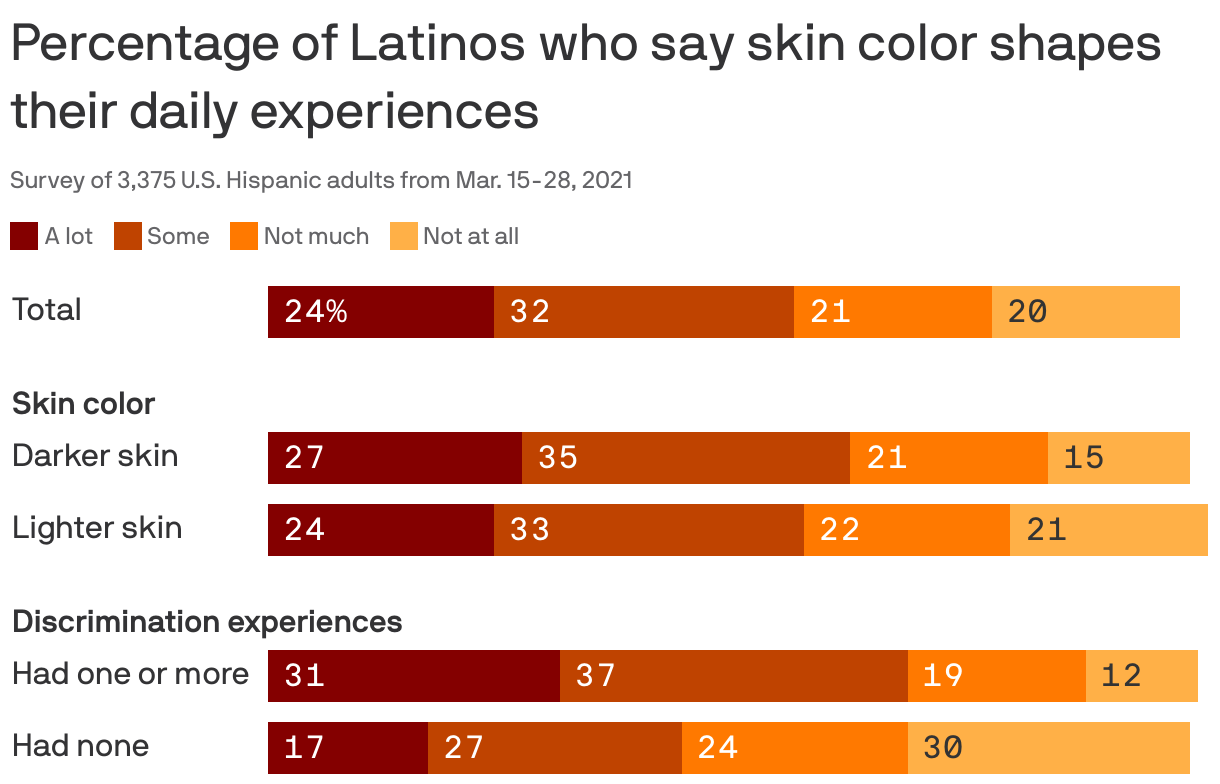
Young U.S. Latinos are more likely than their older counterparts to speak up against discrimination, reporting incidents like being called names or told to go “back” to their country, according to a Pew poll.
Why it matters: The poll suggests younger generations are much less willing to endure micro-aggressions as the U.S. increasingly reflects upon and reckons with racial and ethnic discrimination.
- Latinos under age 50 are also more likely to say Hispanic racial issues get too little attention in the U.S., and to criticize friends or family members who make racially or ethnically insensitive comments.
By the numbers: The Pew poll also looked at how Latinos' daily experiences vary depending on their skin color.
- 62% stated they feel colorism affects them because darker skin is seen as an impediment to get ahead, while 59% consider having lighter skin an advantage.
- The poll also looked at colorism within the Hispanic community: 41% of Latinos with darker skin said another Latino person had treated them unfairly or discriminated against them, whereas 25% of Latinos with a lighter skin color reported the same treatment.
Go deeper: Most Latino professionals feel overlooked for promotions
4. The civil rights history of U.S. Latinos
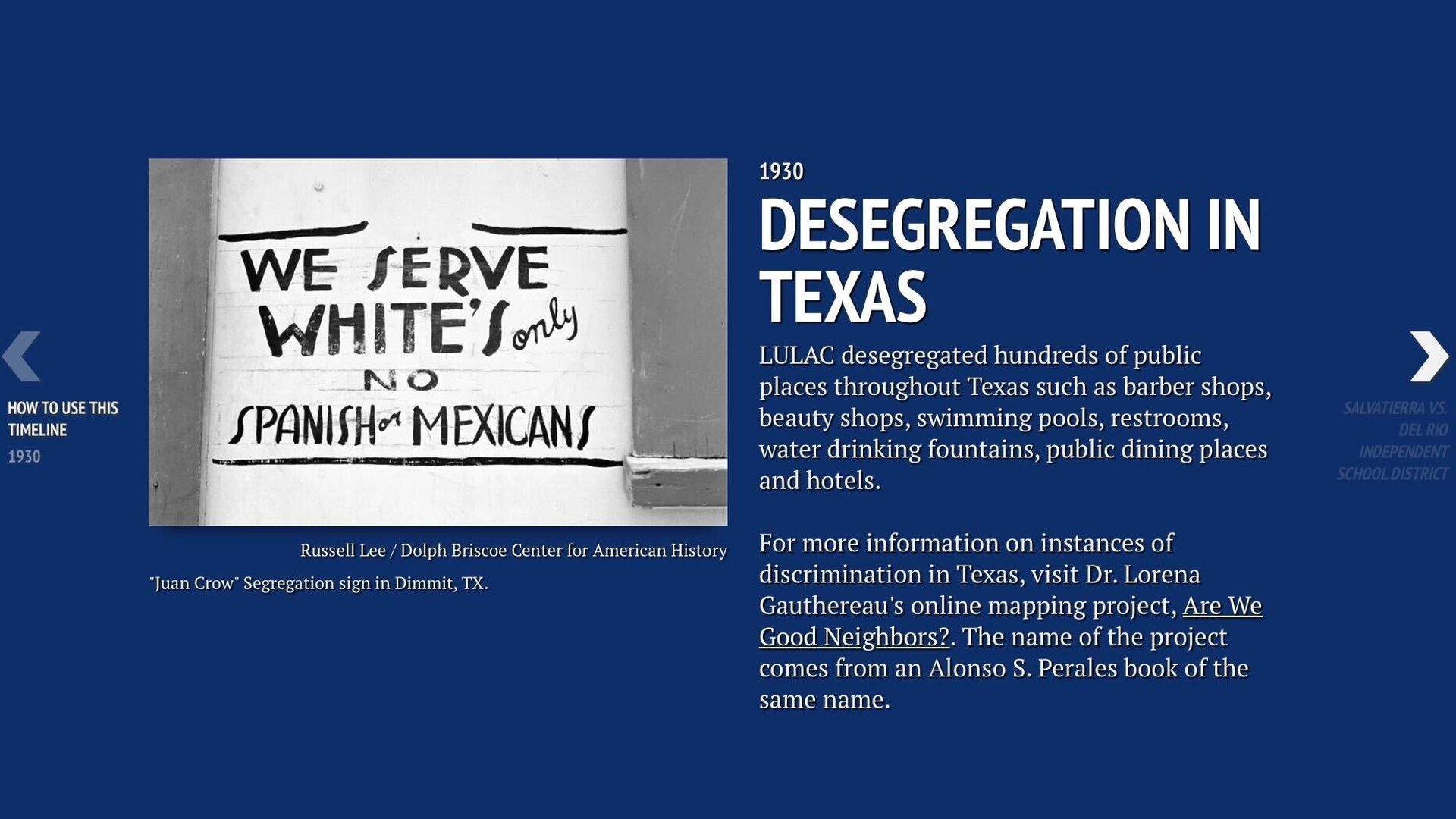
Credit: LULAC
The League of United Latin American Citizens published an extensive timeline this month of the legal battles, union formations, and political strategies used to advance the civil rights of U.S. Latinos, Axios' Yacob Reyes writes.
Why it matters: The organization’s timeline comes amid a broader discussion of the marginalization Latinos still face across the United States, including health care inequities and structural racism.
Details: The interactive timeline is a compilation of historical records, art, and photos that document Latinos' nearly century-long "battle for civil rights," the organization said in a news release.
- It outlines LULAC's fight to repeal legislation that discriminated against Latinos, called "Juan Crow laws," which restricted access to public spaces, such as swimming pools, restrooms and water drinking fountains.
- It also documented a slew of successful lawsuits to integrate Texas school systems that segregated Mexican children until 1945 because they were “more poorly clothed and mentally inferior to white children.”
What they're saying: "Many people are uninformed or base their facts on disinformation about the true contributions of Latinos in our country," LULAC President Domingo Garcia said in a statement.
5. Stories we’re watching
The president of El Salvador, Nayib Bukele, addresses the closing ceremony of the Latin Bitcoin conference (LaBitConf) at Mizata Beach, El Salvador, on Nov. 20, 2021. Photo: Marvin Recinos/AFP via Getty Images)
1. President Nayib Bukele of El Salvador has upped his cryptocurrency bet, announcing this weekend his government will create a “Bitcoin City” near a volcano.
- Bukele made Bitcoin legal tender in El Salvador in June, the first country to do so, arguing it would foster investments and financial welfare in the impoverished Central American nation.
- The promised city would be built with cryptocurrency bonds near the base of the Conchagua volcano, where Bukele claims the typically high environmental effects of creating bitcoins and running their transactions can be offset by using the volcano for geothermal energy.
2. Honduran presidential candidates closed out their campaign events this weekend, ahead of the country's Nov. 28 vote.
- The top two candidates, former first lady Xiomara Castro and Nasry Asfura of the ruling National Party, have been accused of corruption and possible links to criminal organizations before the elections. Both deny the accusations.
- The current president of the Central American country, Juan Orlando Hernández, was named in U.S. court documents related to drug trafficking after his brother was convicted on drug charges in 2018.
6. 🧏 1 smile to go: ASL reggaeton

Lyrics can be understood by people who are deaf or hard of hearing, thanks to a Latino who interprets popular songs on social media.
Details: Dominican Melqui Pérez is a child of deaf adults who learned to sign before he learned spoken Spanish and English.
- For more than five years, he has uploaded songs that he signs and accompanies with varied facial expressions, so other deaf people can understand the lyrics and dance along.
- The interpreted songs range from J.Lo and Marc Anthony duets to Café Tacvba classics and newer reggaeton hits from the likes of Ozuna.
By the numbers: One in seven Latino adults in the U.S. experience some hearing loss, according to an NIH report.
- They can be especially vulnerable as many come from bilingual households where they face greater barriers to communication, such as learning sign languages other than ASL.
Thanks for reading. We are off Thursday and will be back on Tuesday. Happy Thanksgiving to our readers in the U.S.! Have a safe one.
Sign up for Axios Latino

Keep tabs on the stories that most affect the U.S. Latino community on both sides of the border, a collaboration with Noticias Telemundo.