Axios Latino

February 24, 2022
¡Bienvenidos! Today we dive into e-commerce, betting on solar power, and which Latin American nations have the most freedom.
- Puede leer la versiĂłn en español aquĂ.
🚨Situational awareness: Russia President Vladimir Putin has launched attacks across Ukraine. Follow Axios' live updates.Â
This newsletter, edited by Astrid Galván, is 1,495 words, about a 5.5-minute read.
1 big thing: Where tamales meet the blues

Illustration: AĂŻda Amer/Axios
Scholars are finding more links between Latinos and Black American cuisine and music that go back centuries, Russ writes.
The big picture: Mississippi Delta bluesman Robert Johnson's famous homage to tamales in "They're Red Hot" — recorded in San Antonio in 1936 — is just one example.
Details: Legend has it that Johnson sold his soul to the Devil for a supernatural guitar talent. He went on to record songs about cars, the crossroads — and tamales.
- According to "Up Jumped the Devil: The Real Life of Robert Johnson," by Bruce Conforth and Gayle Dean Wardlow, between recording sessions, the bluesman took note of the Mexican American women selling tamales during the fiesta.
- The lyrics describe vendors trying to draw attention to their red hot tamales while Johnson's guitar invites listeners to dance.
Yes, but: Even before Johnson went to San Antonio, the tamale was also a common food in the Mississippi Delta and parts of Tennessee where a southern version of the dish had evolved, music historian Elijah Wald told Axios Latino.
- "There were tamales all over the Black South. I would be interested to go back and look at pictures of tamale vendors back in those days."
- Tamales first appear in high numbers along the Mississippi Delta in the early 20th century, according to Melissa Booth Hall, interim co-director of the Oxford, Miss.-based Southern Foodways Alliance.
But, but, but: How did the tamale get there?
- Some believe Mexican migrants who helped clear the Delta at the turn of the century introduced the tamale to the region, Hall said.
- Others theorize U.S. soldiers from Mississippi brought back tamale recipes from the U.S.-Mexico War, while some argue that the Southern tamale is a product of indigenous tribes in the region, though little evidence of that is available.
Click here to read more
2. Latino businesses take to tech
Illustration: AĂŻda Amer/Axios
Latino-owned businesses were more likely to transition to e-commerce and use more technological tools last year than white non-Hispanic ones, according to a Stanford report, Marina writes.
Why it matters: Having an online presence has become key to staying afloat during the pandemic.
- Latinos’ readiness and willingness to adopt technology could create long-term benefits for the U.S. economy, which is increasingly spurred by Latinos.
- Latino-owned ventures have been the fastest-growing small businesses for the past decade, with higher revenue growth and a greater percent increase in hiring.
By the numbers: 18% of Latino owned businesses moved into e-commerce last year, compared to 13% of white non-Hispanic businesses, according to the Stanford report.
- 21% of Latino businesses with employees said they had improved their use of technology, with tools such as payroll services or an expanded social media presence, according to the research.
- That’s compared to 16% of white non-Hispanic businesses.
Funding initiatives from the U.S. Hispanic Chamber of Commerce, Google and Wells Fargo, which works with UnidosUS and LULAC, have helped with transitions to e-commerce and pandemic recovery.
- Latinos have historically had less access to banking tools and to business financing.
- The idea is to give Latino businesses “greater access to funding they may not have had access to prior, supplementing revenue lost” during the pandemic, to “improve their chances to overcome the effects of COVID-19,” Jenny Flores, head for small business growth philanthropy at Wells Fargo, told Axios Latino.
3. The sun burns bright in Puerto Rico
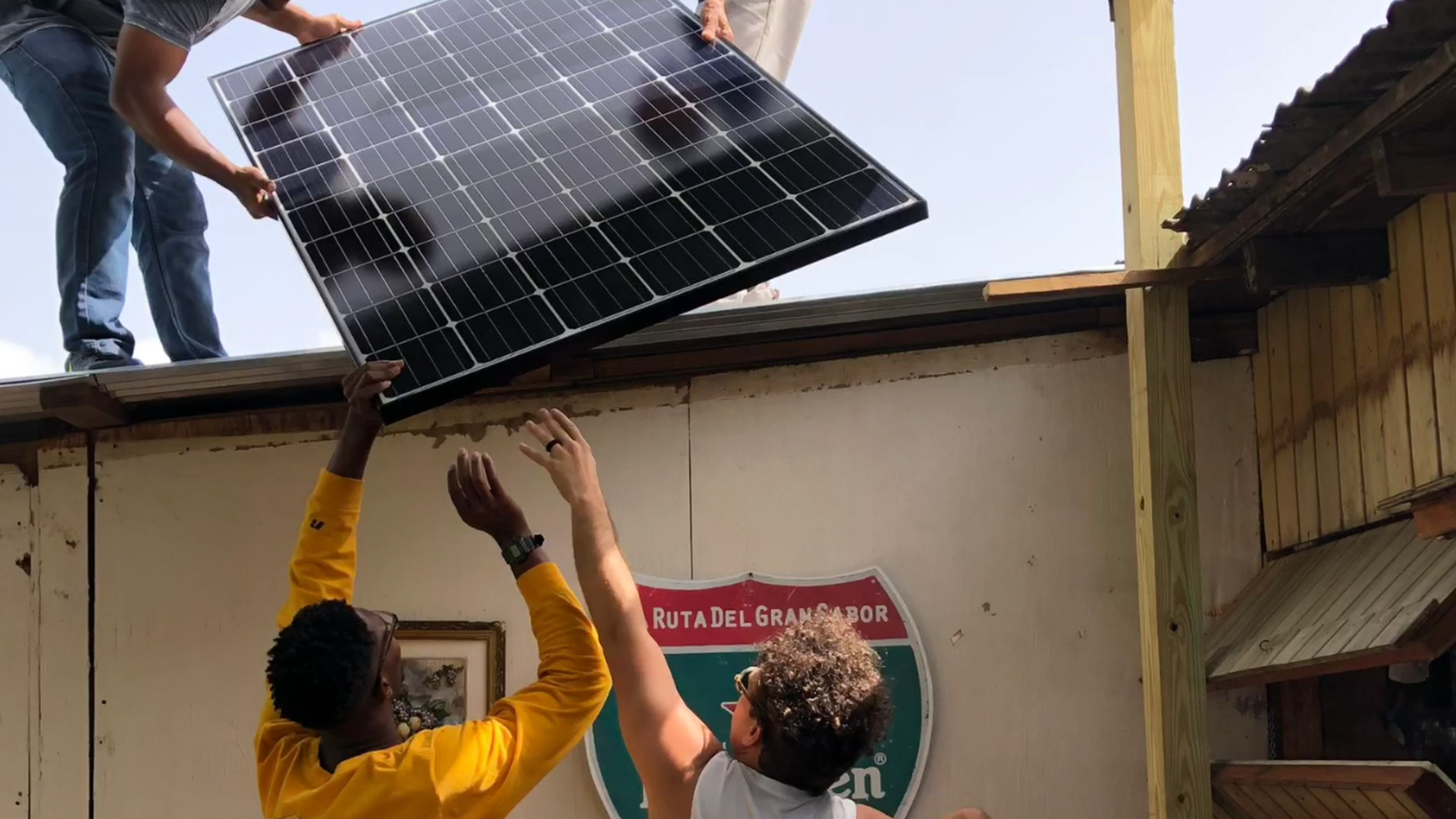
Solar panels being installed for a microgrid in Adjuntas, a town two hours by car from Puerto Rico's capital, San Juan. Photo: Casa Pueblo
Puerto Rico is set to push renewable energy forward on the island after a funding agreement with the U.S. government.
- $12 billion in energy sector recovery funds from 2017’s hurricane Maria will be redirected to energy sources like microgrids, under the early February agreement.
Why it matters: The island’s troubled electrical grid has for years been mismanaged, resulting in regular blackouts even after it was privatized and even though Puerto Ricans pay twice the national average for electricity.
- Committing to renewables will allow communities to have strong and reliable energy, meaning fewer power disruptions and better capacity to quickly recover from failures, according to the agreement.
Details: A 2019 law set a goal for Puerto Rico’s electricity to be 100% derived from renewables by 2050. At the moment, 3% of its grid comes from green energy.
Zoom in: In the mountain town of Adjuntas, the fire department, primary school, radio station, pharmacy and convenience stores — even a movie theater, plus more — are all powered by solar panels.
- "After Maria, we transformed the energy landscape, with houses on a microgrid saving up to $40 in their monthly electric bills, and without getting even a penny of federal funds or Puerto Rican government funds,” Arturo Massol Deyá, director of Casa Pueblo, told Axios Latino. Casa Pueblo is installing the panels through fundraising.
- “If another hurricane comes, Adjuntas is now better off than before Maria. The rest of Puerto Rico can’t say the same.”
4. Moving on up to the free side

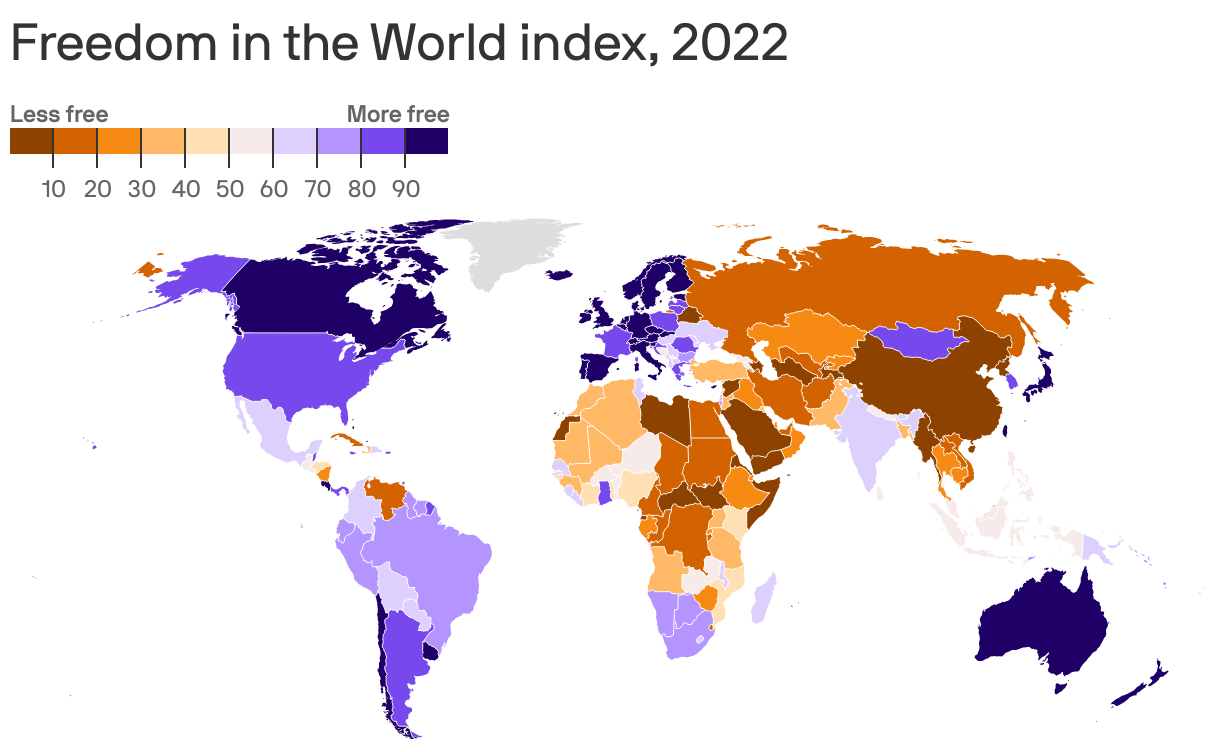
Peru and Ecuador had the most improvement in political and civil liberties in the Americas in 2021 while freedom around the world declined for the 16th straight year, according to a report released today.
What to know: The Freedom in the World report has tracked freedom of expression, electoral participation and safeguards against corruption since the 1970s, scoring countries from 0 (doing poorly) to 100 (mostly free conditions).
- Two thirds of countries in the Americas are currently designated as “free.”
- Those considered just “partly” free — where certain rights like freedom of the press or rule of law are threatened — are Mexico, Honduras, Guatemala, El Salvador, Dominican Republic, Colombia, Bolivia and Paraguay.
Ecuador and Peru had the best positive change in the region, moving to the “free” designation after orderly elections. They had been considered “partly free” in past years because of low transparency and poor anti-corruption efforts.
- Chile's process for creating a new Constitution was also lauded. Chileans will vote on it this year.
Nicaragua, Cuba and Venezuela were once again the worst-graded regional countries, due to rigged or uncompetitive elections and crackdowns against opposition.
- The report also warned that political and civil liberties in El Salvador and Brazil could be under threat due to Salvadoran Nayib Bukele’s removal of judges and Jair Bolsonaro’s repeated criticisms of electoral authorities before an October presidential vote.
Read more here
5. Stories we're watching
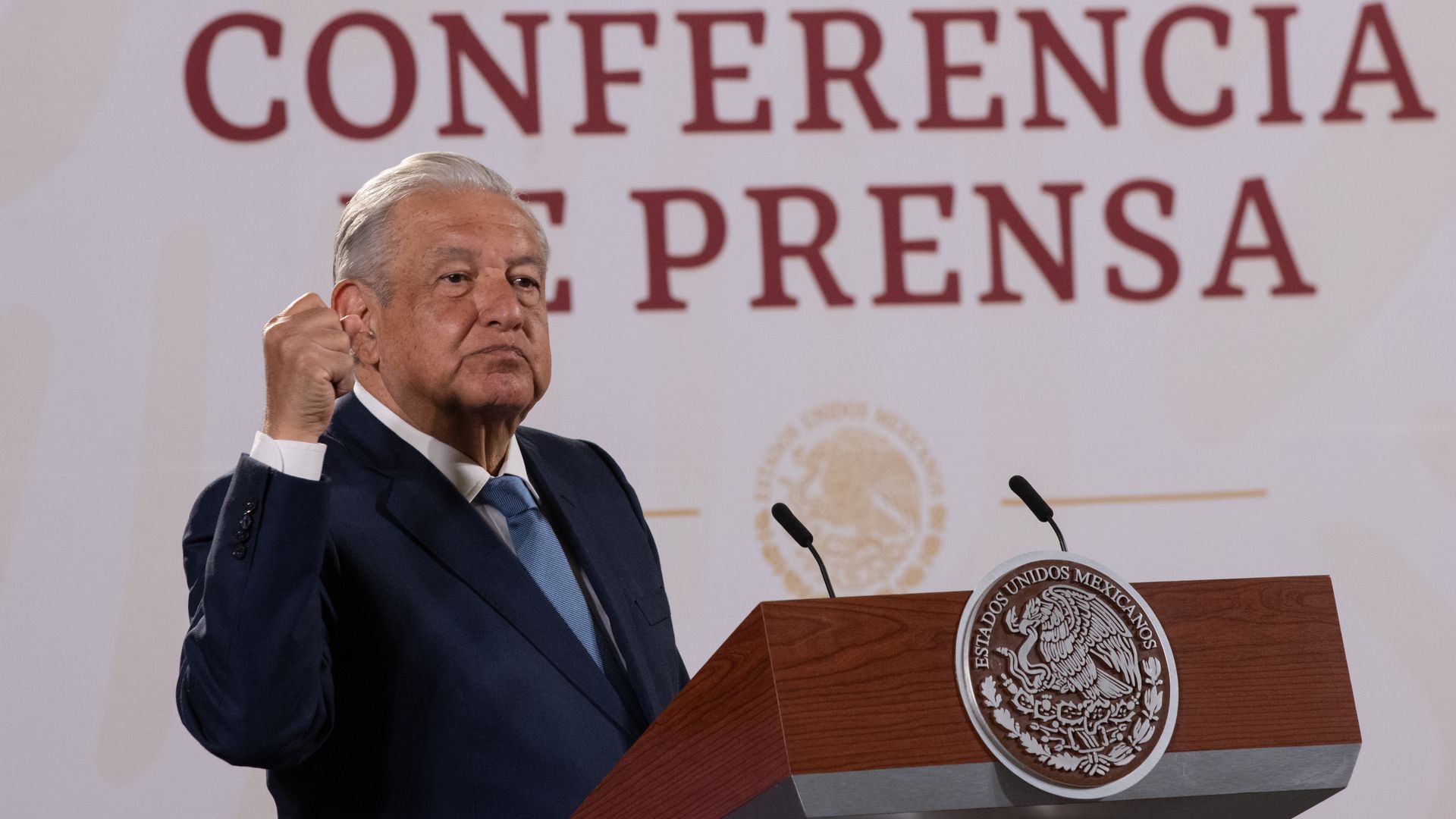
Mexican President Andrés Manuel López Obrador. Photo: Alex Dalton/Eyepix Group/Future Publishing via Getty Images
1. Mexican President Andrés Manuel López Obrador said yesterday that U.S. Secretary of State Antony Blinken is “misinformed” after calling for greater accountability and protections for journalists in Mexico.
- “Otherwise he’s acting in bad faith” because “while it is regrettable that journalists are being killed, there is no impunity,” López Obrador said in his morning news conference.
- But most assassinations of journalists remain unpunished: Only 6% of the related criminal cases opened in the past decade have resulted in a conviction.
2. Honduran president Xiomara Castro met yesterday with Gen. Laura J. Richardson, head of the U.S. Southern Command, to discuss collaboration against drug-trafficking and on environmental protections.
- The meeting took place days after the U.S. requested the extradition of former president Juan Orlando Hernández, accused of trafficking cocaine while he was in power.
- Later today, there will be a hearing to determine if Hernández can await a decision on his extradition under house arrest instead of in a special jail.
6. 🪀 1 smile to go: A new spin for old toys
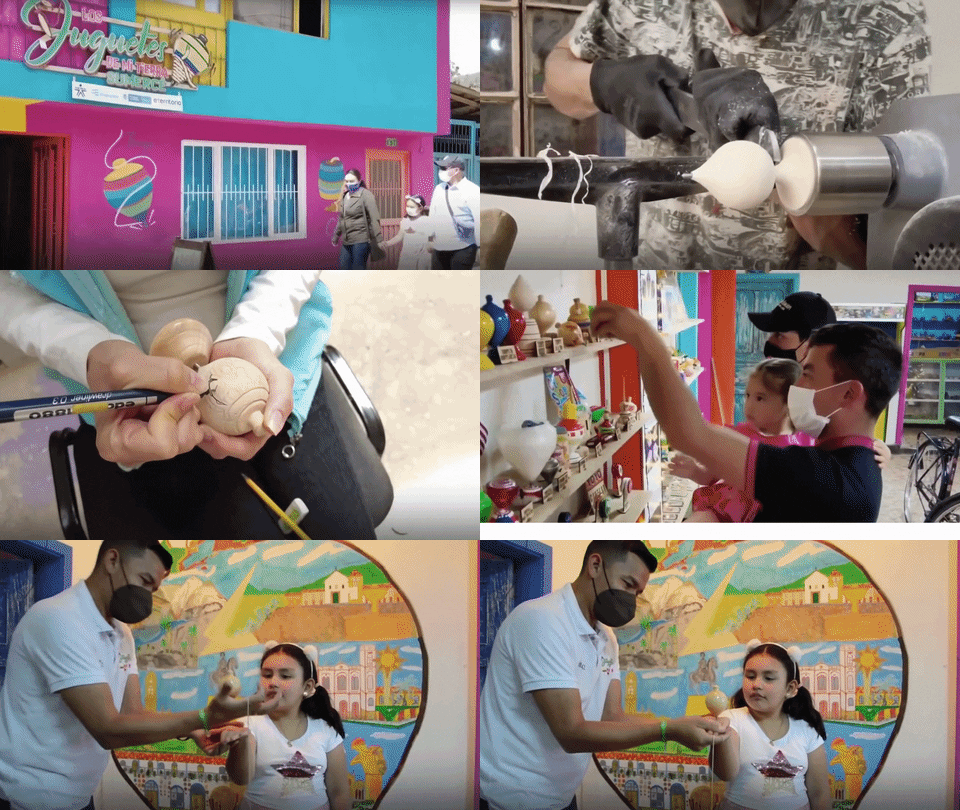
A Colombian IT engineer-turned-toymaker is betting that an appetite for nostalgia will make handmade toys all the rage again.
Details: Wooden spinning tops (pirinolas and trompos), yo-yos and cup-and-balls (baleros or cocas) take center stage in the museum Juguetes de mi Tierra, in Boyacá, Colombia.
- Wilson GĂłmez opened it last year hoping to promote offline, non-battery operated entertainment among newer generations.
- GĂłmez, who is a national spintop champion, started off by selling kits with a trompo, yo-yo and coca in Colombia and in cities like Paris and Cleveland where spintop contests were held.
- The museum owner also worked with a congressman on legislation introduced in Colombia in January that would declare some of those traditional toys part of the country's "intangible cultural heritage."
7.🪅Pachanga Thursday: "¡Americano!"

A scene from the Phoenix Theater Company's staging of "¡Americano!" Photo: Reg Madison
Enhorabuena to journalist and writer Fernanda Santos, who co-wrote the musical "¡Americano!" — a show that will make its off-Broadway debut for a 12-week engagement this spring.
- "¡Americano!" is based on the story of Tony Valdovinos, who found out he was undocumented when he was unable to join the Armed Forces after 9/11. Valdovinos then became an activist in Arizona, mobilizing Latino voters.
- The show’s music and lyrics were composed by Carrie Rodriguez, with arrangement from Sergio Mendoza, choreography from Sergio Mejia, and a book co-authored by Santos, Jonathan Rosenberg and Michael Barnard, who also directs.
Want to be featured in 🪅 Pachanga Thursday? You can tell us about your own feats by replying to this email.
Thanks for reading. We'll be back Tuesday!
Sign up for Axios Latino

Keep tabs on the stories that most affect the U.S. Latino community on both sides of the border, a collaboration with Noticias Telemundo.