
Axios Kansas City

July 06, 2026

☀️ Good morning! We've got a special summer edition today, busting sun protection and tanning myths before you head outside.
- We'll be back to our regularly scheduled KC programming tomorrow.
☀️ Today's weather: Sunny, with highs in the upper 80s.
Sounds like: "Sunshine On My Shoulders" by John Denver.
Today's newsletter is 994 words — a 3.5-minute read.
1 big thing: 📈 Melanoma is climbing
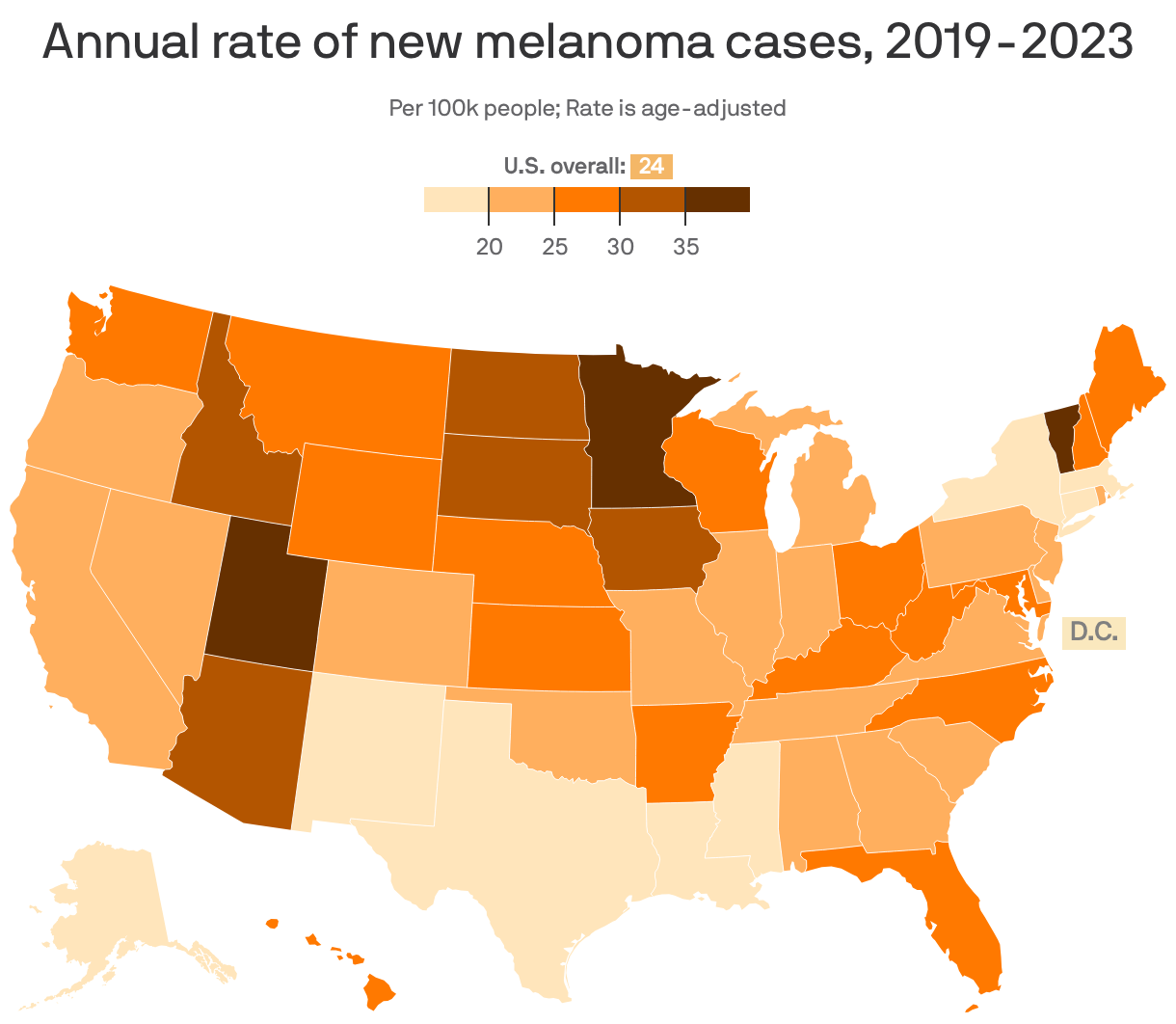
Open embedded content from datawrapper.dwcdn.netNew invasive melanoma cases rose about 47% over the past decade, per the Skin Cancer Foundation. The Kansas City metro is no exception.
State of play: The states with the highest numbers aren't necessarily the sunniest. Differences in screening, demographics and behaviors like indoor tanning all help explain the rates.
By the numbers: For every 100,000 people, 24 new cases of this cancer were reported in the U.S. — up from previous years — according to the most recent data compiled by the CDC and the National Cancer Institute.
Zoom in: The metro splits across the state line. Kansas sees 28.7 new cases per 100,000 a year, above the national rate, while Missouri sits below it at 21.4, per CDC and NCI data from 2019 to 2023.
Both states show the same gender gap the experts flag. The rate for men runs well ahead of women, 34.3 to 24.7 in Kansas and 26.3 to 17.8 in Missouri.
The big picture: It's not just that there's more disease.
- More aggressive screening is catching skin cancers that might have gone undiagnosed years ago.
The intrigue: Differences in state melanoma rates are driven in large part by population demographics.
- Melanoma is far more common in non-Hispanic white people, who make up about 80% of the population in North Dakota and Minnesota, compared with under 40% in California, American Cancer Society epidemiologist Ahmedin Jemal tells Axios.
- The local numbers track that. Among white, non-Hispanic residents, the rate climbs to 29.3 in Kansas and 25.0 in Missouri, far above every other group.
Sun protection and indoor tanning habits also influence melanoma rates, Siegel says.
2. America's sunscreen paradox
Even as SPF products now promise better coverage than ever, people are deliberately chasing tans.
Why it matters: That's not only unsafe but also at odds with the culture's anti-aging skin care obsession.
What they're saying: "There's no 'healthy tan,'" Philadelphia-based dermatologist Nazanin Saedi tells Axios. "A tan is a sign of sun damage," she says.
- "You can use all the retinol you want," says Anthony Rossi, a dermatological surgeon at Memorial Sloan Kettering Cancer Center. "No amount of retinol is going to counteract your lack of sunscreen."
Threat level: Too much UV doesn't just age your skin — it can cause cancer, as Rossi knows firsthand.
- A '90s tanning bed user, he tells Axios he developed skin cancer himself. And he's watching a new generation make the same mistake and use tanning beds again.
- Now, he says, "I'm cutting off more and more skin cancers" from patients in their teens, 20s and 30s.
State of play: There's been "a resurgence of tanning culture and sunscreen phobia," largely due to sunscreen misinformation shared on social media, Rossi says.
Case in point: One-third of Gen Z respondents flunked a new American Academy of Dermatology sun safety quiz — even as most rated their own habits "good" or "excellent."
- And 64% said they'd encountered sunscreen misinformation online.
Reality check: A "natural" skin care movement is pushing people to make their own sunscreens with ingredients like beef tallow — or skip applying altogether. Dermatologists don't approve.
- "The whole DIY thing always boggles my mind," says Rossi, who formulates his own sunscreen and notes a real one takes chemistry and precise specs. You shouldn't DIY something meant to prevent disease, he says.
- Beef tallow, he adds, has "at most maybe an SPF of 2 — not even enough to stop a burn." He says it's "basically putting baby oil on your skin" that clogs pores and causes acne.
- "If you want to be 'natural,'" Saedi says, "let's find you a mineral sunscreen."
Between the lines: The sun does offer real health benefits, but you don't need to skip sunscreen to get them.
- For example, the argument that you have to tan to make vitamin D "is not that kosher," Rossi says. "If you use sunscreen every day, you don't become vitamin D deficient."
3. 🧴 A new sunscreen ingredient, finally

Active sunscreen ingredient bemotrizinol — popular in Europe and Asia — was just approved by the FDA for use in the U.S.
Why it matters: The ingredient has been celebrated by dermatologists because it offers strong ultraviolet A and B protection and is easy to wear.
- "It just feels so nice, smooth and elegant — it doesn't feel as sticky or have such a white cast, like so many of the sunscreens we have available," Saedi says.
Catch up quick: It's the first update of over-the-counter sunscreen products since the late 1990s.
- It comes after other recent sunscreen innovations: New mineral sunscreens now come in a range of shades and blend better.
What we're watching: The Dutch brand DSM-Firmenich is expected to begin selling a bemotrizinol product later this year.
💭 Abbey's thought bubble: If it saves me from sun damage, I'm down!
4. Beware the "Barbie drug"
A dangerous peptide marketed online as a sunless tanning shortcut is resurfacing.
The big picture: Melanotan II — nicknamed the "Barbie drug" because it can also suppress appetite — mimics a hormone that tells the body to make more melanin.
- It can be found as a nasal spray or shot, but it's not approved by the FDA or any other major regulator.
- Case studies suggest it could lead to the development of skin cancer.
What we're hearing: "People who inject melanotan, their moles start to change," says Rossi. He's removed atypical moles from a patient who used it.
- But he's seeing it taken at the gym as part of a "beautification stack" — and he's worried.
- "I don't really see a medical benefit of it at all," Rossi says.
🎙️ Travis had a great time on KCUR's "Up To Date."
🎂 Abbey hopes Grandma Pat had a wonderful birthday yesterday!
Thanks to our editors, Ashley May and Chloe Gonzales.
Sign up for Axios Kansas City