Axios Houston

August 10, 2026

🖍️ Hello, Monday! Today, we bring you a special back-to-school edition as Houston ISD students return to school.
🌧️ Today's weather: Chance of showers and thunderstorms, with a high in the low 90s.
🛎️ Sounds like: The first school bell.
Today's newsletter is 965 words — a 3.5-minute read.
1 big thing: 📈 More AI-driven schools
The high-end, AI-powered private Alpha Schools plans to grow from a dozen to roughly 50 campuses in the 2026 school year, its founder tells Axios.
Why it matters: While traditional schools navigate how to adopt AI, Alpha Schools has created an AI-dependent classroom model that the company claims reduces screen time and increases human interaction.
- Tuition costs $45,000 to $75,000 a year.
State of play: This school year, Alpha plans to open campuses in 27 markets in California, Florida and Texas, including one in The Woodlands.
- Alpha is also exploring another Houston-area campus in the Heights, saying "we have received enough initial interest to begin organizing prospective families," spokesperson Sofia Swanson tells Axios.
Plus, Houston ISD is also launching a pilot program using Alpha's AI-powered learning platform at Clemente Martinez and Gregg elementary schools this year.
- Students who score above 60% on reading and math assessments will spend part of their mornings using Alpha's "TimeBack" program before rejoining their classmates, the district announced in July.
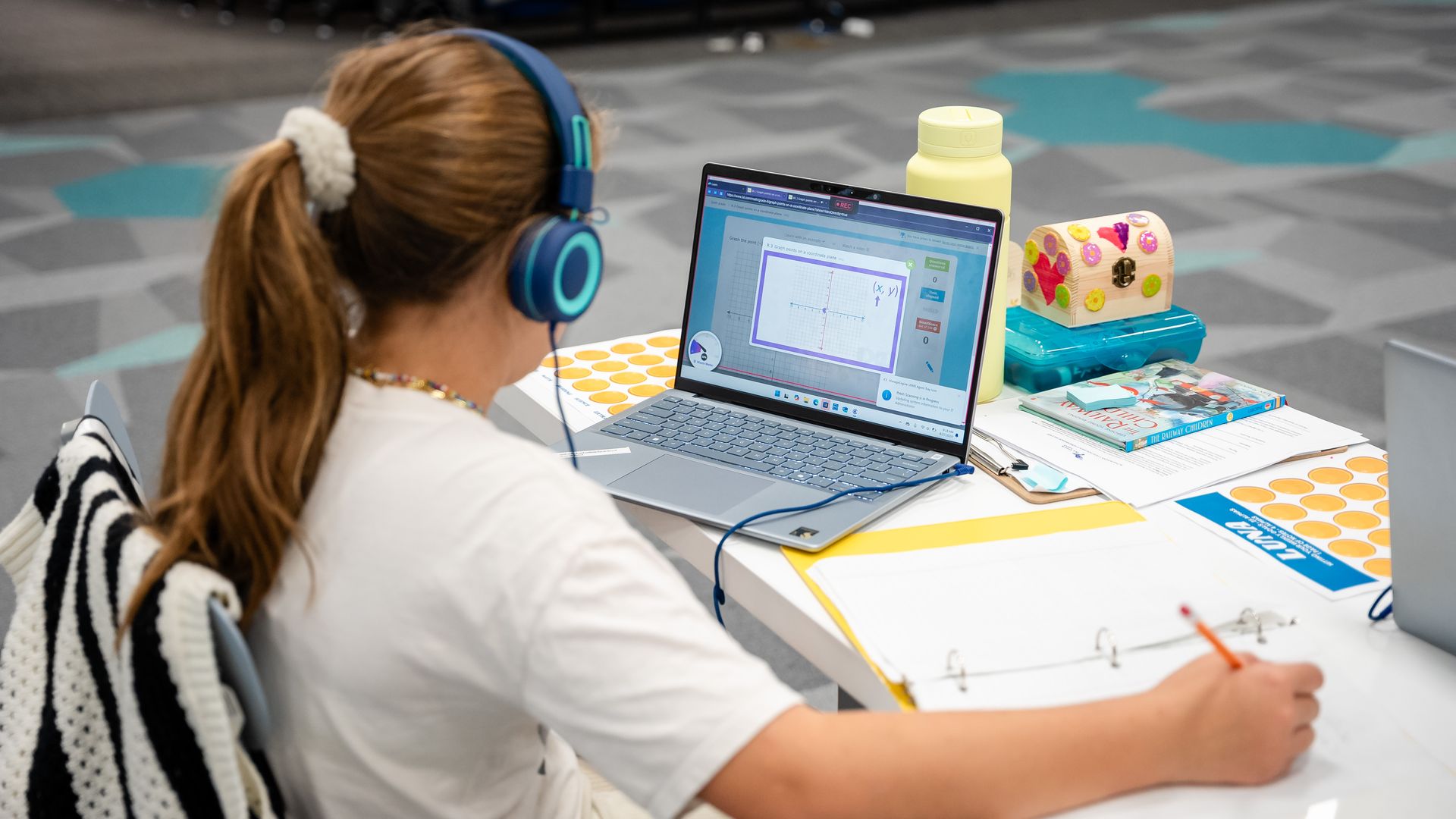
How it works: Students at Alpha campuses spend no more than two hours a day on AI software to learn core subjects, says MacKenzie Price, co-founder and CEO of Alpha Schools.
- They spend the rest of the day developing life skills in workshops. (For example, students have organized a music festival for a nonprofit.)
- Instead of licensed teachers conducting lessons, Alpha Schools hires "guides" whose jobs are to motivate and coach students. They're paid at least $100,000 a year.
Friction point: Penn State professor Gerald LeTendre says his concern with AI education models — including Unbound Academy and Khan Lab School — is they risk conflating teaching and tutoring.
- He argues helping teachers become proficient in AI is a more promising strategy than replacing them.
The big picture: Many public schools have been slow to put clear guardrails around AI.
- Just 18% of teachers in public K-12 schools in a recent Gallup study said they've received formal guidance from school administrators on how to use AI tools.
- Meanwhile, parents are balancing whether letting their children use AI strengthens digital literacy or results in cognitive decline.
Your Local Newsroom
Every morning, we're focused on bringing you the stories that help you better understand your city and the community around you.
State of play: Strong local journalism takes a dedicated team and readers who believe in its value. Member support helps us continue delivering clear, trustworthy reporting where it matters most.
💭 Become a member today. You'll help support independent local journalism and keep our newsroom focused on serving your community.
Thank you for reading and supporting local journalism.
2. 📓 Where families spend the most


U.S. families expect to spend nearly $1,000 on average on back-to-school shopping this year, according to a PwC survey.
- Nearly half expect to spend more than they did last year.
State of play: Families in the South are expected to spend $830 during back-to-school season, including on clothes, tech, after-school activity equipment, books, school supplies and other one-time purchases.
Zoom in: Deloitte's 2026 Houston Back-to-School Survey found local K-12 parents plan to spend an average of $796 per child this year.
- Clothing and accessories account for the largest share of expected spending in Houston, at 44%.
- 70% of Houston parents surveyed say their child's preferences generally influence them to spend more.
What's happening: Prices are higher, classroom needs have changed and kids have more say over what families buy — including requests for pricier items.
- They're seeing more ads on screens and often using digital wallets to buy things without parental interference, PwC's Kelly Pedersen tells Axios.
The big picture: Total K-12 back-to-school spending could climb around 10% this year compared to last, hitting a record $43.3 billion, the National Retail Federation forecasts.
Reality check: The spending doesn't stop once school starts.
- Households nationwide plan to spend $635 a month on recurring expenses like meals, snacks and tutoring, per PwC.
3. Bayou Buzz

🤖 President Trump criticized Texas for being anti-data centers, saying it's a "mistake," days after Gov. Greg Abbott issued a statewide pause of approval for data centers trying to connect to the power grid. (Texas Tribune)
🏠 Texas ranks No. 3 in the U.S. for international homebuyers, who spent nearly $4 billion on homes statewide over the past year. (Chron)
🌜 Photos and videos show a new crater and plume of moon dust after a SpaceX rocket crashed into the lunar surface last week. (Houston Chronicle)
4. 📵 Study: Cellphone bans don't help
Schools across the U.S. are cracking down on student cellphone use, but a new study finds the restrictions bring mixed results.
The big picture: Schools that require students to lock away their phones during class have seen phone use decline substantially, according to the study shared by the National Bureau of Economic Research in April.
- Student well-being also appears to improve the longer the rules remain in place.
Zoom in: Under Texas law, public school districts must prohibit students from using cellphones and other personal communication devices during the school day.
- But Houston ISD had already moved to restrict cellphone use before the statewide law took effect in 2025. The district now requires students to keep devices at home or turned off and stored in backpacks or lockers during the school day.
Yes, but: "For academic achievement, average effects on test scores are consistently close to zero," when it comes to overall bans, the researchers wrote.
- And they found "little evidence" those policies affect attendance, attention in class or perceived online bullying.
By the numbers: As of this year, roughly two-thirds of states have enacted legislation limiting student phone access, per the study.
The bottom line: Cellphone bans may still benefit students — even if they don't directly translate into higher test scores.
Thanks to Sami Sparber, Carly Mallenbaum and Astrid Galván for editing.
🍑 Shafaq ate her first good yellow peach this season (finally!).
Congrats to Jacalyn J., who answered the Friday news quiz correctly! Answers: Houston Methodist is the top-ranked hospital in Texas on the U.S. News list, Houston Restaurant Weeks generates donations for the Houston Food Bank and Rice University expanded free tuition to families making up to $200,000.
Sign up for Axios Houston