Axios Hill Leaders

September 14, 2026
βοΈ Fly-in day! Tonight's edition is 973 words, 3.5 minutes.
- π€ Thune's AI push
- π§ GOP chilly on checks
π¨ Breaking: Sen. Mitch McConnell voted at the Capitol tonight for the first time in three months after being hospitalized in June.
- He didn't take questions but cast a vote in favor of Matthew Byrne's nomination to be a district judge in Ohio.
π¦ Situational awareness: Look for former Sen. Joe Manchin (D-W.Va.) to hit the campaign trail again β in Maine.
- Manchin endorsed Republican Sen. Susan Collins today and said he'll stump for his friend, whom he called "the soul of the Senate."
1 big thing: π€ Thune's AI push
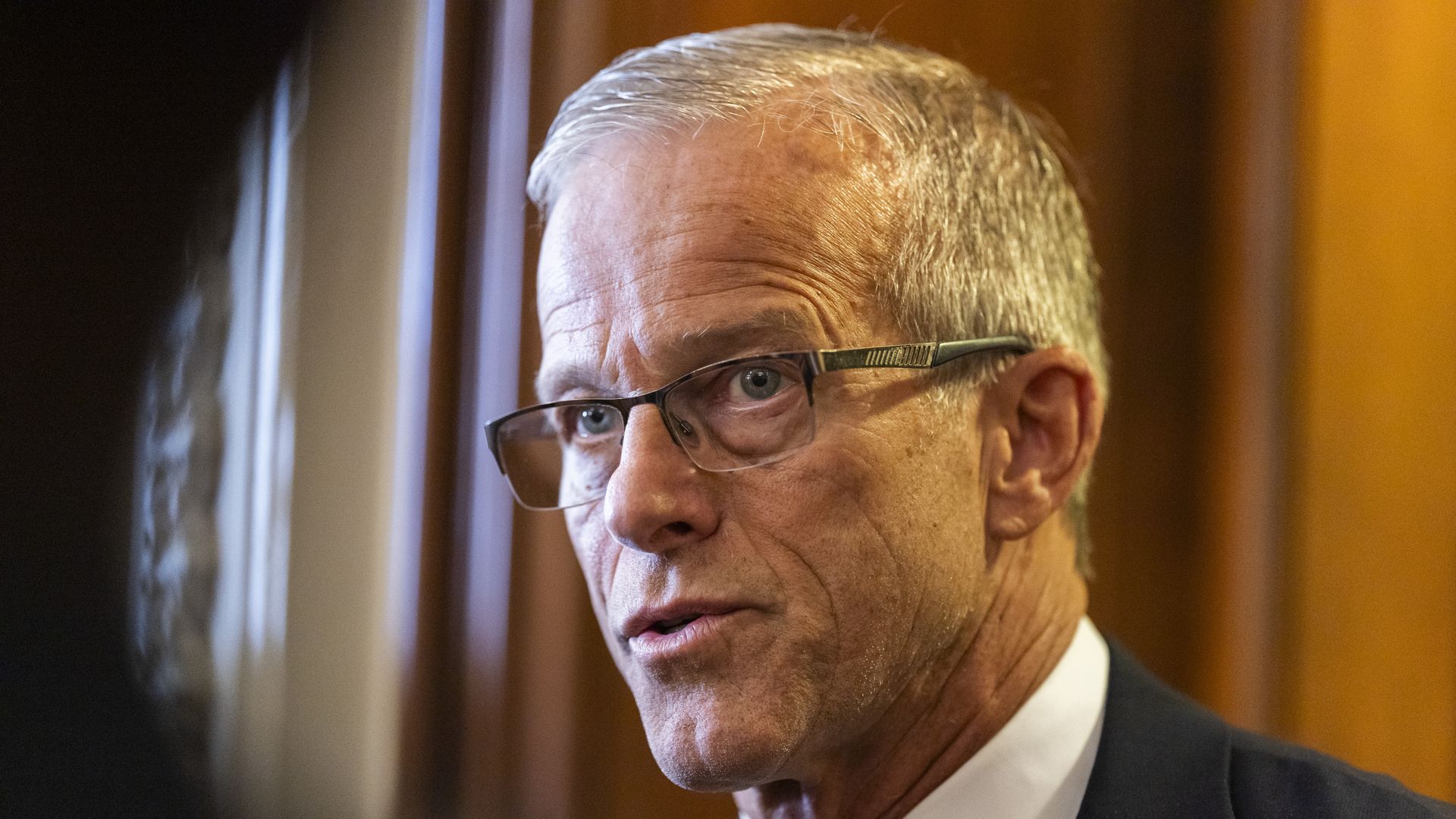
Majority Leader John Thune is asserting Congress' prerogative to act on AI β but he's urging a "light touch" even in the face of "consequential risks."
Why it matters: On his first day back after a five-week break, Thune (R-S.D.) outlined his vision for congressional action on an issue President Trump has dismissed as a "hoax."
- π "Congress has a job to do," Thune said.
- "I think there are some potential consequential risks associated with AI," Thune told reporters when asked if he believes AI poses an existential threat to humanity. He added, "Guardrails there make sense to me" about cutting-edge, frontier AI models.
- π¨ But Thune also said that "there are always people who are creating a worst-case-scenario-type conversation out there."
π Driving the news: An AI panic is rippling through Congress, but mostly on the Democratic side, with House Minority Leader Hakeem Jeffries (D-N.Y.) calling to "slow down the pace of development" of AI to avoid a potentially catastrophic outcome.
- Publicly, Trump is professing not to be concerned and insists that he should have the sole authority to regulate AI.
- "The only control or 'guardrails' that AI needs is a STRONG AND SMART (High IQ!) PRESIDENT, and the U.S.A. has that, in spades," he posted on his Truth Social account this morning.
π Zoom out: Republicans aren't questioning Trump's ability to lead the country's approach to AI regulation, but they are suggesting that Congress has a role to play.
- And they aren't ruling out legislation.
- "So we may need to do something," Speaker Mike Johnson (R-La.) said. "But there are existing guardrails, and corporate responsibility is a big part of this."
Zoom in: Thune said he spoke with Sen. Amy Klobuchar (D-Minn.) on Saturday night about their AI bill, which would force companies creating frontier AI models to guard against catastrophic risks and submit to federal oversight.
- Thune said he has been working with Commerce chair Ted Cruz (R-Texas) to reintroduce the bill "hopefully soon."
- House GOP leaders, meanwhile, have given no indication they plan to keep the chamber in session after this week to work on AI-related legislation.
- "I don't know that staying in more weeks in September is going to be the catalyst for that," Rep. Jay Obernolte (R-Calif.), the lead Republican on the FRONTIER Act, told us.
Between the lines: Before this weekend, much of the AI debate in Washington β and in Senate races β was focused on data centers and the amount of electricity they consume.
- π³οΈ Republicans, as well as the White House, are eager to convince voters that they won't face higher utility bills caused by data centers and their need for megawatts.
- Thune left open the possibility of the Senate voting on a version of the House's Ratepayer Protection Act, which is aimed at ensuring communities are not forced to pay more for increased energy use by data centers.
- The House is expected to vote on the bill tomorrow.
The bottom line: Thune is signaling he's open to some regulation that wouldn't stifle innovation.
- "I think you also want to make sure that the more advanced threats can be mitigated," he told reporters.
- π "I do think we are in a race with China, and I think there's huge upside, obviously, with AI as well."
βΒ Stef W. Kight, Hans Nichols and Kate Santaliz
2. π§ GOP chilly on checks

Senate Republicans are doubtful β and, in some cases, dismissive β of Trump's proposal to give Americans $5,000 checks if Republicans keep control of Congress.
Why it matters: Trump's proposal isn't dead on arrival. But Republicans aren't exactly lining up behind it either.
- βοΈ "I am withholding judgment on the bill until I see their list of pay-fors," Sen. John Kennedy (R-La.) said. "I don't support going and borrowing $1.2 trillion to be able to write the checks."
- π "I would need to see details on it," Sen. Ted Budd (R-N.C.) said.
- Sen. Steve Daines (R-Mont.) said he wasn't sure about the mechanics of the proposal but that he's "also worrying about $40 trillion in debt."
"You know, there's no specific proposal out there," Senate Majority Leader John Thune (R-S.D.) said. "And obviously, however that were to come together, Congress would have a big role in determining."
π Zoom in: There are two massive unknowns about the "Trump Dividend" the president promised in Dallas last week: eligibility and price tag.
- Vice President Vance has suggested that wealthy Americans wouldn't receive the payment.
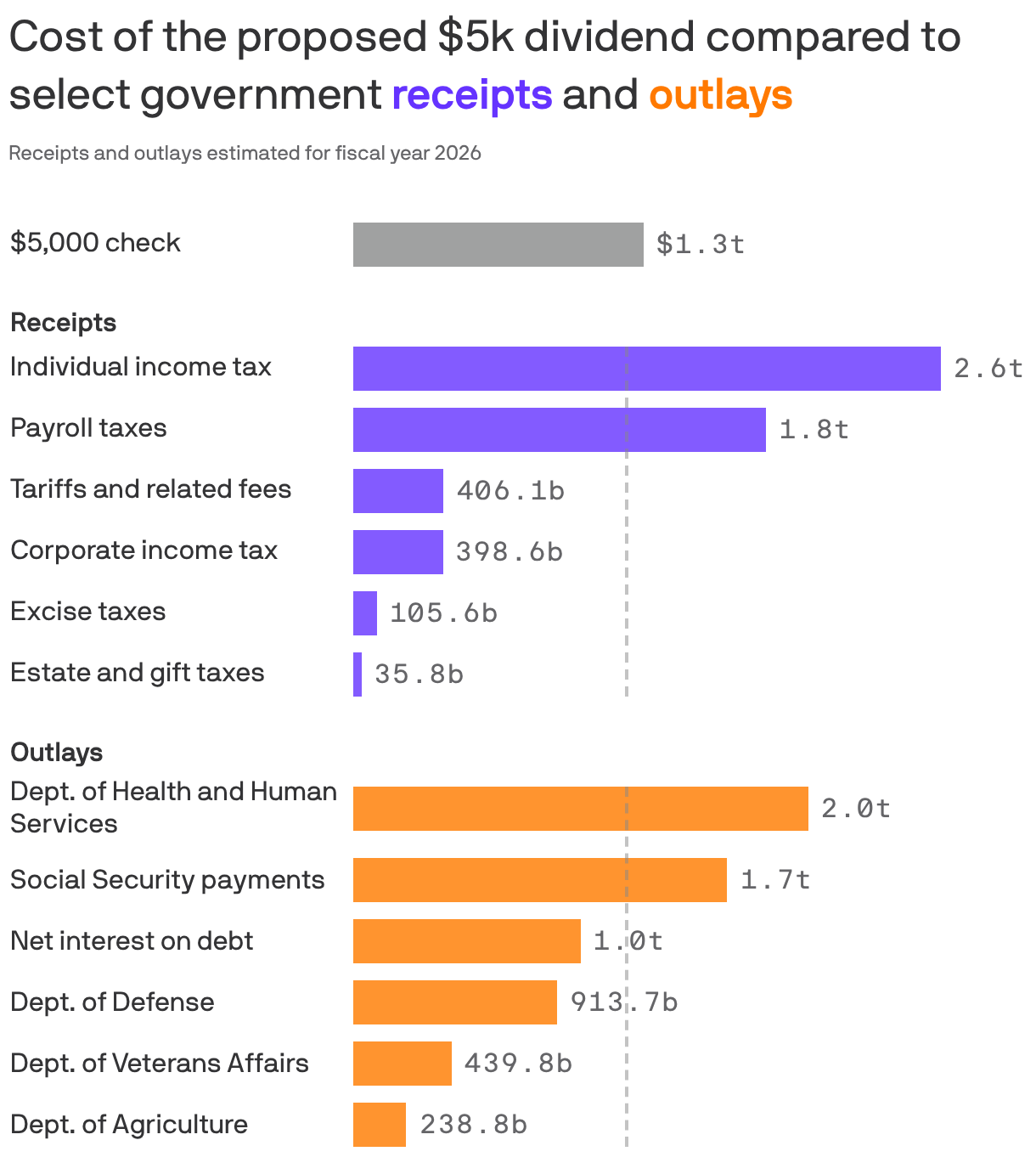
- If every "every adult citizen in the United States" were eligible, as Trump suggested, it could cost some $1.3 trillion.
- That would be more than three times what the U.S. collects annually from tariffs and other customs duties and fees.
π€ The intrigue: Speaker Mike Johnson (R-La.), who frequently defers to Trump, said yesterday that Congress would have to approve the payments.
- Asked in NBC's "Meet the Press" if he'd commit that the checks will be sent, Johnson said, "I commit that Congress will work through it and find consensus on that like they have to do everything else."
- Rep. Keith Self (R-Texas) told us: "Well, if it happens, I'm recommending to people that they put it away in order to pay for the additional inflation. We will see."
β Hans Nichols, Stef W. Kight and Erin Davis
This newsletter was edited by Kathleen Hunter and copy edited by Brad Bonhall.
Sign up for Axios Hill Leaders